The Strategic Pivot to Small Offices for Rent in Makati

The global corporate landscape of 2026 is defined by “The Great Right-Sizing.” As interest rates stabilize but construction costs for custom fit-outs remain at historic highs, executive decision-makers are abandoning the traditional five-year “bare shell” lease. In its place, a more sophisticated model has emerged: the move-in-ready, fully-equipped workspace.
For a multinational firm, the office is no longer just a place for desks; it is a Strategic Anchor. It serves as a compliant base for local hiring, a signal of stability to regional partners, and a low-risk “landing pad” in Southeast Asia’s most established financial hub. This article explores why the shift toward small offices for rent in Makati is the most prudent financial and operational move for firms seeking a high-prestige, low-friction entry into the Philippine market.
WHY MAKATI REMAINS THE GLOBAL GATEWAY
The Context of the “Primary CBD”
Before evaluating specific spaces, it is essential to understand the hierarchy of Philippine business districts. While new hubs like BGC (Bonifacio Global City) offer modern aesthetics, Makati remains the Primary CBD (Central Business District). This term refers to the district with the highest density of financial institutions, foreign embassies, and regulatory bodies. For a decision-maker, being in the Primary CBD means your business exists within the “inner circle” of Philippine commerce.
The Power of the Address: A Signal to Global Markets
For firms based in Japan or the UK, a Makati address is often a prerequisite for high-level B2B trust. It functions as a non-verbal “trust signal.” When your business card or website lists a headquarters in the Ayala Avenue or Legazpi Village area, it communicates a level of capitalization and longevity that newer, fringe districts cannot yet match.
In early 2026, we are seeing a “Flight to Quality” among Australian and US startups. These firms are moving away from older, decentralized buildings and consolidating into Grade A assets in Makati to ensure they have the infrastructure required for modern AI-driven operations and high-speed global connectivity.
The 2026 Landlord’s Market Shift
A critical factor for your immediate consideration is the Market Pivot of Q1 2026. Following a period of high vacancy post-pandemic, real estate analysts (including Colliers Philippines) have confirmed that Makati CBD has officially shifted into a “Landlord’s Market.” > Terminology Note: A Landlord’s Market occurs when the demand for office space exceeds the available supply. This typically results in rising rental rates and fewer concessions (like free rent periods) for tenants.
As of January 2026, vacancy rates in Makati’s premium buildings have tightened to below 6%. For boutique firms and startups, this means that the inventory of high-quality small offices for rent in Makati is shrinking rapidly. Securing a move-in-ready space now allows your firm to lock in current rates before the projected 10-15% price surge expected by the end of the year.
The Modern Startup Mandate: Speed-to-Market
The traditional office procurement process—incorporation, leasing a bare shell, hiring contractors, and waiting 4–6 months for construction—is now considered a competitive disadvantage. Decision-makers are instead opting for the “Plug-and-Play” model. By choosing a space that is already wired with enterprise-grade fiber and furnished with ergonomic stations, a Japan-based firm can have its Manila team operational in as little as 48 hours. This Speed-to-Market is the new gold standard for boutique firms looking to outmaneuver larger, slower competitors.
UNDERSTANDING TOTAL OCCUPANCY COST (TOC) FOR FINANCIAL PLANNING
When browsing listings, you will often see a “Headline Rent”—a primary price per square meter. However, in the Philippines, this number is rarely what you actually pay. To plan accurately, you must use Total Occupancy Cost (TOC).
Terminology Note: Total Occupancy Cost is the “all-in” sum of every expense required to keep the office doors open. This includes the base rent plus “pass-through” costs—expenses the landlord pays initially but bills back to you, such as security, taxes, and shared utilities.
The Hidden Multipliers: VAT and CUSA
The first shock for many multinational firms is the compounding effect of the 12% Value Added Tax (VAT). In the Philippines, VAT is applied not only to your rent but also to your utilities and service fees.
Furthermore, you must factor in CUSA (Common Usage Service Area) fees. These are monthly charges for the maintenance of the building’s “bones”—the elevators, lobby, and shared restrooms. In Grade A Makati buildings, CUSA can add an additional ₱150 to ₱250 per square meter to your monthly bill. When you combine high-consumption centralized air-conditioning (often billed separately based on “chilled water” usage), your actual monthly outlay can be 35% to 50% higher than the initial advertised rent.

The CAPEX vs. OPEX Trap
For your peers in Japan or Australia, capital allocation is a primary concern. A traditional “bare shell” lease in Makati (where you receive four walls and a concrete floor) requires a massive CAPEX (Capital Expenditure).
- Traditional Fit-out: In 2026, high-quality office construction costs in Makati range from ₱25,000 to ₱45,000 per square meter.
- The Math: For a modest 100-sqm office, you might spend ₱3.5M ($62,000 USD) before you even hire your first employee. This capital is “sunk”—you cannot take the flooring or the plumbing with you if you leave.
By opting for small offices for rent in Makati that are move-in ready, you bypass this “financial trap.” You convert a massive, non-recoverable upfront cost into a predictable, monthly OPEX (Operating Expense). This keeps your balance sheet lean, allowing you to reallocate those millions of pesos into localized marketing or talent acquisition.
The “6+2” Burden
Finally, consider the liquidity requirement of traditional leases, which typically demand a “6+2” structure: six months of security deposit plus two months of advance rent. For a premium Makati space, this means cutting a check for eight months of rent before receiving the keys. Move-in-ready providers typically offer much softer entry terms, often requiring only two months of deposit, which significantly preserves your firm’s cash flow during the critical first year of expansion.
WHAT YOU AND YOUR PEERS MUST CONSIDER FOR DEEP EVALUATION
As of early 2026, the Makati office market has split into two distinct tiers. While older, “Class B” buildings face rising vacancies, premium “Grade A” assets are seeing record-high demand. This divergence is driven by a phenomenon known as the Flight to Quality.
Terminology Note: Flight to Quality refers to a market trend where tenants move away from aging, lower-cost buildings toward premium, well-managed assets that offer better technology, safety, and amenities. In 2026, this is often a “flight to safety” to ensure businesses can survive power fluctuations or regulatory changes.
Building Grades: Why “Grade A” is the Multinational Standard
For your peers in Singapore or the US, the distinction between building grades is the difference between a seamless operation and a logistical nightmare.
- Redundancy: Grade A buildings in Makati typically offer 100% back-up power with multiple “redundant” generators. In a region where grid stability can be tested by tropical weather, this is non-negotiable for 24/7 global connectivity.
- The “Premium” Mix: Being a tenant in a Grade A building places you alongside other multinationals and reputable banks. This creates an environment of security and prestige that is essential when inviting high-value clients to your office.
The 2026 Sustainability Reporting Mandate
A major driver for the current demand in premium spaces is a recent regulatory shift. As of January 2026, the Philippine Securities and Exchange Commission (SEC) has officially begun implementing Mandatory Sustainability Reporting for large entities and publicly listed companies.
Terminology Note: ESG (Environmental, Social, and Governance) is a framework used to assess a company’s business practices and performance on various sustainability and ethical issues.
Even if your firm is a boutique startup, your global partners in Europe or the UK likely have “Scope 3” emission targets—meaning they are required to report on the carbon footprint of their entire supply chain, including the offices they rent. If you are looking for small offices for rent in Makati, choosing a LEED-certified or green-certified building is no longer a luxury; it is a requirement for future-proofing your corporate compliance.
Scalability and the “Agility Premium”
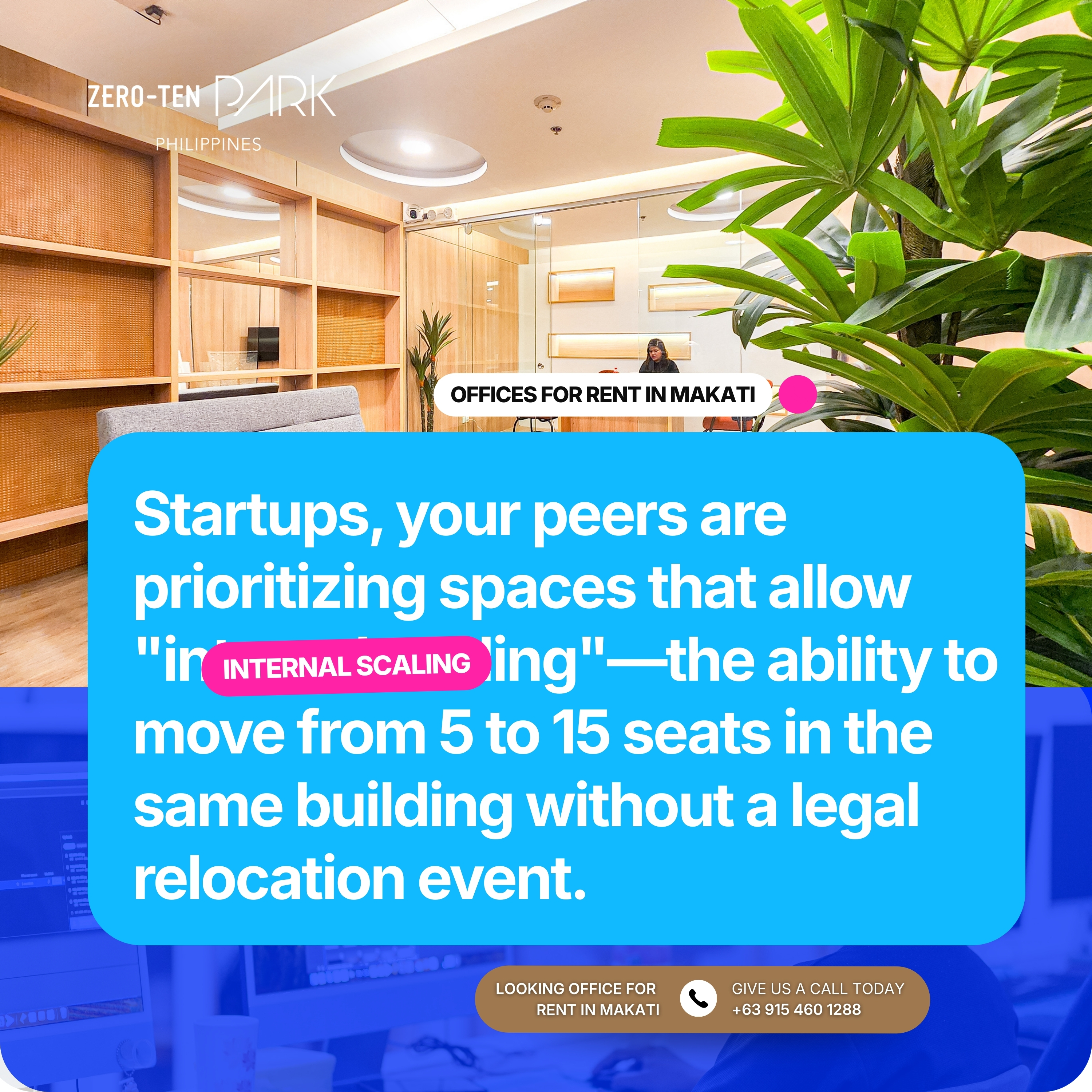
One factor your peers are prioritizing in 2026 is Internal Scalability. In a traditional lease, growing your team from 5 to 15 people usually requires a “Relocation Event”—breaking your lease, paying penalties, and moving to a larger floor.
- The Solution: Multinational decision-makers are now seeking providers within Makati that allow for “Frictionless Upsizing.”
- The Logic: You start with a 4-seater suite today. When your Japan-based HQ approves a larger local budget in six months, you simply move down the hall to a 12-seater unit under the same master agreement. This Agility Premium saves weeks of legal review and thousands of dollars in moving costs.
INFRASTRUCTURE AND AMENITIES: THE STANDARD FOR BOUTIQUE SUCCESS
There is a significant difference between an office that is “ready” (meaning it simply has furniture) and one that is Enterprise-Grade.
Terminology Note: Enterprise-Grade Infrastructure refers to IT and support systems designed for high-availability, high-security, and high-performance. These are built to sustain 24/7 operations and handle heavy data loads, far exceeding the “retail-grade” internet or power setups found in standard residential or low-tier commercial spaces.
Redundant Business Continuity: The 2026 Connectivity Standard
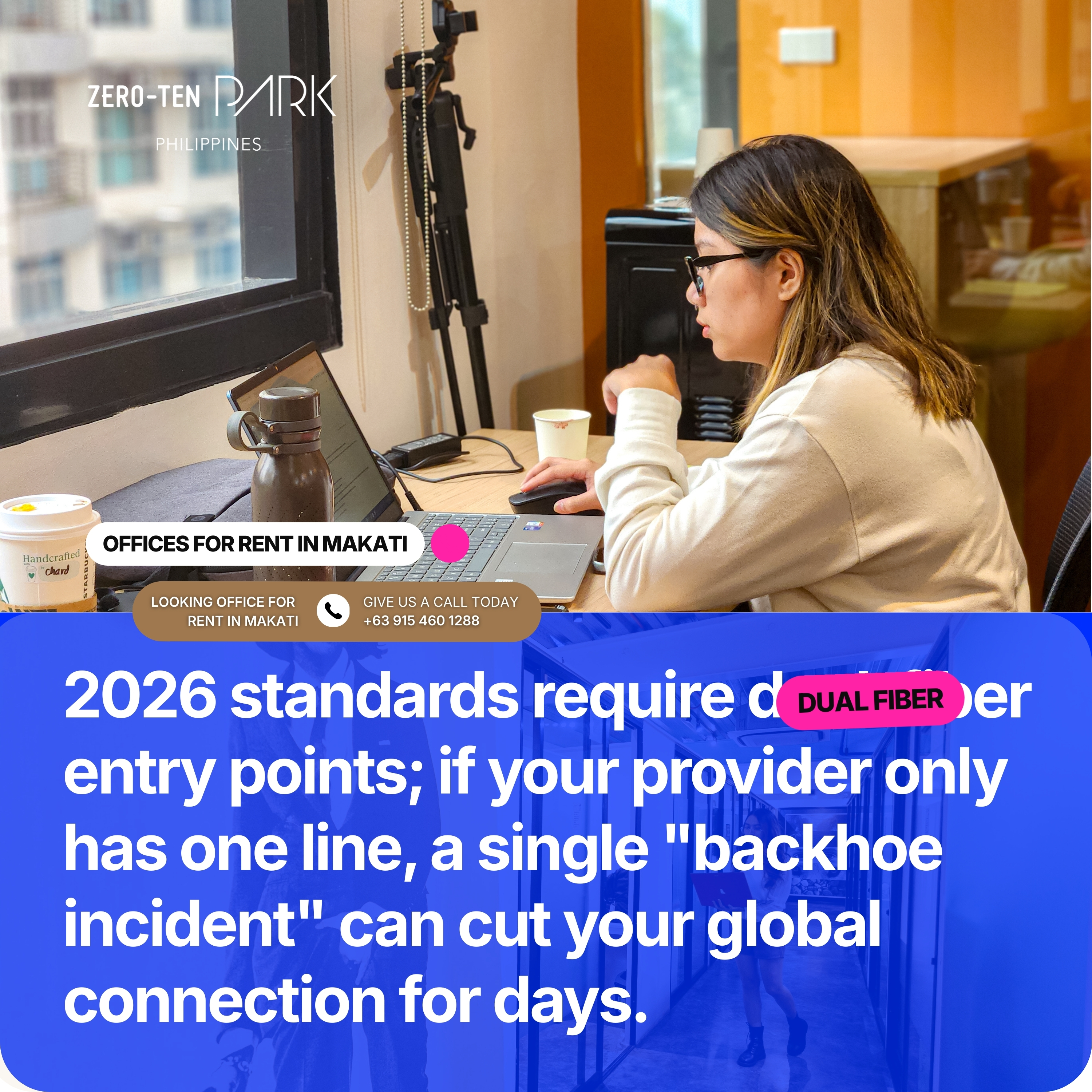
In the interconnected markets of Japan, Singapore, and Australia, a “dropped call” isn’t just an inconvenience; it’s a lost opportunity. Leading small offices for rent in Makati now prioritize Failover-Ready Connectivity.
Terminology Note: Failover is a backup mode in which a system (like your internet) automatically switches to a secondary connection if the primary one fails. Redundancy means having those extra “backup” systems already in place.
As of early 2026, the standard for a boutique firm is no longer just “having Wi-Fi.” It is having dual-fiber entry points from different providers (e.g., PLDT and Globe). If Provider A suffers a regional outage, the system automatically “fails over” to Provider B without the employees even noticing a lag in their global video conference.
The “Never-Go-Down” Mandate of 2025/2026
Following a series of localized power grid fluctuations in Metro Manila during the hot summer months of 2025, premium office providers in Makati have implemented a “Never-Go-Down” protocol. This is a real-world response to ensure that multinational teams remain online even during city-wide outages. For you and your peers, this means evaluating whether a space offers N+1 Power Redundancy.
Terminology Note: N+1 Redundancy is a form of resilience that ensures system availability in the event of a component failure. “N” is the power needed to run the office, and “+1” is the independent backup generator standing by.
The “Human” Support System: Beyond the Reception Desk
For a decision-maker from the UK or US, hiring a full-time office manager for a 5-person team is often cost-prohibitive. However, the move-in-ready model provides this through a shared Community Management Team.
- The On-Site Concierge: These are not just security guards; they are professional administrative partners who handle document notarization, manage local courier logistics (like Lalamove or Grab), and greet your international partners with the high hospitality standards expected in the Philippines.
- Tech-Enabled Wellness: 2026 has seen a surge in “WELL-certified” amenities. This includes high-grade air filtration (HEPA) and ergonomic “focus zones” designed to reduce employee burnout—a major consideration for startups competing for top talent against giant BPOs.
STRATEGIC LOCALIZATION: CHOOSING THE RIGHT MAKATI SUB-DISTRICT
While Makati is often discussed as a single entity, it is actually composed of several Micro-Markets, each with its own specific “vibe,” price point, and tenant profile.
Terminology Note: A Micro-Market is a small, specialized area within a larger city that behaves differently from the rest of the market. In Makati, choosing the wrong micro-market can mean being surrounded by law firms when you wanted tech startups, or being too far from the transit hubs your employees rely on.
Ayala Avenue & CBD Core: The Institutional Hub
Ayala Avenue is the “Wall Street of the Philippines.” This is where the country’s largest banks (BDO, BPI), the Philippine Stock Exchange, and global consulting giants are headquartered.
- Best For: Finance, legal, and multi-sector conglomerates.
- The Draw: Maximum prestige. If your Japan-based headquarters values an address that commands instant respect from institutional partners, this is the non-negotiable choice.
- The Consideration: It is the most “formal” area, with high foot traffic and a fast-paced, corporate energy.
Legazpi Village: The Creative and Talent Magnet
Legazpi Village has emerged in 2026 as the primary destination for “Entrepreneurial Incubation.” It balances high-rise office towers with walkable, tree-lined streets filled with artisan coffee shops and boutique gyms.
- Best For: Startups, tech firms, and Australian/US companies focusing on Gen Z and Millennial talent acquisition.
- Current Event: The “Live-Work-Play” Resilience: While peripheral areas saw high vacancies in 2025, Legazpi maintained a tight 8% vacancy rate. This is because employees want to be here.
- The Value: When looking for small offices for rent in Makati, Legazpi offers a “neighborhood feel” that serves as a powerful tool for employee retention, as team members can walk to Legazpi Active Park or Greenbelt Mall during lunch.
Salcedo Village: The Professional Enclave
Salcedo is the “quiet sibling” to Legazpi. It is traditionally more residential and polished, hosting many foreign embassies and high-end law offices.
- Best For: Consultancy firms and firms requiring a quieter, more focused working environment.
- The Draw: It feels less “bustling” than the CBD core but remains within a 10-minute walk of Ayala Avenue. The famous Salcedo Saturday Market provides a unique community-building opportunity for your local team.
Rockwell Center: The Exclusive Bubble
Rockwell is a master-planned “city within a city” located just north of the main CBD. It is gated, highly secure, and features its own luxury mall (Power Plant Mall).
- Best For: Luxury brands, elite service providers, and firms where the decision-maker lives within the community.
- The Consideration: It is more isolated from the main Makati transit lines (MRT), meaning it is best suited for teams that primarily use private transport or live on-site.
SPECIALIZED SUPPORT FOR MULTINATIONAL EXPANSION
While your office provides the walls and the internet, your business requires a legal “skeleton” to function. This includes tax IDs, labor contracts, and government permits.
Terminology Note: Soft Infrastructure refers to the legal, regulatory, and human resource frameworks required to operate. In the Philippines, this involves navigating a “multi-agency” landscape (SEC, BIR, and DOLE) where each has its own unique set of filing requirements.
Employer of Record (EOR): Hiring Without the Wait
For many of your peers in the US or Singapore, the goal is to “test” the Philippine market before committing to a full subsidiary. This is where an Employer of Record (EOR) becomes a strategic tool.
Terminology Note: An Employer of Record (EOR) is a third-party organization that becomes the legal employer of your local staff. They handle payroll, taxes, and mandatory benefits (SSS, PhilHealth, Pag-IBIG), while you retain 100% control over the employees’ daily work and output.
As of early 2026, many premium small offices for rent in Makati have integrated EOR partnerships directly into their service menu. This allows a Japanese firm to hire five local developers or accountants in a matter of days, bypassing the 4–6 week timeline typically required for SEC (Securities and Exchange Commission) registration.
The 2026 eSPARC Digital Acceleration
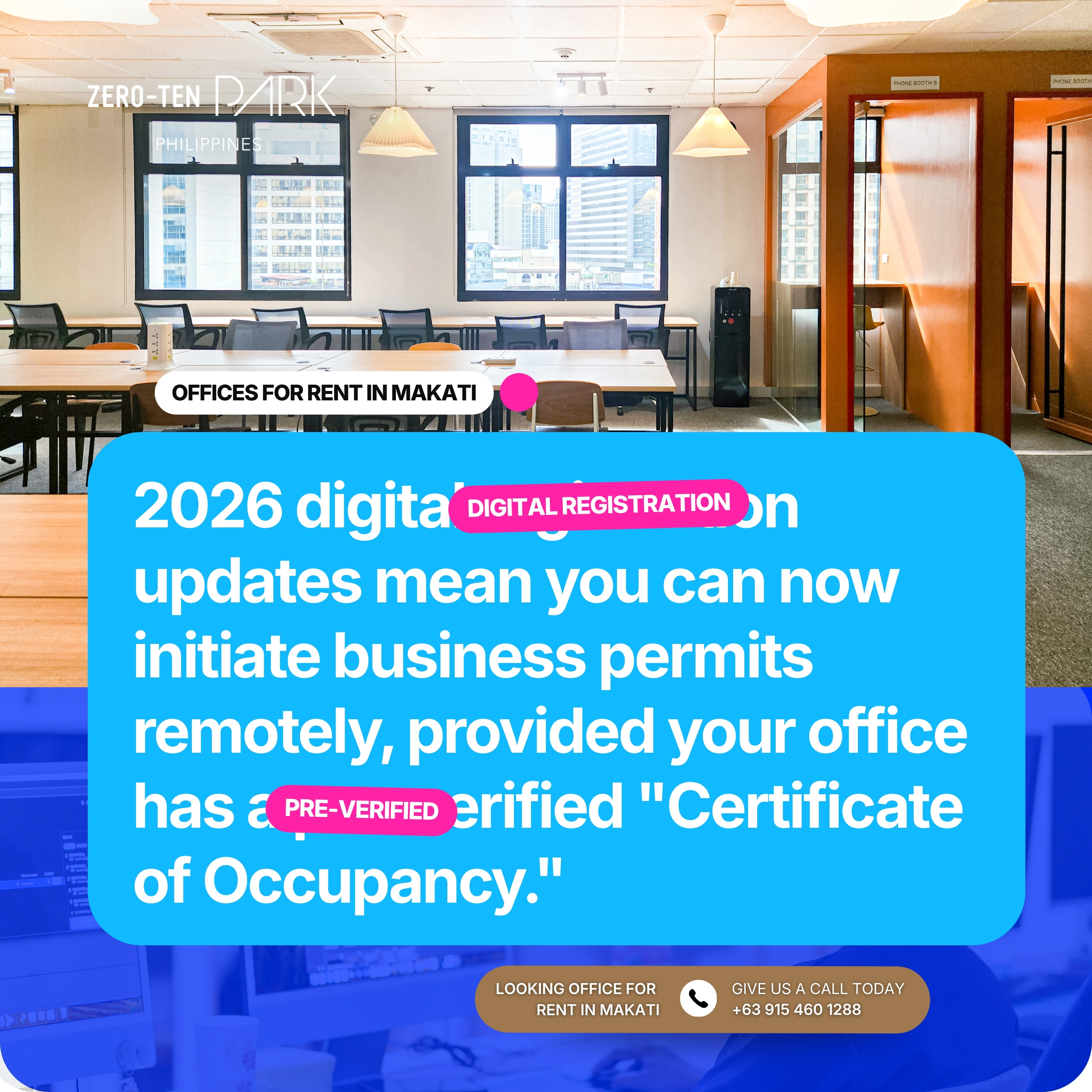
A significant development for 2026 is the full implementation of the SEC’s eSPARC (Electronic Simplified Processing of Applications for Registration of Company) enhancements.
- The Update: Business registration that once took months can now be initiated digitally in a “One-Stop-Shop” environment.
- The Makati Advantage: Because Makati is the primary hub for the SEC, move-in-ready office providers often have “Local Concierge” teams who physically expedite the final notarized filings, ensuring your Mayor’s Permit and BIR Authority to Print are secured without your executive team having to fly into Manila.
Navigating the 2026 “CREATE MORE” Tax Landscape
The implementation of the CREATE MORE Act (enacted late 2024/2025) has changed the game for multinational decision-makers. This law has streamlined tax incentives for “High-Value Domestic Market Enterprises.”
Terminology Note: VAT Zero-Rating is a tax incentive where certain business purchases are taxed at 0% instead of 12%. Under the new 2026 guidelines, being located in a registered IT-BPM hub in Makati can help your firm qualify for these significant savings on local service procurements.
Cross-Border Networking: The “Hidden” Amenity
Finally, for boutique firms from the UK or Australia, the value of a Makati office is the Ecosystem. By choosing a move-in-ready space, you are not just renting a desk; you are buying into a network.
- The “Warm Intro”: Community managers in these spaces often act as “Business Matchmakers,” connecting you to local legal counsel, specialized accountants, or even potential local clients who are already working three doors down from your suite.
CONCLUSION: A STRATEGIC FOUNDATION FOR GROWTH
As you reach the end of your evaluation, it is easy to be swayed by aesthetic features or “headline” discounts. To avoid this, you must apply a Decision Framework.
Terminology Note: A Decision Framework is a logical tool used to rank options based on pre-defined priorities (e.g., cost, location, risk). It prevents “analysis paralysis” by focusing only on the metrics that impact your 3-to-5-year business plan.
The “Pre-Termination” Trap: A 2026 Warning
One area often overlooked by multinational firms is the Pre-Termination Clause. In the tightening Makati market of 2026, landlords are becoming stricter.
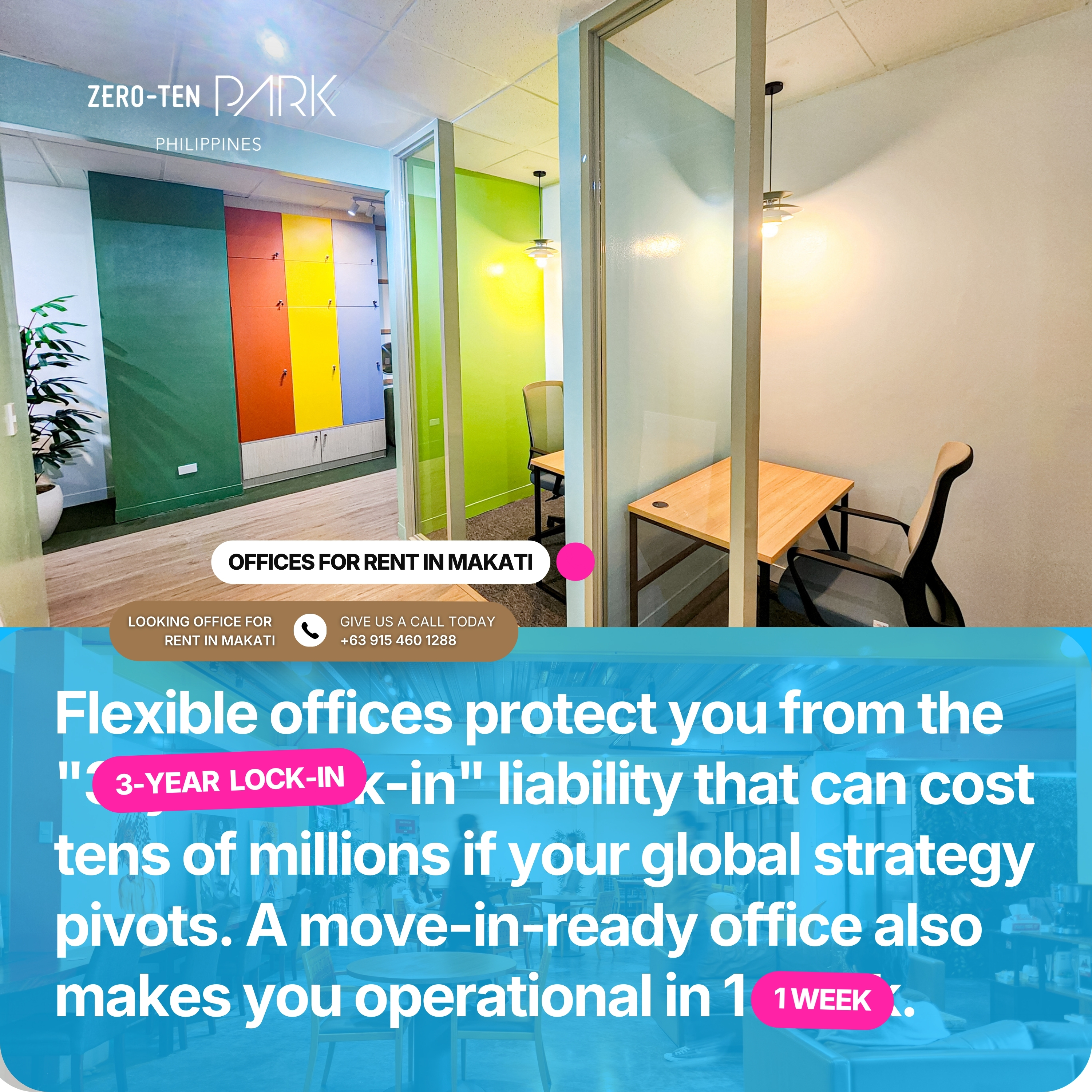
- The Risk: In a traditional lease, if your HQ in Australia decides to pivot and close the Manila branch, you may be liable for the entire remaining balance of a 3-year lease.
- The Advantage: Move-in-ready small offices for rent in Makati typically offer shorter “lock-in” periods (6–12 months). This “Agility Insurance” is often worth the slightly higher monthly rate, as it protects your firm from massive legal liabilities during global restructuring.
Final Decision Checklist: The “Core Four”
Before signing any Letter of Intent (LOI), ensure you and your peers have checked these four critical 2026 benchmarks:
- VAT-Inclusive TOC: Have you seen the “Gross Rent” inclusive of 12% VAT and CUSA? (Assume a 30-40% increase over the base price).
- Fiber-Optic Diversity: Is there more than one ISP (Internet Service Provider) entering the building? (Essential for your US/UK video-heavy workflows).
- The “6+2” vs. “2+2” Math: Does the space require 8 months of cash upfront (Traditional) or just 4 (Flex)?
- ESG Compliance: Does the building have a 2026-valid green certification to satisfy your European carbon-reporting mandates?
The Competitive Edge: Beyond Real Estate
Choosing an office in Makati is not merely a real estate transaction; it is a Strategic Declaration. It tells your partners in Japan and Singapore that you are serious about Southeast Asia. By selecting a move-in-ready space, you are choosing to spend your first 90 days in the country building your team and closing deals, rather than supervising a construction crew and arguing over electrical permits.
In the fast-moving economy of 2026, Time is the only non-renewable resource. The right office gives you that time back.
ZERO-TEN PARK: YOUR LAUNCHPAD IN THE HEART OF LEGAZPI VILLAGE
The Context of “Hospitality-Led Productivity”
At Zero-Ten Park, we believe that an office should be more than a utility—it should be a service. While other providers offer “transactional space,” we practice Omotenashi.
Terminology Note: Omotenashi is the Japanese philosophy of wholehearted hospitality that anticipates a guest’s needs before they arise. In a workspace context, this means your office is “precisely calibrated”—from the temperature to the Wi-Fi mesh—before you even walk in.
Why Multinational Decision-Makers Choose Zero-Ten Park
For firms with bases in Japan, Singapore, and Australia, we provide a “Soft Landing” that eliminates the typical friction of Philippine expansion. Here is how we assist your specific strategic needs:
- The Japanese Desk & Global Corridor: We serve as a direct link between Fukuoka, Tokyo, and Makati. Our Japanese Desk is staffed by bilingual professionals who understand both the cultural nuances of Japanese corporate standards and the local regulatory landscape of the Philippines.
- Integrated EOR & Compliance Support: As discussed in Section VI, the legal barrier is the hardest to clear. Zero-Ten Park offers in-house Employer of Record (EOR) services. You can hire your first 10 Filipino employees through our legal entity while you wait for your own SEC registration to clear, allowing you to generate revenue on Day 1.
- Business Matching & Incubation: We don’t just give you a key; we give you a network. Our community managers act as Business Producers, providing “warm introductions” to vetted legal partners, tax consultants, and even potential B2B clients within our global network of over 400 companies.
Technical Specifications: The Zero-Ten Standard
We understand that your UK and US partners require 24/7 reliability. Our facility at the Frabelle Business Center is engineered for zero downtime:
| Feature | Zero-Ten Park Makati Standard |
| Location | 11F Frabelle Business Center, Rada St., Legazpi Village (The “Walkable Hub”). |
| Connectivity | Business-grade fiber with Failover Redundancy and managed IT support. |
| Power | 100% Back-up Power (N+1) ensuring full AC and IT functionality during grid outages. |
| Security | 24/7 Biometric access, CCTV monitoring, and on-site concierge. |
| Specialized Zones | Soundproof phone booths, focus pods for deep work, and spacious boardroom |
✨ WORKING WITH ZERO-TEN PARK PHILIPPINES
Whether you are a boutique firm of 2 or a regional team of 40, our space is designed to be Elastic. You can start in a coworking “hot desk” to test the waters, move into a 4-seater private office as you hire, and eventually occupy a custom-branded suite—all without ever changing your business address or updating your BIR permits.
At Zero-Ten Park Makati, we handle the “Zero” (the permits, the furniture, the leaky pipes, and the internet lag) so you can focus on the “Ten”—your growth, your team, and your global impact.
FREQUENTLY ASKED QUESTIONS
Contextually, the answer depends on your Time-to-Market. In early 2026, Makati construction costs for a “bare shell” (an empty concrete space) have peaked at roughly ₱35,000–₱50,000 per sqm. For a boutique firm, the move-in ready model is the strategic winner; it eliminates the 6-month construction delay and converts a high-risk upfront investment into a predictable, tax-deductible monthly expense.
An Escalation Clause is a pre-agreed annual percentage increase in your rent to account for inflation. In the high-demand “Landlord’s Market” of 2026, the standard rate in Makati has stabilized at 5% to 7.5% per annum. When reviewing a contract, always calculate your “Year 3” rent to ensure the compounding effect doesn’t exceed your long-term budget.
The CREATE MORE Act (2024/2025) significantly impacts how multinational firms are taxed. If your firm is an export-oriented service provider (like many Japanese or Australian tech firms), being in a PEZA-registered building allows you to avail of VAT Zero-Rating. This means you are legally exempt from the 12% VAT on your rent and utilities, which can save you millions of pesos over a 3-year period.
Yes, but with a caveat. Most premium move-in-ready providers allow you to use their prestigious Makati address for your SEC (Securities and Exchange Commission) and BIR (Bureau of Internal Revenue) filings. However, you must ensure your lease agreement explicitly permits “Business Registration.” This “Soft Infrastructure” is essential for firms that want to hire local Filipino talent legally via their own entity rather than through an EOR.
N+1 Redundancy is a technical standard for power and cooling. “N” represents the power required to run the office, and “+1” is the entirely independent backup system. Because 2025 saw increased pressure on the Metro Manila power grid, multinational decision-makers now view N+1 as a mandatory insurance policy. It guarantees that even during a city-wide blackout, your Makati team stays online and connected to your global bases without a second of downtime.

GET A QUOTE TODAY
"*" indicates required fields
Ready to level up your business presence and save more every month? Complete the form now and our team will handle the rest.