Makati Office Space: The Founder’s Guide to Scaling from 2 to 20 Employees

Scaling a business in the heart of the Makati Central Business District (CBD) is a bit like playing a high-stakes game of Tetris. One moment, you’re a lean duo; the next, you’ve secured a Series A, and suddenly you need a Makati office space that fits 18 new faces, high-speed Wi-Fi, and a distinct brand culture. The transition from 2 to 20 employees is the “Death Valley” of office space. You are too big for a single dedicated desk, but too small to sign a five-year lease on a bare-shell skyscraper floor. At Zero-Ten Park Makati, we provide the flexible infrastructure to bridge this gap.
The Makati Paradox: Why Traditional Leases Are Growth Killers for Startups
To understand how to scale, you must first understand the “Makati Trap.” Makati remains the crown jewel of Philippine commerce. From the high-rises of Ayala Avenue to the creative pockets of Salcedo and Legazpi Villages, it is the place to be.
However, the traditional commercial real estate market here was never designed for agility.
The Math of Inflexibility
Most Class A and B buildings in Makati require a minimum three-to-five-year lease. When you are a team of two, you might think, “We’ll just rent a 50-square-meter space.”
But here is where the “Growing Pains” begin:
The Fit-Out Debt
Traditional spaces are often bare shell, meaning you must pay for flooring, ceiling tiles, lighting, and HVAC distribution. For a team of 20, a professional fit-out in Makati can cost ₱1.5M to ₱3M upfront. That is capital that should be going into hiring or marketing, not into a landlord’s floor.
The “Crystal Ball” Requirement
A traditional lease forces you to predict exactly how many people you will have in 2029. If you grow to 40 people in two years, you are stuck in a space that’s too small. If you stay at 15, you are paying for “ghost desks.”
The Security Deposit Trap
In the CBD, landlords often demand three months of security deposit plus three months of advance rent. For a growing company, locking up half a million pesos in a non-interest-bearing account is an opportunity cost that hurts.
Why a Makati Office Space Is a Smarter Alternative
Coworking at Zero-Ten Park solves the “Makati Paradox” by converting Capital Expenditure (CapEx) into Operating Expenditure (OpEx). You aren’t renting an office. You are subscribing to a growth platform. When you move from 2 to 20 people, your space moves with you. You don’t have to move offices. You simply expand your footprint within the same ecosystem.

Spatial Intelligence: Designing for the “Five Tiers” of Productivity
When a startup grows from 2 to 20 people, the office stops being just a place to sit. It becomes an operating system for productivity, collaboration, and credibility. A poorly designed workspace can create constant distractions, communication bottlenecks, and a weak client impression. On the other hand, a well-structured environment quietly guides how teams focus, collaborate, and present themselves to the world. To scale effectively, your office should support three distinct tiers of work. Each tier serves a different function within a growing team, from deep focus to collaboration and client interaction.
The framework below outlines how these tiers work and how intentional workspace design can support each one.
|
Tier |
Challenge / Insight |
Design Solution |
| Tier 1: Deep Work Zone | Scaling introduces the “Noise Problem.” With 20 people, sales calls, scrums, and Slack chatter interrupt focused work. Research from the University of California, Irvine shows it takes 23 minutes and 15 seconds to regain focus after interruptions. | Design for acoustic variety. At Zero-Ten Park, high ceilings and quiet “nooks” support deep work. Instead of just 20 desks, include five “escape pods” for uninterrupted thinking. |
| Tier 2: Collaborative Hub | A team of 20 usually becomes four smaller teams of five. Without intentional design, communication slows and teams become siloed. The Allen Curve shows proximity dramatically increases interaction frequency. | Create intentional collision spaces like lounges and artistic pantry areas, functioning as the “Water Cooler 2.0.” A coworking ecosystem encourages natural collaboration and cross-team energy. |
| Tier 3: Client Interface | In Makati, your office acts as your business card. A team of two can meet clients at cafés, but a team of 20 must project credibility and stability. | Use an Industrial-Chic aesthetic: exposed pipes, polished concrete, warm lighting, and curated greenery. This signals a modern, tech-savvy, sophisticated brand, far stronger than a home office or sterile corporate suite. |
| Tier 4: The Recharge Zone | As teams grow, workloads intensify and screen time increases. Without spaces to pause, employees experience mental fatigue that reduces creativity, focus, and decision-making quality. Sustainable productivity requires intentional moments of recovery, not just constant output. | Create recharge areas such as lounges, comfortable seating zones, or well-designed pantry spaces where employees can step away briefly. At Zero-Ten Park, communal areas are designed to support informal breaks and spontaneous conversations that help teams reset before returning to work. |
| Tier 5: The Leadership & Strategy Zone | Scaling past 15–20 people introduces complex leadership conversations: performance reviews, investor discussions, hiring interviews, and strategic planning. Open offices are not built for confidential or high-stakes discussions, creating friction for decision-making. | Provide private meeting rooms and strategy spaces where leadership teams can think and talk without interruption. At Zero-Ten Park, fully equipped meeting rooms allow companies to conduct executive discussions, negotiations, and interviews without building expensive infrastructure themselves. |
The Invisible Engine: Infrastructure and the “Boring” Costs of Scaling
Most founders focus on desks and views. The real “Growing Pains” hide inside the walls. When you scale from 2 to 20, your technical requirements do not simply grow. They mutate.
The Facility Management Sinkhole
Who fixes the AC when it leaks?
Who restocks the toilet paper?
Who cleans the pantry?
For a team of two, the founder does it. For a team of twenty, if the founder is still doing it, the company is losing money.
The Research
Small business owners spend 15–20% of their week dealing with administrative friction.
By scaling inside Zero-Ten Park, you outsource these operational burdens.
We become your:
- Facility managers
- IT support
- Janitorial team
All under one monthly membership.
Security and Compliance
As your company grows, so does your liability.
You need:
- 24/7 security
- CCTV systems
- Biometric access
Building these systems independently for a small team is cost-prohibitive. Within a coworking ecosystem, you inherit enterprise-level security protocols without the overhead.
The Connectivity Ceiling
A home-grade router or a basic “Business Lite” internet plan will collapse under 20 people. Between video conferencing, cloud CRMs, and personal devices, 20 employees can easily consume 50–100 Mbps of constant symmetrical bandwidth.
The Hidden Cost
In a private office, installing a dedicated fiber line in Makati can take months, often involving:
- Construction permits
- Cabling fees
- Building approvals
The Zero-Ten Solution
We provide redundant high-speed fiber internet, handling:
- Load balancing
- Cybersecurity
- Network stability
Your team plugs in. It simply works.
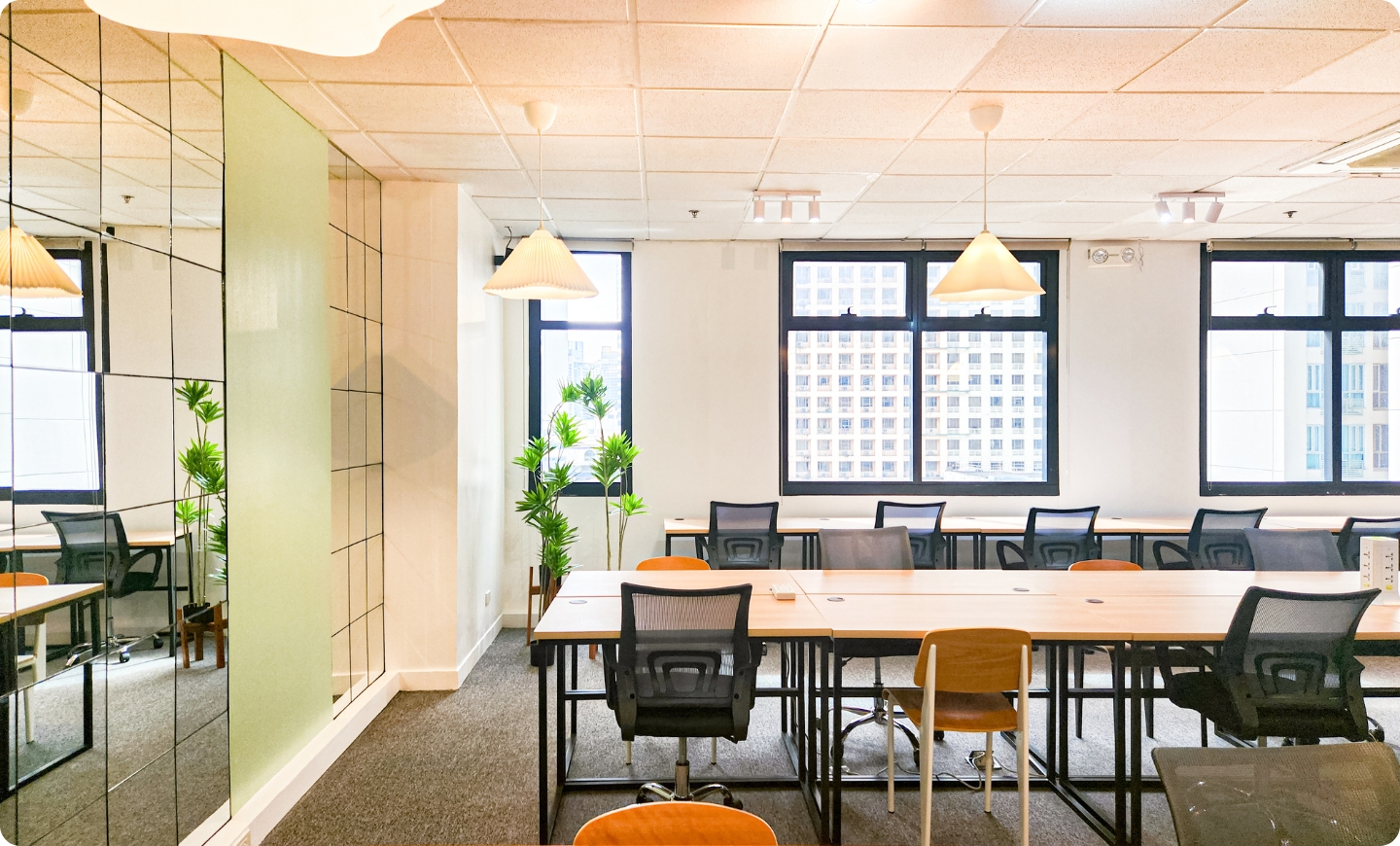
Space Feature at Zero-Ten Park Makati


Cultural Architecture: Using Community to Fight Scale-Up Burnout
Scaling from 2 to 20 people is a financial tightrope. You must maximize runway.
Preservation of Agility
The real value of coworking isn’t the free coffee — it’s the freedom to exit and expand. If your team grows to 30 people, you add desks; if you pivot and shrink to 15, your plan adjusts accordingly. Traditional leases punish downsizing with massive penalties, but in coworking, your office behaves like a living organism, adapting alongside your P&L statement.
The Loneliness of the Growing Team
Ironically, larger teams often feel more isolated. Move your 20-person team into a sealed private office on the 30th floor of a Makati tower, and you’ve created a bubble. At Zero-Ten Park, we combat this with what we call Community-as-a-Service — a belief that mindful gatherings are the antidote to scale-up stress. Employees gain access to a broader social network through workshops, curated community events, and idea exchanges with other founders. That peripheral community matters more than people realize: it takes the pressure off leadership to be the sole source of engagement, energy, and inspiration.
Scaling with Soul
Scaling from 2 to 20 people shouldn’t feel like a crisis — it should feel like a celebration of market traction. Choosing Zero-Ten Park Makati means more than placing desks in a room. You gain a foundation of infrastructure, community, and aesthetic excellence. You focus on growing the business. We’ll handle the walls.
Cost Per Desk vs. Total Cost of Occupation (TCO)
Founders often make the mistake of comparing traditional office monthly rent directly against a coworking membership — and that comparison is misleading. The true Total Cost of Occupation for a private Makati office includes base rent, CUSA charges, electricity, water and cleaning supplies, dedicated internet, a receptionist or admin salary, maintenance and repairs, and furniture depreciation. When you stack it all up, a coworking membership at Zero-Ten Park typically runs 25–40% cheaper than the full TCO of a traditional private office. The math isn’t close.
Retention Through Environment
In the Makati talent war, startups compete directly with multinational corporations — and a 24-year-old developer doesn’t dream about working in a cubicle. They want a destination workspace. Our focus on Artistic Professionalism creates an environment people actually want to photograph and share, because an Instagrammable office is a recruitment tool. When candidates walk into Zero-Ten Park, they don’t see just another job. They see a vibrant ecosystem. They see a lifestyle.
FREQUENTLY ASKED QUESTIONS
Traditional leases in Makati often require long-term commitments, large security deposits, and expensive office fit-outs. Coworking spaces offer flexible memberships that allow startups to scale their workspace up or down as their teams grow, helping founders preserve capital and reduce operational risk.
Workspace design directly affects how employees focus, collaborate, and recharge. A well-designed office includes dedicated areas for deep work, collaborative discussions, client meetings, and short breaks. When these environments are intentionally structured, teams experience fewer interruptions and more effective communication.
Yes, members with 24/7 plans or private offices have round-the-clock access to their workspace via their secure biometric access cards.
For day pass users or inquiries, the front desk officially operates from 9:00 AM to 7:00 PM, Monday through Friday.
Many startups begin feeling workspace limitations once their team grows beyond five to eight people. At that stage, frequent meetings, calls, and collaboration require a more structured environment with reliable internet, meeting rooms, and dedicated workspaces.
Startups should evaluate factors such as flexibility of lease terms, internet infrastructure, access to meeting rooms, community networking opportunities, and overall operational costs. A scalable workspace should allow teams to grow without requiring expensive relocations or long-term commitments.
Book a Site Visit!