Legal and Compliance Essentials When Building a Remote Team in the Philippines

For many startup founders, the Philippines represents more than just a cost-saving measure; it is a strategic hub for high-quality backend operations and administrative excellence. However, the transition from hiring locally in high-cost tech hubs like New York or Singapore to establishing a presence in Southeast Asia comes with a steep learning curve.
The Philippine legal system is famously protective of labor. Unlike the “at-will” employment common in the United States—where termination can often occur for any reason without notice—the Philippines operates on a Security of Tenure principle. This means that once an employee is hired, they have a legal right to their position unless “Just” or “Authorized” causes for dismissal are proven through a rigorous due process. For a founder, navigating this requires a shift in mindset: compliance is not a checkbox; it is a fundamental part of your risk management strategy.
STATUTORY BENEFITS & THE 2025 REGULATORY SHIFT
When Building a Remote Team in the Philippines, your first hurdle is understanding “Statutory Benefits.” In simple terms, these are non-negotiable, government-mandated contributions that an employer must pay on top of an employee’s base salary. Think of them as the Philippine equivalent of FICA in the US or Superannuation in Australia, but with more moving parts.
As of January 2025, the cost of compliance has increased due to scheduled rate hikes aimed at strengthening the country’s social safety nets. If you are calculating your “fully loaded” employee cost, you must use the updated 2025 figures to avoid budget underestimations.
The “Big Three” Contributions
- SSS (Social Security System):
- What it is: A social insurance program providing disability, retirement, and death benefits.
- 2025 Update: The contribution rate has officially increased to 15% (previously 14%). As an employer, you shoulder 10%, while the employee covers 5%.
- The Cap: The Maximum Monthly Salary Credit (MSC) has been raised to ₱35,000. For your high-earning backend developers or managers, your monthly contribution is now capped at this higher ceiling, increasing your per-head cost compared to 2024.
- PhilHealth (Philippine Health Insurance Corporation):
- What it is: The national health insurance program.
- 2025 Update: The premium rate is now solidified at 5% of the monthly basic salary. This cost is split exactly 50-50 between you and the employee.
- The Cap: This applies to salaries up to ₱100,000. Any income above this threshold is capped at a fixed monthly premium of ₱5,000 (split ₱2,500 each).
- Pag-IBIG (Home Development Mutual Fund):
- What it is: A mandatory savings fund primarily used for housing loans.
- 2025 Update: Following the 2024 increase, the maximum monthly compensation used for this calculation remains at ₱10,000. You and the employee both contribute 2% of this amount, effectively capping your monthly employer liability at a modest ₱200 per person.
Why This Matters for Founders Today
Understanding these statutory benefits is critical because, in the Philippines, they are not just “payroll line items”—they are legal obligations that define your startup’s financial health and legal standing. For a founder, the 2025 shift matters for four primary reasons:
1. Accurate Financial Forecasting (The “Fully Loaded” Cost)
2. Avoiding Criminal and Civil Liability
3. Talent Retention and “Employer of Choice” Status
4. Impact on Business Permits and Licensing

1. Accurate Financial Forecasting (The “Fully Loaded” Cost)
When you hire in high-cost hubs like New York, you’re used to looking at the gross salary. In the Philippines, the “sticker price” of a salary is misleading.
- The 20-30% Rule: Between the 15% SSS rate, the 5% PhilHealth premium, and the 13th-month pay, you should expect the “fully loaded” cost of an employee to be 20% to 30% higher than the base salary you offered.
- Budgeting for 2026: If you are still using 2024 spreadsheets, you are under-budgeting. The increase in the SSS Maximum Salary Credit to ₱35,000 specifically impacts the senior backend talent you likely need, as you’ll be paying the maximum employer contribution for those higher-income roles.
2. Avoiding Criminal and Civil Liability
Unlike many Western jurisdictions where payroll errors lead to civil fines, the Philippines treats the non-remittance of SSS, PhilHealth, and Pag-IBIG as a criminal offense.
- Personal Liability: As a founder or director, you can be held personally liable. Willful failure to remit SSS contributions can result in fines and, in extreme cases, imprisonment of 6 to 12 years.
- The “Interest Trap”: If you miss a payment, the interest is not negligible. SSS imposes a 2% monthly penalty on unpaid contributions. Over a year, a “small” oversight can balloon into a significant financial drain.
3. Talent Retention and “Employer of Choice” Status
In the Philippine tech and admin market, candidates don’t just look at the net pay; they look at the stability of their benefits.
- Social Safety Net: These benefits provide the employee’s healthcare (PhilHealth), retirement pension (SSS), and path to homeownership (Pag-IBIG).
- The Compliance Audit: Top-tier talent will often check their SSS portals to ensure their foreign employer is actually remitting. If they see a gap, they will view your startup as “unstable” and likely jump to a competitor or an established EOR that guarantees compliance.
4. Impact on Business Permits and Licensing
To operate legally, you need a yearly Mayor’s Permit. In many local government units (LGUs), you cannot renew your business license without showing a Certificate of No Pending Case or proof of updated contributions from SSS and PhilHealth. Non-compliance doesn’t just hurt your payroll; it can literally shut your doors.
To help you manage the operational side of Building a Remote Team in the Philippines, here is a comprehensive 2026 Founder’s Compliance Calendar.
This schedule consolidates the deadlines for tax filings (BIR), statutory benefits (SSS, PhilHealth, Pag-IBIG), labor reporting (DOLE), and data privacy (NPC) into a single scannable reference.
2026 Startup Compliance & Reporting Calendar
Q1: The Season of Reporting & Renewals
This is the most critical quarter for compliance. You are closing out the previous year while renewing your legal right to operate.
| Date | Agency | Requirement | Context |
| Jan 15 | DOLE | 13th Month Pay Compliance Report | Mandatory proof that you paid the 13th month by Dec 24. Filed via the Establishment Report System (DERS). |
| Jan 20 | LGU | Mayor’s Permit Renewal | Renewal of your local business permit at the City Hall where your entity is registered. |
| Jan 31 | BIR | Form 1604-C (Alpha List) | The annual list of all employees and the total taxes withheld from them in 2025. |
| Jan 31 | BIR | Annual Registration Fee | A flat ₱500 fee (Form 0605) to maintain your status with the tax bureau. |
| Mar 31 | NPC | Annual Security Incident Report (ASIR) | A summary of all data breaches (or lack thereof) for the year 2025. Required even for “Nil” reports. |
Monthly: Recurring Statutory “Must-Dos”
In the Philippines, statutory benefits and withholding taxes follow a staggered schedule based on your company’s registration number or name.
| Deadline | Agency | Requirement | Jargon Buster |
| 10th – 15th | BIR | Form 1601-C | Withholding Tax on Compensation: Remitting the income tax you deducted from employee paychecks. |
| Last Day | SSS | Monthly Contribution | Payment of the 15% social security rate for the previous month. |
| Staggered* | PhilHealth | Monthly Premium | Remittance of the 5% health insurance premium. Deadline depends on your PEN ending digit (e.g., 0-4 pay by the 15th). |
| Staggered* | Pag-IBIG | Monthly Remittance | Housing fund contributions. Deadlines are based on the first letter of your company name (e.g., A-D pay by the 14th). |
Quarterly: Tax Benchmarking
These are the “big” tax dates. If you are profitable or VAT-registered, these will impact your cash flow significantly.
- 1702Q (Quarterly Income Tax): Due 60 days after the close of each quarter for corporations.
- 2550Q (Quarterly VAT): Due on the 25th day of the month following the close of the quarter.
Strategic Summary for Founders
Navigating these dates manually is a significant “founder tax” on your time. As you scale, most startups transition to one of two models to handle this calendar:
- EOR (Employer of Record): They take the legal liability for all the dates above, effectively “outsourcing” the entire calendar to their legal team.
- Managed Payroll: You keep the local entity but hire a local firm to handle the BIR, SSS, and DOLE filings while you focus on product.
13TH MONTH PAY & MANDATORY COMPLIANCE REPORTING
For founders coming from “bonus-heavy” cultures, it is vital to distinguish between a performance bonus and 13th Month Pay. While a Christmas bonus is discretionary (given at the employer’s whim), 13th Month Pay is a strict statutory requirement under Presidential Decree No. 851.
Think of it not as a “gift,” but as deferred compensation that the law requires you to pay out by the end of the year. In the Philippines, this is a non-negotiable part of the employment contract for all rank-and-file employees—a term used by the Department of Labor and Employment (DOLE) to describe any staff member who does not hold managerial or executive powers.
The Math: How to Compute 1/12
The formula is straightforward but rigid: take the total basic salary earned by the employee within the calendar year and divide it by 12.
- What’s Included: Only the “basic” pay.
- What’s Excluded: Overtime pay, night shift differentials, holiday pay, and cost-of-living allowances (unless these are integrated into the basic salary by contract).
- Prorated Rule: If you hired a developer in July, you do not owe them a full month’s salary in December. You owe them the total basic salary they earned from July to December divided by 12.
The December 24 Deadline & “No Exemption” Policy
The law mandates that this must be paid on or before December 24. A recent 2025 Labor Advisory (No. 16, Series of 2025) issued by DOLE reiterated that no requests for exemption or deferment will be accepted. Even if your startup is pre-revenue or facing a temporary “cash crunch,” the government views 13th Month Pay as a vested right of the worker.
Tax Implications (The ₱90,000 Threshold)
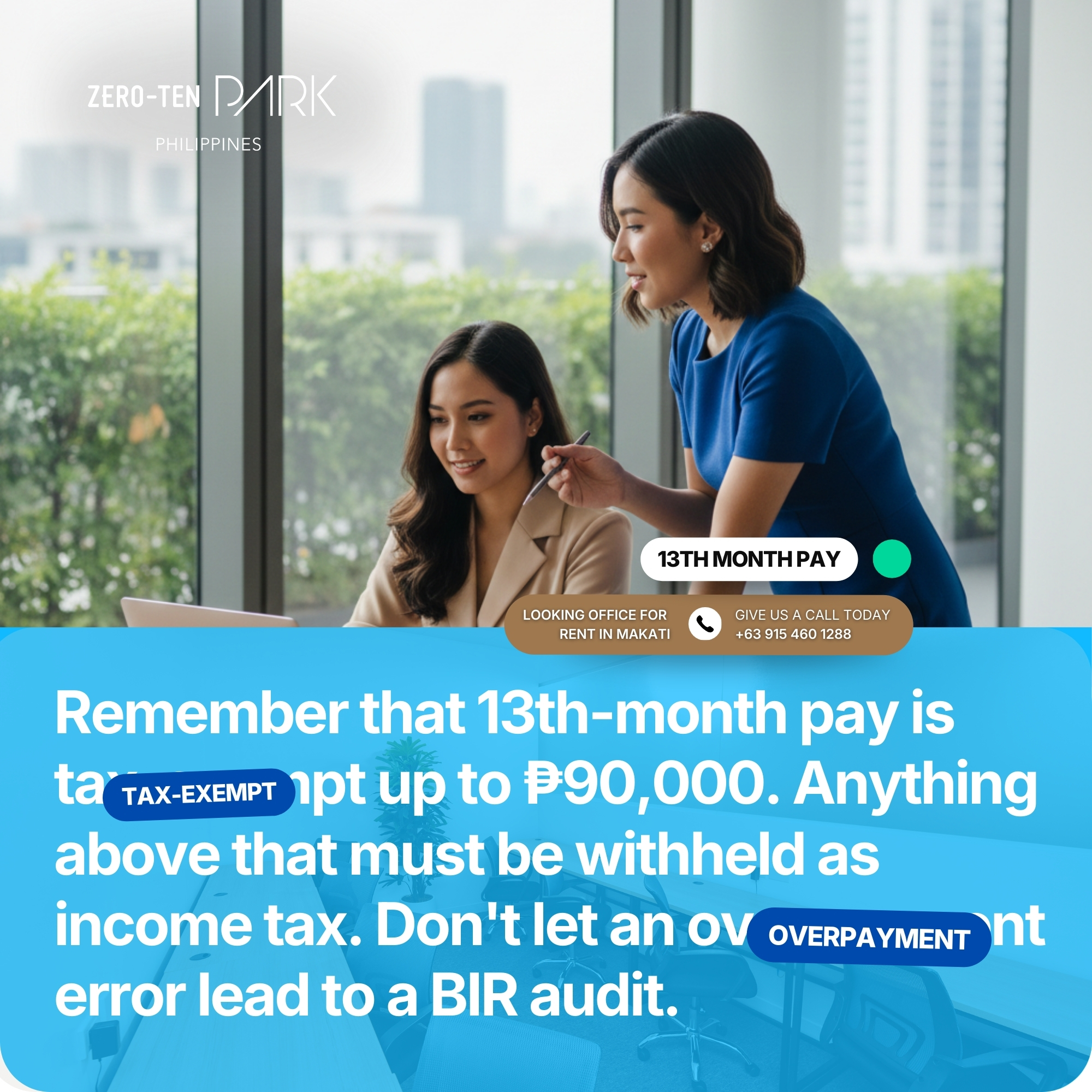
When Building a Remote Team in the Philippines, you must also act as a tax withholding agent. Under the current TRAIN Law, 13th Month Pay and other benefits are tax-exempt up to ₱90,000.
- If your senior backend lead receives a 13th month payout of ₱100,000, only ₱90,000 is tax-free.
- The remaining ₱10,000 must be added to their gross income and taxed at their applicable personal income tax rate.
By ensuring this payout is handled accurately and reported on time, you protect your startup from the “Money Claims” cases that often haunt foreign entities during their second or third year of operation.
THE "CONTROL TEST" & THE MISCLASSIFICATION TRAP
For a founder, the ability to iterate quickly and pivot is essential. Often, the fastest way to scale is to hire “independent contractors”—a setup that feels familiar to those used to the flexible gig economies of New York or Singapore. However, in the Philippines, the law looks past the title on your contract and examines the economic reality of the relationship.
The legal “landmine” here is Misclassification. This occurs when you treat a worker as a contractor (paying them a flat fee with no benefits) while the law views them as a Regular Employee. If a Philippine court reclassifies your team, you could be liable for years of back-dated benefits, 13th-month pay, and unpaid employer tax contributions.
The Four-Fold Test: The Legal Yardstick
To determine if an employer-employee relationship exists, the National Labor Relations Commission (NLRC) uses the “Four-Fold Test.” While all four matter, the fourth is the “smoking gun.”
- Selection and Engagement: Did you personally interview and hire the individual?
- Payment of Wages: Do you pay them a regular, recurring amount (like a salary) rather than a project-based fee?
- Power of Dismissal: Do you have the right to terminate them for performance or disciplinary reasons?
- The Control Test (The Determinative Factor): Do you control not just the result of the work, but the means and methods used to achieve it?
The 2025 Enforcement Climate
The risk profile for startups changed in early 2025. The Department of Labor and Employment (DOLE) has begun cross-referencing digital payment platforms with social security records. If you have ten “contractors” receiving identical monthly payments from a foreign entity but zero SSS contributions are being filed, your startup may be flagged for a Compliance Audit.
The Founder’s Risk: If you lose a misclassification case, you don’t just pay a fine. You are often ordered to “regularize” the worker. Under Philippine Security of Tenure, this means you can no longer terminate them without “Just Cause” (e.g., serious misconduct) and a rigorous two-notice legal process.
How to Protect Your Startup
If your goal is a true contractor relationship, your contracts and daily operations must reflect autonomy. The worker should use their own equipment, set their own hours, and be judged solely on the output delivered (e.g., a completed module of code) rather than the process (e.g., being at their desk for 8 hours). For most startups needing dedicated backend support, the safer and more scalable route is to use an Employer of Record (EOR) to ensure your team is legally classified as employees from day one.
Deep Dive: When "Remote" becomes "Employment"
- When Building a Remote Team in the Philippines, founders often inadvertently exert “Control” in ways that trigger employee status.
- Tools and Equipment: If you provide the laptop, pay for the internet allowance, or mandate the use of specific proprietary software, you are providing the “means” of production.
- Schedules and Integration: Requiring your backend team to be active on Slack during specific New York hours (e.g., 9 PM to 5 AM Manila time) or mandating attendance at daily “stand-ups” suggests you are controlling their “manner and time” of work.
- Performance Standards: In a landmark 2024 Supreme Court ruling (Escauriaga v. Fitness First Philippines), the court held that even workers labeled as “freelancers” were actually employees because the company imposed strict quotas, mandatory training, and specific rules on how to conduct their tasks.

DATA PRIVACY, AI, AND THE 2025 NPC ENFORCEMENT ERA
For a founder running a startup from a hub like New York or Singapore, data is your most valuable asset—and your greatest liability. In the Philippines, data protection is governed by the Data Privacy Act (DPA) of 2012. However, as of late 2024 and throughout 2025, the regulatory body—the National Privacy Commission (NPC)—has shifted its focus from merely encouraging registration to active enforcement, specifically targeting how remote teams handle automated systems.
If your backend team is processing customer data, managing databases, or building features that involve machine learning, you are no longer just subject to “standard” privacy rules. You are now navigating the NPC’s 2025 AI Advisory Guidelines.
Key Terminology: PICs vs. PIPs
To stay compliant, you must first identify your role in the eyes of Philippine law:
- Personal Information Controller (PIC): This is likely your startup. You are the entity that decides why and how personal data is processed.
- Personal Information Processor (PIP): This is often your Philippine team or the local EOR you use. They process data on your behalf.
Under the DPA, the PIC (you) bears the ultimate responsibility for any breaches, even if the error was made by a remote staff member in Manila.
The 2025 AI Pivot: NPC Advisory 2024-04
Building a Remote Team in the Philippines in today’s tech climate means your team is likely utilizing AI to clean data, analyze user behavior, or automate customer support. The NPC now mandates that if your team uses AI systems to process personal data, you must adhere to three specific pillars:
- Meaningful Human Intervention: You cannot let an AI make “solely automated” decisions that significantly affect a person (e.g., automatically rejecting a loan or flagging a user for fraud) without a qualified human—likely your Philippine backend lead—reviewing the output.
- Privacy Impact Assessment (PIA): For any AI-driven process, the NPC now expects you to have a documented PIA. This is a “stress test” for your data workflows to ensure you aren’t inadvertently leaking sensitive information through your AI models.
- The Right to Object: Users now have a reinforced right to object to their data being used for “AI training.” Your Philippine team must have a clear workflow to “excise” specific user data from training sets upon request.
Mandatory 2025 Reporting Deadlines
The NPC has digitized its enforcement. All startups with a Philippine presence (direct or via EOR) must now use the NPC Seal of Registration and adhere to strict annual filings:
- Annual Security Incident Report (ASIR): You must submit this report every year by March 31. Even if you had zero data breaches in the past year, you are still legally required to file a “Nil Report.”
- Data Protection Officer (DPO): You must formally designate a DPO. For many remote startups, this is a senior member of the local Philippine team who serves as the point of contact for the NPC.
Why "Privacy by Design" is the New Standard
In September 2025, the NPC released Circular 2025-02, which introduces “Privacy Engineering.” This means you can no longer “bolt on” privacy features after a product is built. Your Philippine remote team is expected to implement Privacy-Enhancing Technologies (PETs)—such as data masking and end-to-end encryption—during the development phase of your backend systems.
Failure to comply in this new era of enforcement doesn’t just result in a fine; the NPC now has the authority to issue “Takedown Orders” or “Blacklist Orders,” which could effectively shut down your team’s ability to access your global servers from Philippine IP addresses.

FOREIGN NATIONAL EMPLOYMENT & THE NEW DO 248-25 RULES
As your startup matures, you may find the need to relocate a key team member—perhaps a Head of Product from New York or a Technical Lead from Tokyo—to Manila to oversee local operations. While the Philippines is welcoming to foreign investment, the labor landscape for foreign hires underwent a seismic shift with the release of Department Order No. 248, Series of 2025 (DO 248-25) and its supplemental guidelines (DO 248-A).
Before sending a foreign national (FN) to lead your team, you must understand that the Philippines operates on a “Filipino First” policy. A foreigner is only permitted to work if it can be proven that no Filipino is “competent, able, and willing” to do the job.
The Alien Employment Permit (AEP) & The 15-Day Rule
The Alien Employment Permit (AEP) is the mandatory prerequisite for any foreigner intending to work in the Philippines for more than six months.
- Pre-Employment Filing: Under the 2025 rules, you can now file for an AEP while the candidate is still outside the country. However, the permit will only be released once they arrive and present their visa.
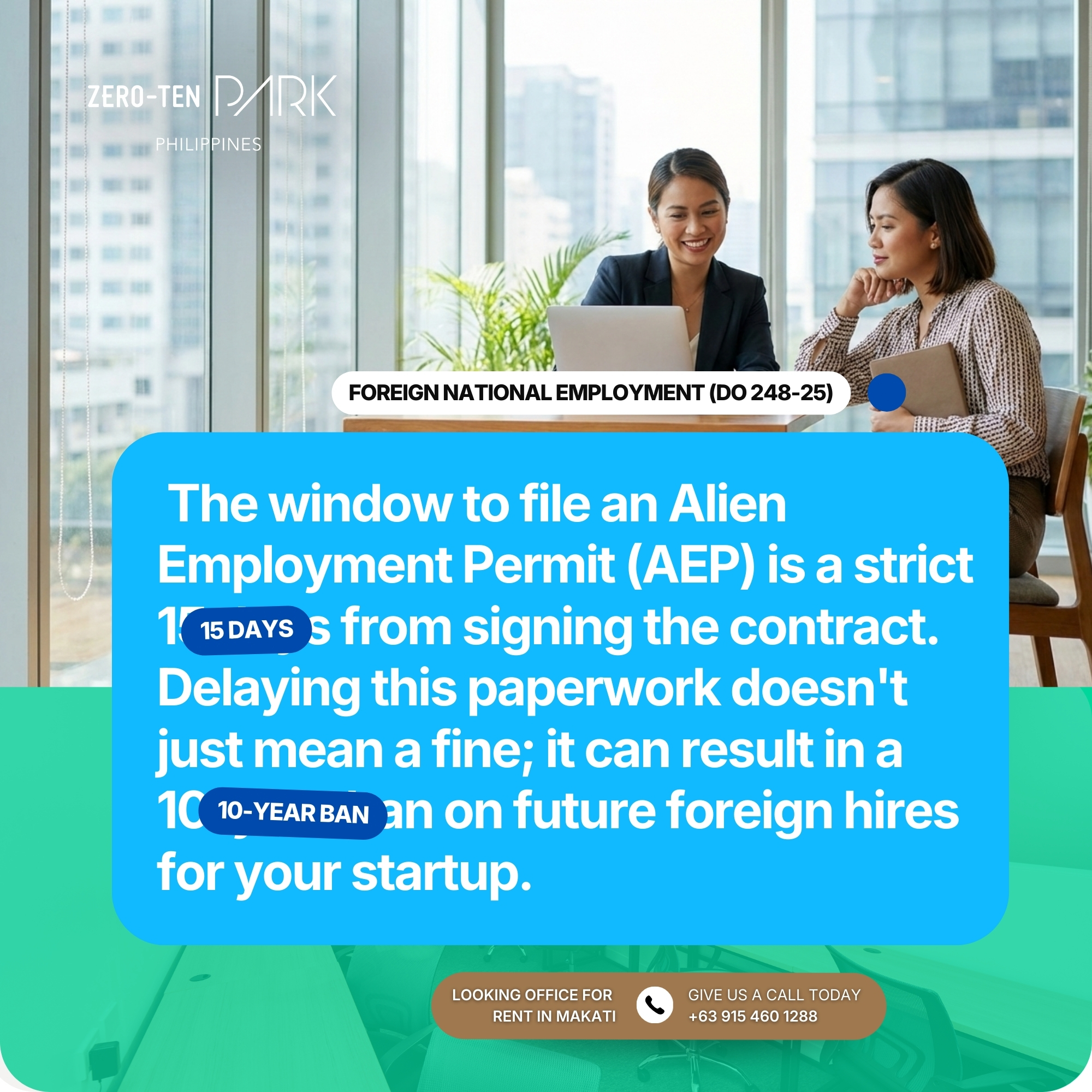
- Strict Filing Window: You must file the AEP application within 15 calendar days of signing the employment contract or issuing the appointment letter. Missing this window results in heavy fines and can jeopardize the visa process.
The Labor Market Test (LMT) & Economic Needs Test (ENT)
When Building a Remote Team in the Philippines, you might assume hiring a foreign manager is a simple internal transfer. However, DO 248-25 introduces a more rigorous Labor Market Test:
- Mandatory Publication: You must publish the job vacancy and the name of the foreign national you intend to hire in a newspaper of general circulation.
- The New ENT: The 2025 rules introduced the Economic Needs Test. DOLE now evaluates whether the foreign hire truly fills a “specialization gap” in the local market. If the government determines a local professional could perform the role, the AEP can be denied.
The Understudy Training Program (UTP): The Knowledge Transfer Mandate
One of the most significant pillars of DO 248-25 is the requirement for Skills Transfer. If your startup enjoys fiscal incentives (like those from PEZA or the BOI) or is considered a “strategic investment,” you are legally mandated to implement an Understudy Training Program (UTP).
- The 1-to-2 Ratio: For every foreign national you hire, you must designate at least two (2) Filipino understudies who are “next-in-rank.”
- Mandatory Reporting: You must submit a structured training plan and semi-annual progress reports signed by the foreigner, the understudies, and yourself. This ensures that when the foreigner’s permit expires (usually after 1–3 years), the local team is ready to take over.
Exemptions: The “Corporate Officer” Path
There is a strategic “fast track” for founders. If the foreign national is appointed as a Corporate Officer—specifically named in your company’s Articles of Incorporation or By-Laws (such as President, Treasurer, or Corporate Secretary)—they are generally exempt from the newspaper publication and the Understudy Training Program requirements. However, they still must secure a Certificate of Exemption from DOLE.
The Cost of Non-Compliance
The 2025 enforcement is strict. Employing a foreigner without a valid AEP or failing to implement a required UTP can lead to:
- Fines: Up to ₱10,000 per year of violation for both the employer and the employee.
- Barring: Willful misrepresentation or fraud in AEP applications can result in a 10-year ban from applying for any work permits in the Philippines.
TERMINATION & "SECURITY OF TENURE": NAVIGATING THE HIGH BAR FOR SEPARATION
For many startup founders, the most striking difference between their home jurisdiction and the Philippines is the concept of Security of Tenure. In the U.S., “at-will” employment allows for termination at any time for almost any reason. In the Philippines, however, employment is a constitutionally protected right. Once you hire someone, they have a legal right to keep that job unless you can prove a specific, legally sanctioned reason to let them go.
This doesn’t mean you are stuck with low performers forever, but it does mean that Building a Remote Team in the Philippines requires a disciplined, documentation-first approach to management.
The Legal Framework: Just vs. Authorized Causes
In the Philippines, there is no such thing as a “simple” termination. You must categorize every separation into one of two buckets:
- Just Causes: These are reasons attributable to the employee’s fault (e.g., serious misconduct, gross neglect of duties, or fraud). Think of these as “firing for cause.”
- Authorized Causes: These are business-driven reasons not caused by the employee (e.g., redundancy, retrenchment to prevent losses, or closing the business). These require paying Separation Pay—typically one month’s salary for every year of service.
The “Twin-Notice Rule”: Procedural Due Process
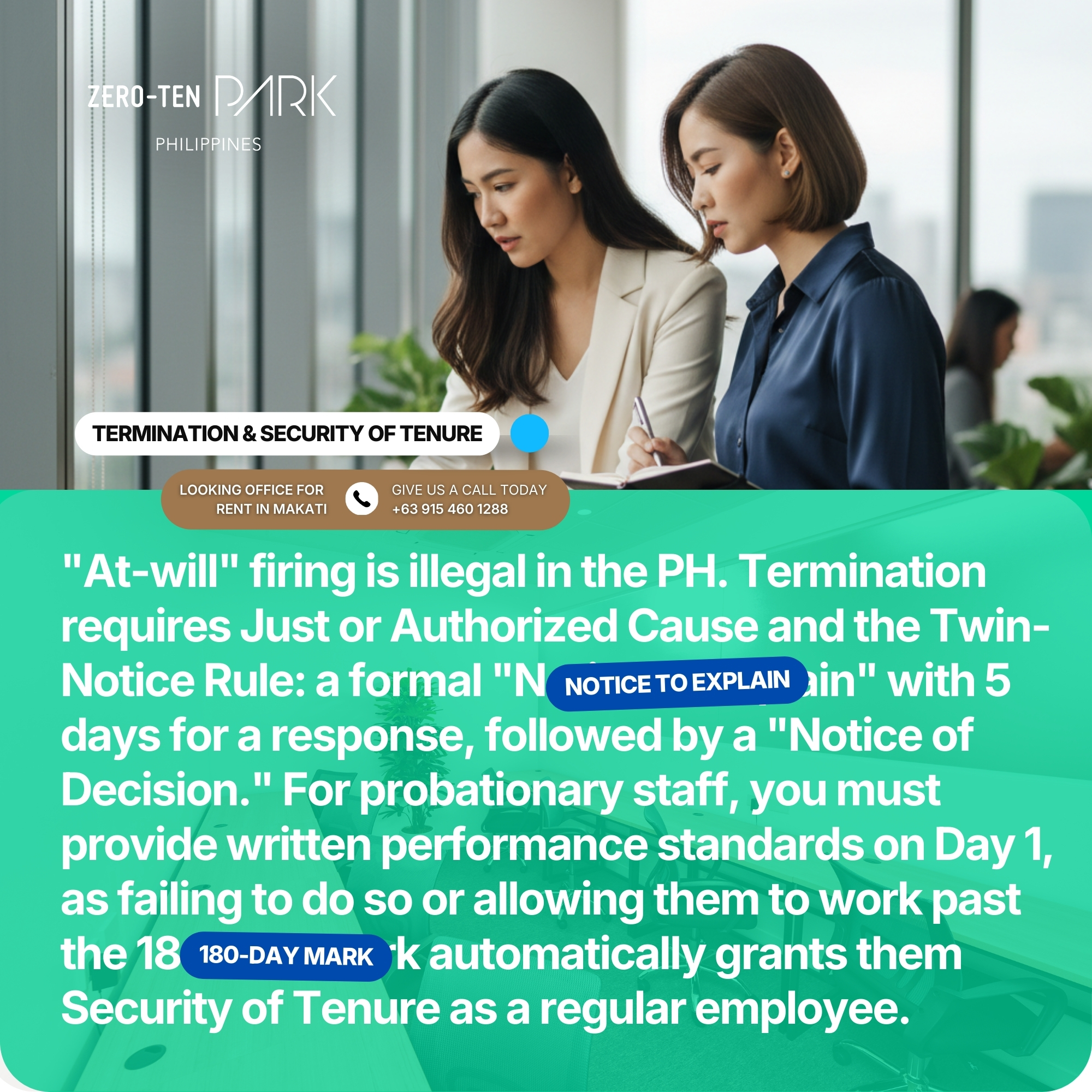
Even if you have a rock-solid reason to fire someone (Substantive Due Process), the termination is illegal if you don’t follow the Twin-Notice Rule (Procedural Due Process).
- First Notice (Notice to Explain/NTE): You must give the employee a written notice detailing the specific charges against them. Crucially, they must be given at least five (5) calendar days to submit a written explanation.
- Administrative Hearing/Conference: While not always mandatory, it is highly recommended to hold a “hearing” where the employee can present their side.
- Second Notice (Notice of Decision): After considering their explanation, you issue a second notice informing them of your final decision (termination, suspension, or warning).
Current Event Note (September 2025): The Supreme Court recently reiterated in Amor v. Constant Packaging Corp that even preventing an employee from accessing their work tools (like revoking Slack or Gmail access) without a valid legal reason and prior notice constitutes Illegal Dismissal.
The Probationary Trap: The 180-Day Rule
The first six months of employment are considered a “probationary period.” This is your window to evaluate “fit.” However, there is a catch: you must provide the employee with written performance standards on their very first day of work.
- The Standards: If you don’t tell them on Day 1 that they need to close 10 tickets a week to be regularized, you cannot fire them for only closing 5 tickets later.
- Automatic Regularization: If an employee works even one day past their 6-month (180-day) mark without a formal regularization letter or a termination notice, they are automatically considered a Regular Employee with full security of tenure.
The Financial Risk of “Illegal Dismissal”
If a founder skips these steps, the consequences are expensive. A “wrongfully” terminated employee is entitled to Full Backwages (all the salary they would have earned from the day they were fired until the court decides the case) plus Reinstatement to their old job. If you don’t want them back, you must pay Separation Pay on top of the backwages.
Strategic Advice for Founders
To protect your startup, never terminate an employee “on the spot.” Instead:
- Document everything: Use a Performance Improvement Plan (PIP) if a backend dev is slipping.
- Use an EOR: If you aren’t ready to manage a local HR department and the NLRC legalities, an Employer of Record can handle these “difficult conversations” using their local legal expertise.
- Issue the NTE early: Don’t wait until you’re angry. If there’s a policy breach, start the paper trail immediately.
To protect your startup from illegal dismissal claims, a Performance Improvement Plan (PIP) must be more than just a list of complaints; it must be a legally defensible roadmap.
In the Philippines, a PIP serves as evidence that you provided “substantive due process” by giving the employee a fair opportunity to correct their performance before moving toward termination.
Performance Improvement Plan (PIP) Template
Strictly for Performance-Based Evaluation in the Philippines
Part 1: Employee & Plan Overview
- Employee Name: [Name]
- Position: [e.g., Senior Backend Developer]
- Date of Issue: [Current Date]
- PIP Duration: [e.g., 60 Days] (Typically 30, 60, or 90 days)
- Review Intervals: [e.g., Weekly on Fridays at 10 AM PHT]
Part 2: Performance Gaps & Evidence
Context: You must cite objective facts, not feelings. Vague terms like “bad attitude” will not hold up in an NLRC hearing.
| Performance Area | Specific Deficiency | Evidence / Incident Date |
| Code Quality | Frequent bugs in production deployments. | Deployment logs on Oct 12 & Oct 24. |
| Timeliness | Missed sprint deadlines for Project X. | Jira Sprint Report for Sprint #14. |
| Communication | Failure to respond to P1 Slack alerts. | Slack timestamps from Oct 20-22. |
Part 3: SMART Improvement Goals
Context: Goals must be Specific, Measurable, Attainable, Relevant, and Time-bound.
- Goal 1: Achieve a 95% pass rate on first-round code reviews for the next 8 weeks.
- Goal 2: Complete 100% of assigned Jira tasks within the agreed sprint timeline.
- Goal 3: Respond to “High Priority” internal messages within 30 minutes during work hours.
Part 4: Employer Support & Resources
Context: To be legally defensible, you must show you tried to help. If you provide no support, the PIP can be viewed as “Constructive Dismissal” (forcing them to quit).
- Training: Access to [Course Name] or 1:1 mentorship with [Team Lead Name].
- Tools: Provision of [Specific Software] or increased server access.
- Feedback: Weekly 30-minute syncs to discuss blockers and progress.
Part 5: Acknowledgement & Consequences
Context: You must clearly state the outcome of failing the PIP without sounding “predetermined.”
“I acknowledge that I have received this Performance Improvement Plan and understand the expectations outlined. I understand that failure to meet these standards by the end of the PIP period may result in further disciplinary action, up to and including the termination of my employment for Just Cause (Gross and Habitual Neglect of Duties), subject to the required due process.”
- Employee Signature: ____________________ Date: __________
- Manager Signature: ____________________ Date: __________
Strategic Founder’s Tip: The “Signed Receipt”
If an employee refuses to sign the PIP, do not panic. Under Philippine labor guidelines, you can simply have two witnesses sign a note on the document stating: “Employee was presented with this document on [Date] at [Time] but refused to sign. Contents were explained verbally.” This serves as sufficient proof that the notice was served.
CONCLUSION: THE FOUNDER’S PATH TO SCALABLE GROWTH
Building a successful operation in the Philippines is a journey that moves from the initial promise of cost-efficiency to the long-term reality of strategic growth. As a founder, your ability to treat legal and compliance essentials as a “foundational feature” of your business—rather than a late-stage add-on—will ultimately determine your success.
The shift in the 2025 regulatory landscape, from the hike in statutory contributions to the aggressive enforcement of data privacy and foreign employment rules, signals a maturing market. The Philippines is no longer just a “back-office” destination; it is an innovation hub with a workforce that is highly protected by the state. By respecting the principle of Security of Tenure, maintaining rigorous Data Privacy standards, and navigating Foreign Employment laws with transparency, you do more than just avoid fines. You build a culture of trust and professional stability that attracts the top 1% of Filipino talent.
Building a Remote Team in the Philippines is ultimately an exercise in cross-border management. While the administrative burden of the “Twin-Notice Rule” or the “13th Month Pay” may feel cumbersome compared to the flexibility of New York’s at-will market, these regulations are the guardrails that ensure your team remains loyal and your operations remain uninterrupted.
Founders who master this landscape gain a significant advantage: a high-performing, culturally aligned, and legally secure team that can scale as fast as the startup demands. Whether you choose to manage these complexities through a local entity or leverage the safety of an Employer of Record (EOR), your commitment to “doing it right” from Day 1 is the most valuable investment you can make in your Southeast Asian expansion.
✨ ZERO-TEN PARK PHILIPPINES: YOUR COMPLIANCE PARTNER IN THE PHILIPPINES
Don’t let administrative hurdles slow your growth. Zero-Ten Park (formerly The Company Philippines) offers a “soft landing” for startups, allowing you to hire and scale in Makati or Cebu without the months of delay required for local entity registration.
- Employer of Record (EOR): We legally hire your team under our entity, handling all SSS, PhilHealth, Pag-IBIG, and 13th-month pay for you.
- HR & Payroll Excellence: We manage the complex “Twin-Notice” termination process and performance tracking to keep you 100% labor-compliant.
- Cross-Border Bridge: With a dedicated Japanese Desk and a network spanning the US, Singapore, and Japan, we simplify your international operations.
- Premium Workspace: Access 24/7 Grade-A office infrastructure in the heart of the Makati business district.
FREQUENTLY ASKED QUESTIONS
No. A performance bonus is discretionary and usually tied to KPIs or company profit. The 13th-month pay is a statutory requirement under Presidential Decree No. 851. You are legally obligated to pay it to all rank-and-file employees who have worked for at least one month, regardless of their performance. Failing to pay this by December 24 can lead to labor complaints and interest penalties.
While you can agree on a USD-denominated salary, the Social Security System (SSS) and Bureau of Internal Revenue (BIR) require all statutory contributions and tax withholdings to be calculated and remitted in Philippine Pesos (PHP). Many founders use a “fixed exchange rate” policy or an Employer of Record (EOR) to handle the conversion and ensure the exact PHP amount is filed with the government each month.
The financial risks are retroactive. If the National Labor Relations Commission (NLRC) determines your contractor is actually an employee (based on the “Control Test”), you may be ordered to pay all unpaid SSS, PhilHealth, and Pag-IBIG contributions, 13th-month pay, and service incentive leaves from the first day they started. Additionally, you may lose the right to terminate the contract “at will,” as they will be granted Security of Tenure.
Yes. Under Republic Act No. 11165 (The Telecommuting Act), remote or “telecommuting” employees must receive the same treatment, benefits, and labor rights as those working at the employer’s premises. This includes overtime pay, night shift differentials, and access to all statutory social safety nets.
The ₱90,000 ceiling applies to the total of “13th-month pay and other benefits.” This includes the 13th-month pay plus other bonuses or productivity incentives you might give. Any amount exceeding this ₱90,000 total in a single calendar year is subject to standard income tax withholding. For high-earning tech talent, it is common for a portion of their 13th-month pay to be taxable.

GET A QUOTE TODAY
"*" indicates required fields
Ready to level up your business presence and save more every month? Complete the form now and our team will handle the rest.