How Australian Fintech and E-Commerce Companies Are Building Back-Office Teams in the Philippines

The Philippines Is Already Running Core Functions for Australia’s Biggest Companies
Canva. Atlassian. Airtasker. Three of Australia’s most successful technology companies have built substantial teams in the Philippines — not as an experiment, but as a structural part of how they operate. Canva’s largest functional team in Manila is Customer Happiness. Airtasker’s AirSupport team is almost entirely Philippines-based. Atlassian runs engineering and support functions out of its BGC office in Taguig.
These aren’t outliers. They’re a signal of where smart Australian businesses are building their operational foundations. For fintech, e-commerce, and growth-stage companies, the Philippines offers something specific: deep talent in the functions that matter most — compliance support, finance operations, customer service, and back-office management — at a fraction of the Australian cost.
What Australian Fintech Companies Are Hiring For
For fintech businesses — lenders, payment platforms, wealth management apps, BNPL providers — the back-office burden is significant. Compliance monitoring, loan processing, KYC verification, customer onboarding support, and financial reconciliation are all roles that require trained professionals but don’t require proximity to the Australian head office.
Philippine professionals in these roles come with strong credentials. The country produces over 100,000 accounting and finance graduates per year, many of whom are familiar with Australian financial tools: Xero, MYOB, QuickBooks, and Salesforce. CPA qualifications are common. English is the language of work.
| Role | Monthly Cost via EOR (AUD) | AU Equivalent (AUD/yr) |
|---|---|---|
| KYC / Compliance Analyst | AUD 1,600–2,200 | AUD 70,000–85,000 |
| Finance Operations Specialist | AUD 1,400–2,000 | AUD 65,000–80,000 |
| Customer Support (financial products) | AUD 1,000–1,500 | AUD 55,000–65,000 |
| Data Analyst | AUD 1,800–2,600 | AUD 80,000–100,000 |
What Australian E-Commerce Companies Are Hiring For
For e-commerce businesses — DTC brands, marketplaces, retail technology — the Philippines provides a highly effective solution to the perennial tension between scaling customer service and managing cost.
Philippine customer support professionals have grown up in a BPO industry that serves global brands. They’re trained in Zendesk, Freshdesk, Gorgias, and Shopify. They know how to handle returns, escalations, and live chat at volume. And they communicate in fluent, idiomatic English that requires no editing or localisation for Australian customers.
Beyond customer service, e-commerce businesses regularly hire Philippine team members for product listing management, inventory coordination, digital marketing, and logistics support — all roles that can run effectively at a 2–3 hour time offset from AEST.
The Office Advantage
For fintech and e-commerce companies with compliance and quality requirements, one practical consideration often gets overlooked: where does your team actually work?
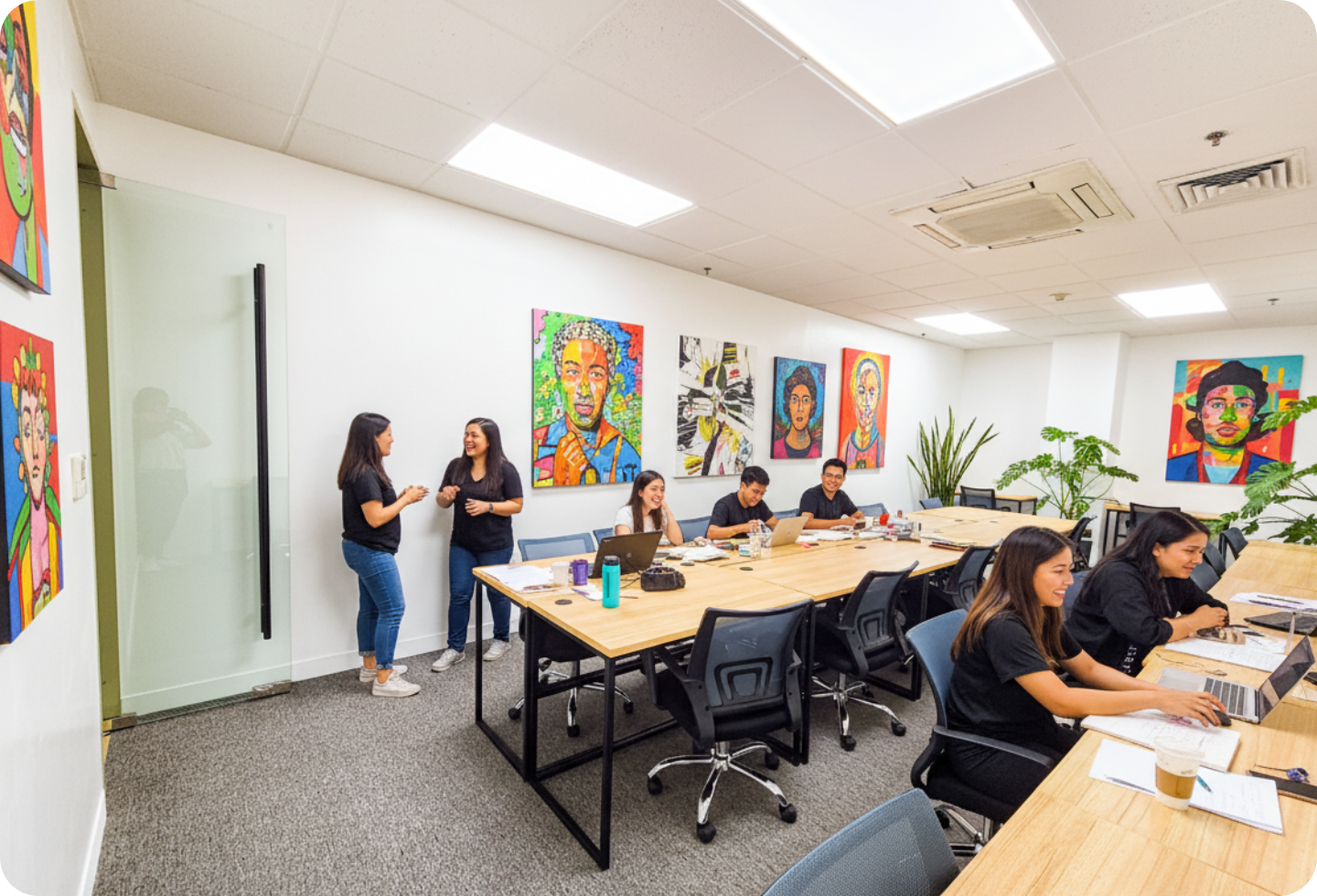
A team working from a managed office environment — with IT controls, a secure network, and on-site supervision — provides a level of oversight and reliability that fully remote arrangements can’t match. For roles that handle sensitive financial data or customer information, this matters.
Where to Start
Most Australian fintech and e-commerce companies make their first Philippines hire in one of two areas: a customer support specialist (immediate impact on support queue and cost) or a finance operations role (immediate impact on bookkeeping and reconciliation). Both are well-established roles in the Philippine talent market with short hiring timelines.
From there, teams typically grow organically as the model proves itself — adding roles, expanding functions, and building a genuine remote division in the Philippines that operates as an extension of the Australian team.
Build Your Philippine Team
Our local EOR team works with Australian fintech and e-commerce companies at all stages — from first hire to established teams. We handle compliance; you handle growth.