Philippine Employer of Record is the Smartest Way for US Companies to Scale in 2026

The global talent landscape has fundamentally shattered the geographic boundaries that once restricted high-growth companies. For forward-thinking US businesses, staying competitive no longer means limiting your talent search to a tight radius around a domestic office or fighting overhyped, hyper-expensive local talent pools. Instead, global hiring has transitioned from a luxury reserved for Fortune 500 enterprises into an absolute survival mechanism for small-to-medium businesses and rapidly scaling startups.
Among the world’s premier talent destinations, the Philippines stands out as an exceptionally compelling hub for American companies looking to build distributed teams. However, tapping into this vibrant market traditionally came with a major operational hurdle: the daunting logistical nightmare of navigating international corporate laws, registering foreign subsidiaries, and wrestling with unfamiliar tax systems.
This is exactly where a professional Employer of Record (EOR) becomes your ultimate expansion catalyst. By serving as an authorized on-the-ground employment partner, an Employer Of Record allows US companies to seamlessly source, hire, and manage top-tier Filipino professionals in a matter of days rather than months. You eliminate the massive capital expenditures and administrative burdens of setting up a standalone foreign corporation, while completely safeguarding your business against cross-border compliance penalties.
Working with a modern Employer of Record gives your executive team the unique ability to focus entirely on what actually drives your business forward: sourcing brilliant minds, building a cohesive company culture, and accelerating your product roadmap. The right provider handles the dense transactional backend—from complex local tax withholdings and statutory health benefits to localized payroll schedules—while you retain absolute operational command over your remote team’s daily activities.
As we navigate the economic landscape of 2026, building an agile, cross-border workforce is the single most effective way to extend your corporate runway, achieve 24/7 operational coverage, and maximize your output per dollar spent. This comprehensive guide serves as your definitive strategic manual, breaking down the operational mechanics, regulatory guardrails, and risk-mitigation strategies required to successfully leverage a Philippine Employer Of Record and scale your business securely.
What Is an Employer of Record (EOR)?
An Employer of Record (commonly abbreviated as EOR) is a third-party organization that legally employs workers on behalf of another company. When you partner with an Employer of Record in the Philippines, the Employer Of Record handles all local employment responsibilities—including onboarding, payroll, local tax withholding, statutory benefits, and strict compliance with Philippine labor laws. Meanwhile, your US business retains full operational control over the employee’s day-to-day work, performance metrics, and deliverables.
In short: You manage the talent, the Employer of Record handles the legal and regulatory infrastructure.
Why US Companies Are Flocking to the Philippines
The macroeconomic shift toward remote work has turned the Philippines into a premier global hub for knowledge workers and specialized professionals. The country offers a unique matrix of competitive advantages that makes it an ideal destination for scaling US businesses:
- Exceptional English Proficiency: The Philippines consistently ranks among the top nations in Asia for English fluency. This is not just conversational English; it is high-level, business-fluent English deeply integrated into the country’s educational system.
- Time Zone Synchronization Strategies: While the Philippines is 12 to 15 hours ahead of the US, a large segment of the professional workforce is highly accustomed to working night shifts (“graveyard shifts”) to align perfectly with US East Coast or West Coast business hours, enabling seamless real-time collaboration.
- Substantial Labor Cost Savings: By leveraging an Employer of Record, US companies typically realize 50% to 70% savings on labor costs compared to hiring equivalent US-based roles, dramatically extending their runway.
- Deep and Highly Educated Talent Pool: With over 500,000 fresh graduates entering the workforce annually, the market goes far beyond customer service. You will find elite talent in software engineering, financial analysis, digital marketing, data analytics, and creative design.
- High Cultural Compatibility: Due to shared historical ties, Filipino professionals possess an innate understanding of American business culture, slang, consumer behavior, and corporate structures, vastly reducing the onboarding friction common in other offshore markets.
How an Employer Of Record Works: The Step-by-Step Global Hiring Framework
Navigating international employment without an on-the-ground partner is an administrative minefield. Here is exactly how the operational workflow functions when you partner with an established Philippine Employer of Record:
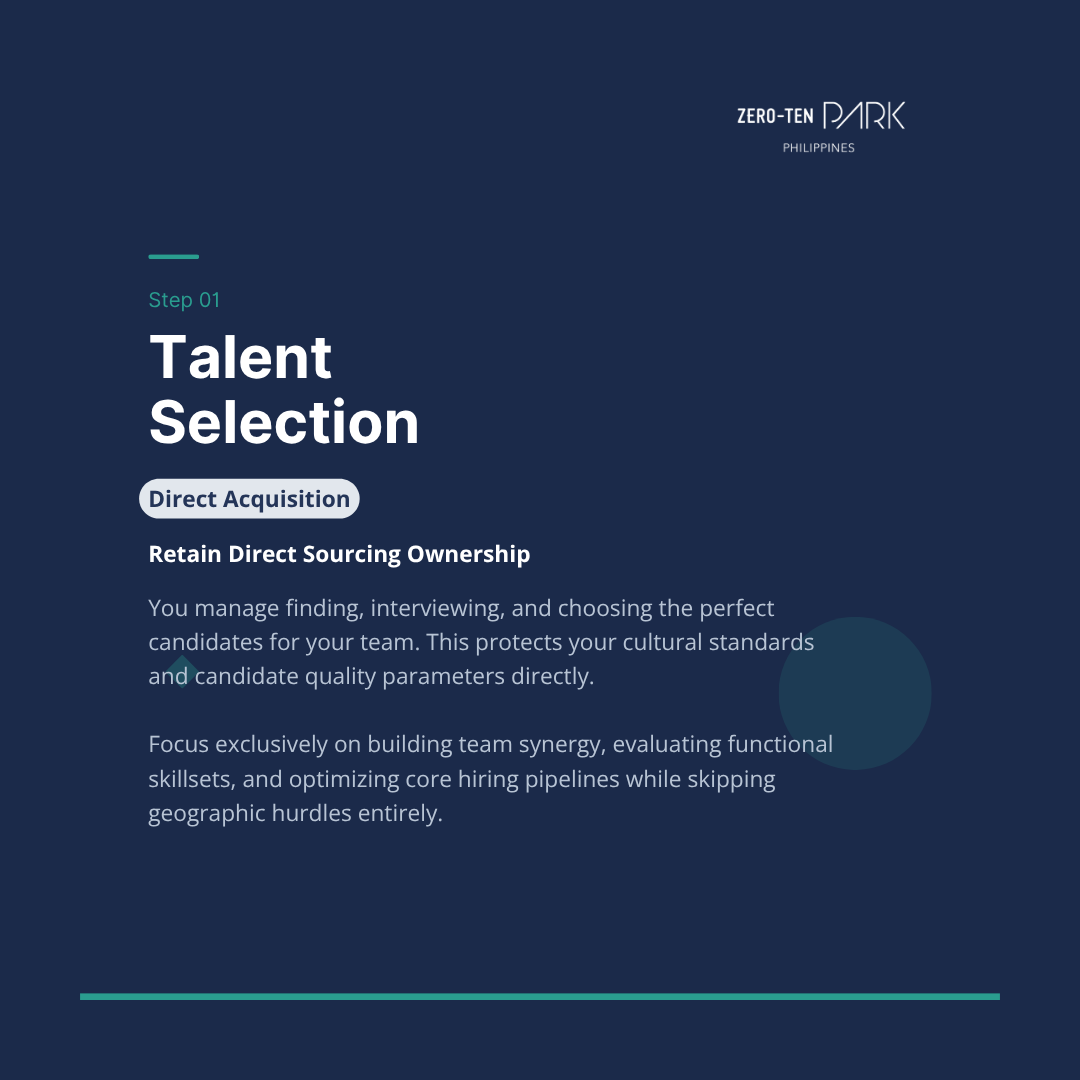
1. Sourcing, Interviewing, and Selecting Top-Tier Talent
The journey begins with your talent acquisition strategy. Unlike traditional outsourcing models (BPOs) where you are often assigned whatever resource is currently on the bench, the Employer of Record model ensures you retain 100% control over your hiring standards. You define the ideal candidate profile, determine technical prerequisites, and control the interview structure.
US companies generally approach this selection phase through three primary channels:
-
Internal Recruitment Arrays: Your in-house HR team posts openings on global platforms like LinkedIn or localized job boards (such as JobStreet or Indeed Philippines), screening applicants directly.
-
Specialized Staffing Agencies: You partner with niche international headhunters who pre-vet candidates specifically within the Filipino tech, creative, or financial sectors.
-
The Employer Of Record’s Native Talent Network: Many premium EOR providers offer “Employer Of Record + Talent Acquisition” hybrid services, leveraging their deeply rooted local networks to deliver a curated shortlist of pre-screened professionals who match your exact criteria.
Regardless of the channel you choose, your leadership team conducts the final interviews, administers technical assessments, and makes the ultimate hiring decision. The individual joins your team, aligns with your core values, and reports directly to your managers.
2. Legal Onboarding and Bulletproof Contract Engineering
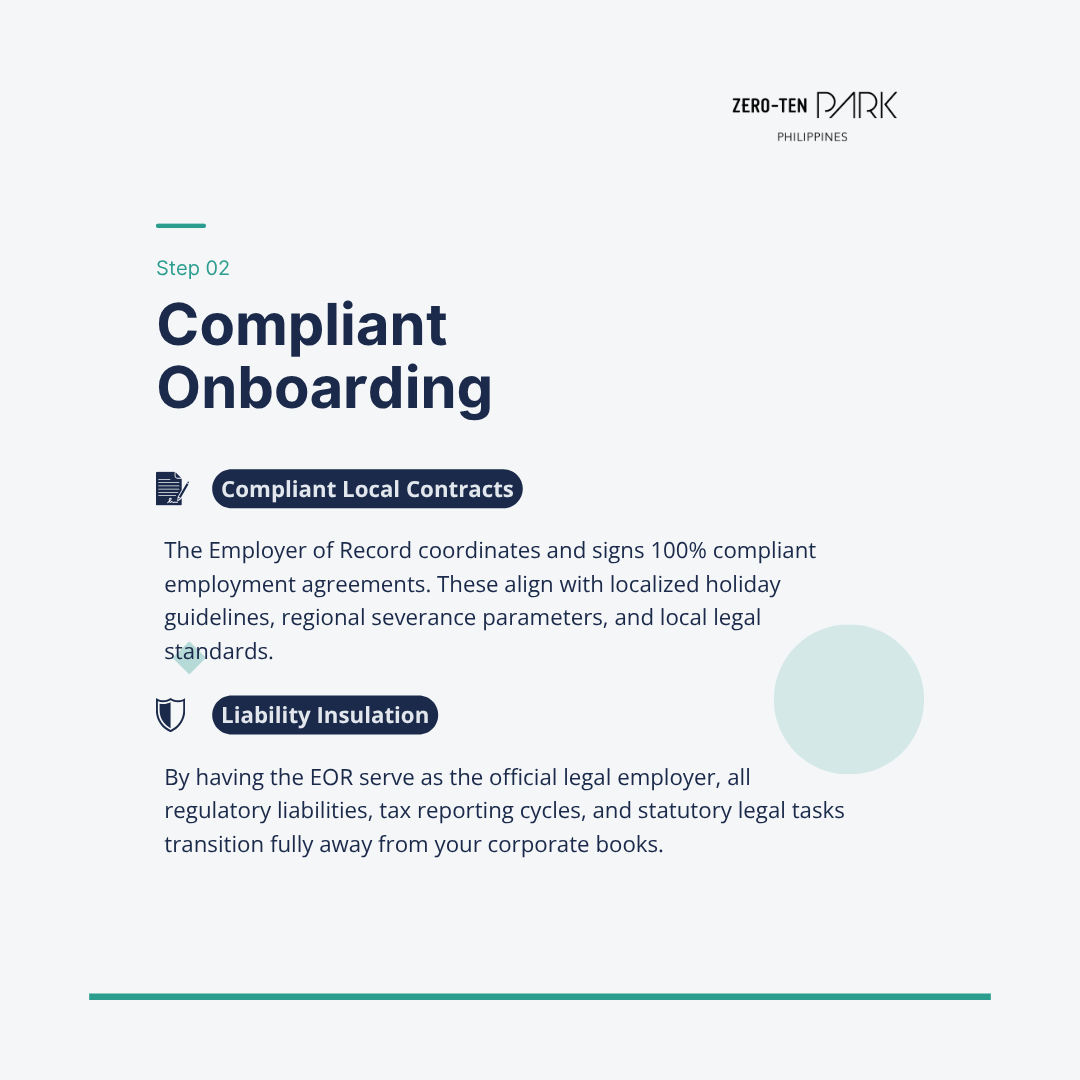
Once you select your ideal candidate and agree on verbal offer terms, the complex legal transition begins. Because your US corporate entity is not registered with the Philippine Securities and Exchange Commission (SEC), you cannot legally execute a domestic employment contract. This is where the Employer of Record officially steps in as the legal employer of record.
The Employer Of Record legal team translates your agreed-upon offer details into a highly robust, multi-layered employment agreement that perfectly conforms to the strict regulations of the Philippine Labor Code. This localized contract explicitly defines:
-
Detailed Scope of Work: Aligning operational roles with local labor classifications to prevent future duties-mapping disputes.
-
Comprehensive Compensation Breakdown: Separating basic salary from non-taxable allowances, night shift premiums, and performance incentives.
-
Strict Intellectual Property (IP) and Data Security Clauses: Ensuring that all code written, designs created, and data processed by the Filipino worker are legally and seamlessly transferred directly to your US entity, complying with both US proprietary standards and the Philippine Data Privacy Act of 2012.
By placing the worker onto the Employer Of Record’s locally compliant, fully insured payroll entity, your US business establishes a total liability shield against wrongful termination suits, local labor audits, and direct corporate exposure.
3. Localized Payroll, Complex Computations, and Statutory Compliance
Processing payroll in the Philippines is notoriously intricate, driven by an employee-centric regulatory landscape that demands flawless precision. Missing a statutory deadline or miscalculating a premium can trigger immediate investigations by the Department of Labor and Employment (DOLE).
When you scale a remote team, your Employer of Record takes over the daily operational burden of navigating these complex payroll variables:
-
Prorated 13th-Month Pay Accruals: Automatically calculating and accruing the mandatory legal bonus throughout the year to guarantee transparent cash flow tracking.
-
De Minimis Benefits and Tax-Exempt Allowances: Structuring compliant, tax-optimized allowance packages (such as meal, clothing, and medical allowances) that maximize your employee’s take-home pay while legally minimizing tax burdens.
-
Night Shift Differential & Holiday Premiums: Tracking and applying the mandatory 10% premium for hours worked between 10:00 PM and 6:00 AM, alongside calculating 100% to 200% wage premiums for work conducted during regular or special Philippine national holidays.
Furthermore, the Employer Of Record acts as the direct fiduciary agent responsible for calculating, withholding, and manually or digitally remitting monthly contributions to the three mandatory pillars of Philippine social infrastructure:
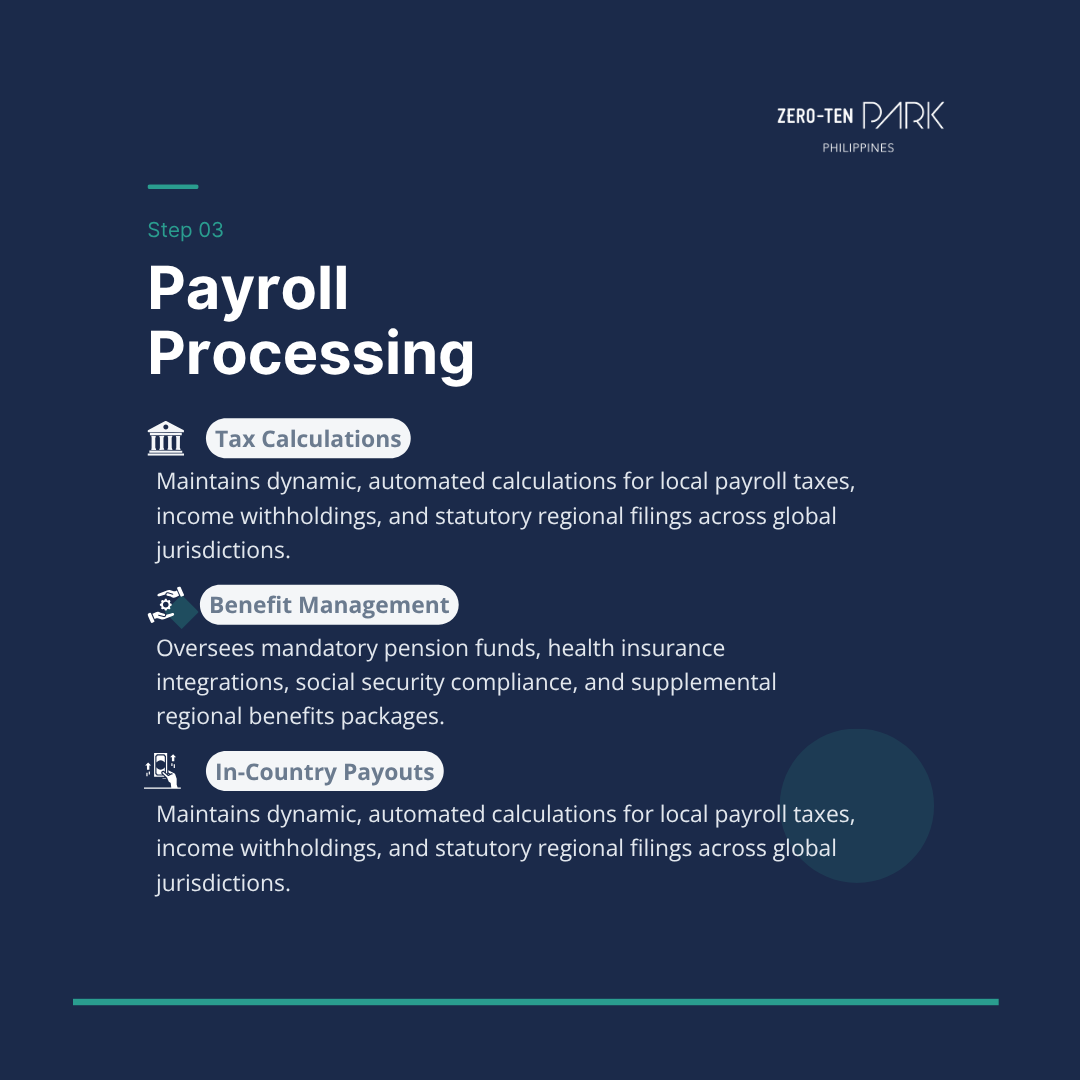
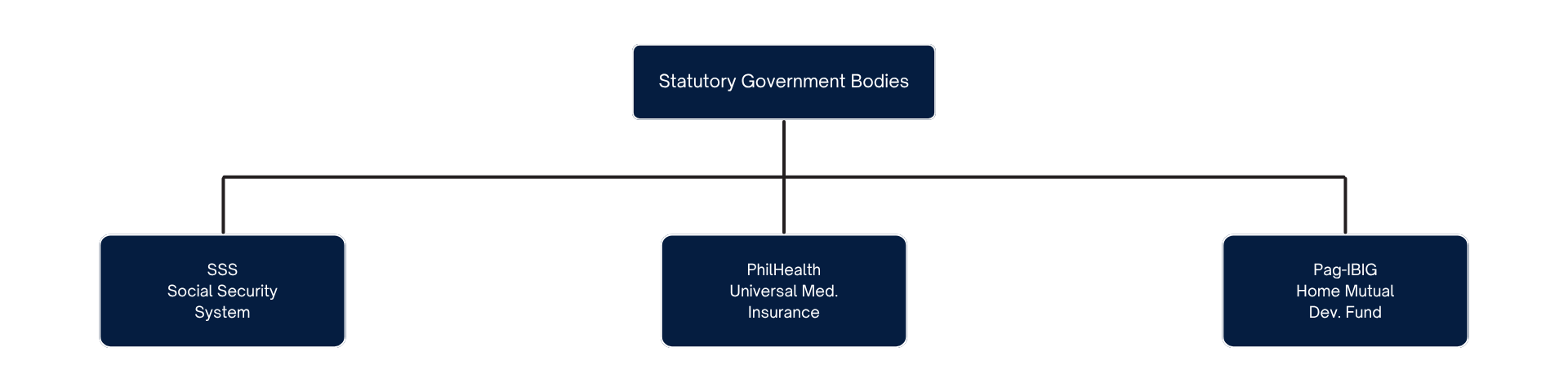
The Employer Of Record handles the burden of managing these distinct government portals, generating employee tax certificates (BIR Form 2316), and processing annualized tax computations, ensuring your team remains in perfect standing with the Bureau of Internal Revenue (BIR).
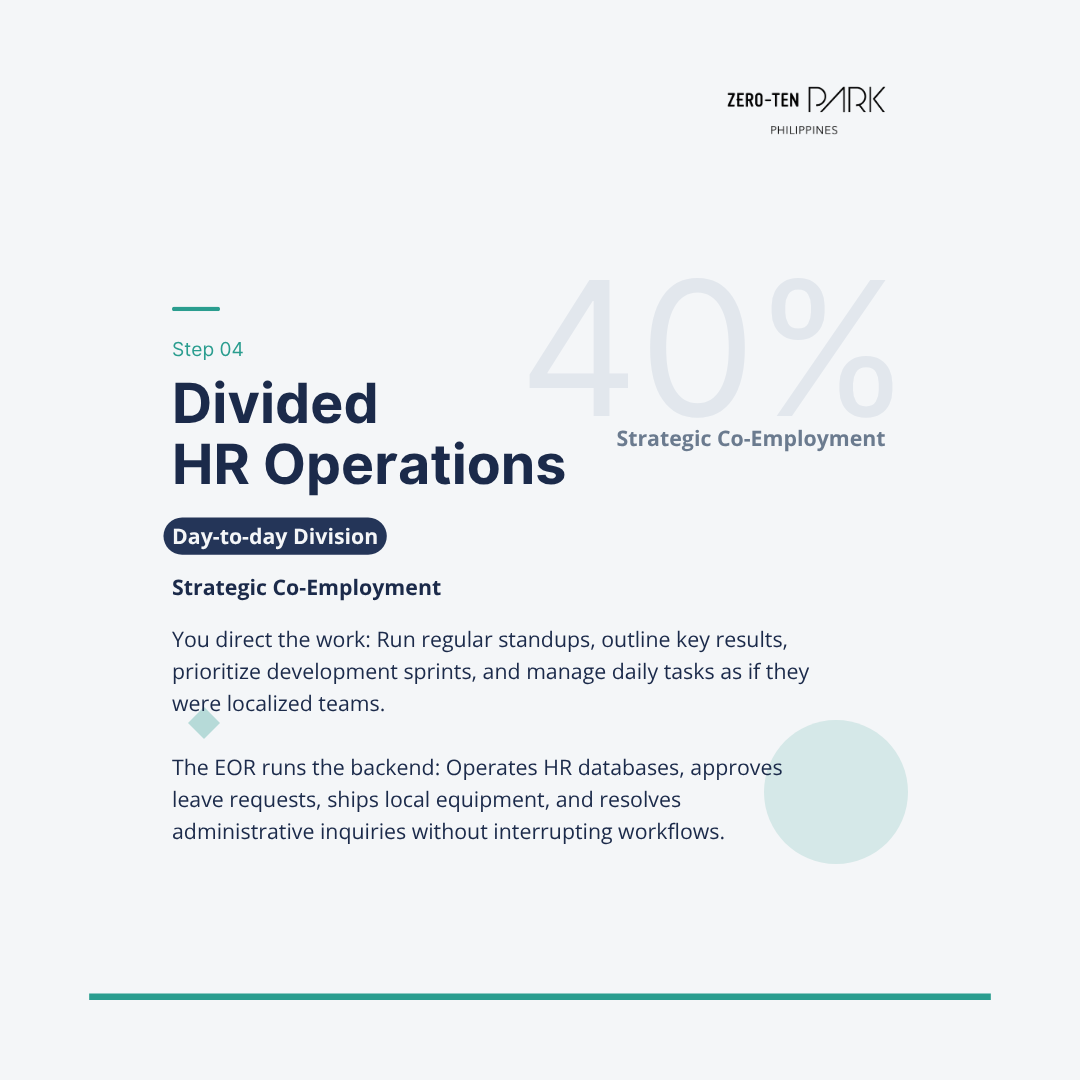
4. Direct Operational Management and Culture Integration
A common misconception is that utilizing a third-party employer distances you from your staff. In reality, the Employer Of Record acts strictly as an invisible administrative backend. Day-to-day, functionally and culturally, the worker belongs entirely to you.
Your US management team retains absolute control over the core operational experience:
-
Direct Workflow Governance: You onboard the employee directly into your day-to-day tech stack (Slack, Jira, Asana, GitHub, or Microsoft Teams). You assign tasks, dictate sprint cycles, and establish key performance indicators (KPIs).
-
Hardware and Asset Management: You decide what equipment your team requires. The Employer Of Record can facilitate the local procurement, imaging, deployment, and tracking of high-end corporate laptops, monitors, and security peripherals, ensuring your remote team is fully operational from day one.
-
Performance Reviews and Career Trajectories: You conduct regular 1-on-1s, drive professional development goals, award internal promotions, and manage performance benchmarks. The worker experiences the exact corporate culture, mission, and vision that you purposefully cultivate.
5. Streamlined Financial Logistics and Consolidated Monthly Invoicing
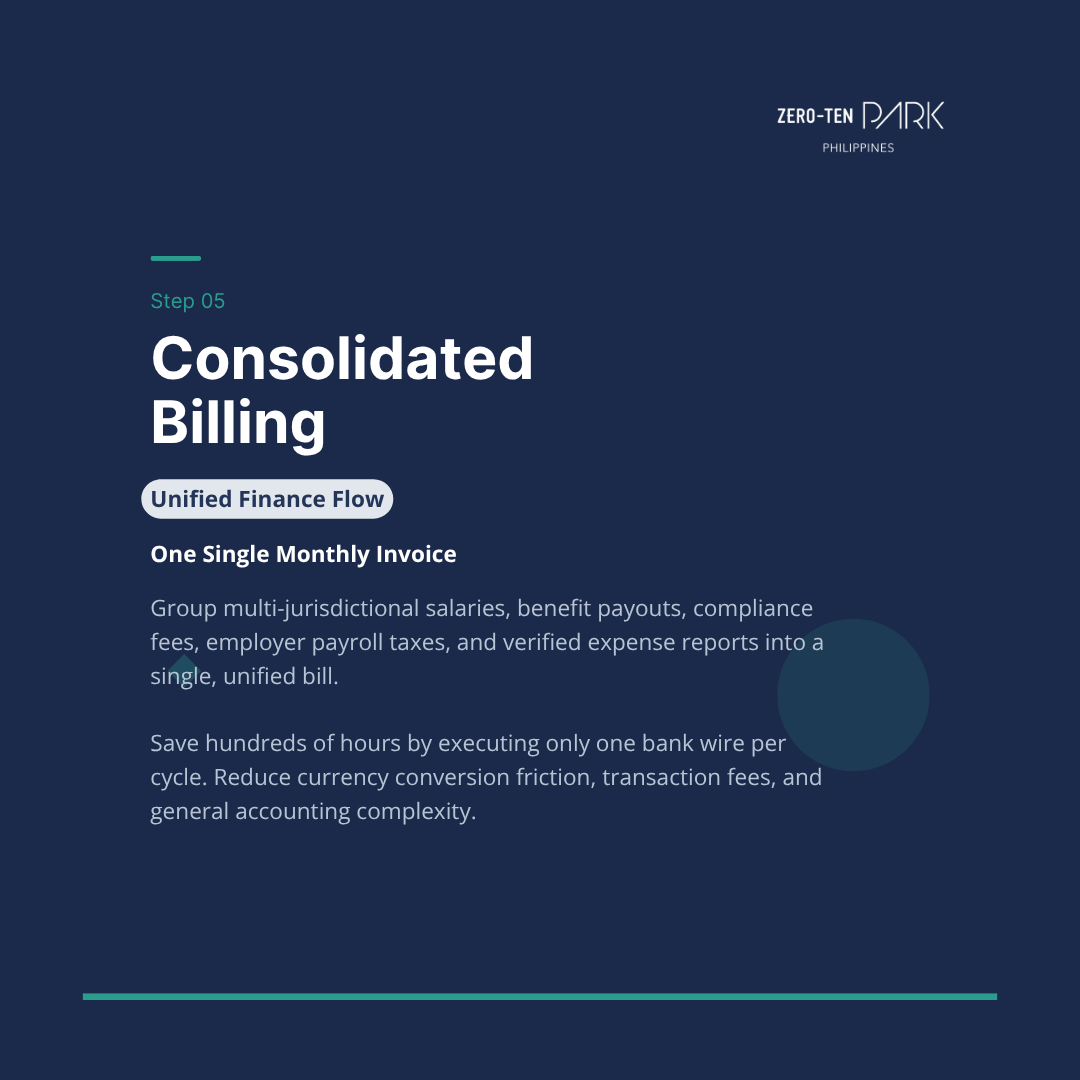
Managing international B2B wires, tracking fluctuating foreign exchange (FX) volatility between the US Dollar (USD) and the Philippine Peso (PHP), and reconciling dozens of individual invoices is a massive time sink for any finance department. The Employer Of Record model reduces this friction down to a simple, predictable B2B transaction.
At the close of every payroll cycle, the Employer of Record generates a single, completely transparent consolidated invoice denominated in USD. This master invoice clearly unbundles all employment costs:
-
Direct gross employee salaries and approved bonuses.
-
Total calculated employer-side statutory contributions (SSS, PhilHealth, Pag-IBIG).
-
Localized supplementary benefits (such as private HMO insurance extensions).
-
A transparent, flat per-employee monthly Employer Of Record management fee.
Your finance team settles this single invoice via a standard domestic ACH or international bank transfer. The Employer Of Record then handles the cross-border treasury management, shields your business from volatile currency market swings, converts the capital into PHP, and guarantees that your distributed team members are paid on time, every time, directly into their local bank accounts.
EOR vs. Setting Up a Local Entity in the Philippines
Many expanding US enterprises wonder whether they should use an Employer of Record or go through the process of establishing their own domestic subsidiary (such as a Domestic Corporation or a Branch Office registered with the Philippine Securities and Exchange Commission).
While incorporating locally yields ultimate control for massive multinational operations, it introduces severe administrative drag and overhead for small-to-medium businesses and rapidly scaling tech startups.
For the vast majority of US businesses entering the Philippine market or scaling up a remote engineering or back-office hub, an Employer of Record represents the faster, more secure, and highly flexible choice.
| Operational Dimension | Using an Employer of Record (EOR) | Establishing a Local SEC Entity |
| Time to Market | Days to weeks | 3 to 6+ months |
| Upfront Capital Expenditure | Minimal setup fees | $10,000 to $50,000+ in capitalization |
| Compliance & Legal Risk | Fully absorbed by the EOR partner | Fully borne by your US corporate board |
| HR & Accounting Overhead | Zero internal overhead required | Requires localized HR, legal, and CPA teams |
| Scalability & Offboarding | Extremely agile; scale up or down quickly | Highly restricted by strict local retrenchment laws |
| Ideal Team Size Scope | Best suited for teams of 1 to 50+ remote workers | Optimized for large operations with 100+ seats |
Key Philippine Labor Laws Every US Executive Must Understand
The regulatory framework governing employment in the Philippines is heavily employee-centric. Unlike the “at-will” employment doctrine standard across most US states, the Philippines fiercely protects workers’ rights. Failing to adhere to these rules can expose your company to devastating legal disputes before the National Labor Relations Commission (NLRC).
When you utilize an experienced Employer of Record, they insulate you from these compliance risks. However, maintaining strategic visibility into these five pillar regulations is essential for every US leader:
1. The Mandatory 13th-Month Pay
Under Philippine Presidential Decree No. 851, all rank-and-file employees are legally entitled to receive “13th-month pay.” This is not a performance-based Christmas bonus; it is a statutory compensation requirement. The benefit must be equivalent to one-twelfth ($1/12$) of the total basic salary earned by an employee within a calendar year. By law, this must be paid out to employees no later than December 24th of each year. Your Employer of Record will automatically calculate, accrue, and distribute this payment to prevent year-end cash flow surprises.
2. Strict Just Cause and Authorized Cause Dismissals
Terminating an employee in the Philippines requires strict adherence to substantive and procedural due process. You cannot dismiss an individual simply because of a general “culture mismatch” or an unproven dip in performance. Termination is legally restricted to two categories:
-
Just Causes: Gross and habitual neglect of duties, serious misconduct, fraud, or commission of a crime against the employer. This requires a rigorous “two-notice rule” and a formal administrative hearing.
-
Authorized Causes: Business-related down-turns such as retrenchment to prevent losses, closure of operations, or redundancy. These actions require mandatory severance pay and a 30-day prior notice filed with the Department of Labor and Employment (DOLE).
Partnering with an EOR guarantees that if a performance issue arises, seasoned local HR professionals will guide the documentation and disciplinary process to keep your company fully compliant.
3. Night Differential and Overtime Structures
Because many Filipino professionals work hours that align with US time zones, companies must account for the Night Shift Differential. According to the Labor Code, any work performed between 10:00 PM and 6:00 AM mandates an additional premium of at least 10% of the employee’s regular hourly rate. Furthermore, standard overtime work (exceeding 8 hours a day) requires an additional premium of 25% to 30% depending on whether the overtime falls on a regular work day, a rest day, or a national holiday.
4. Statutory Leave Mandates (Service Incentive Leave)
An employee who has rendered at least one year of service is legally entitled to a yearly Service Incentive Leave (SIL) of five days with pay. While five days may seem minimal compared to US corporate standards, competitive market forces in the Philippines dictate that premium employers provide 15 to 20 days of combined Paid Time Off (PTO) alongside comprehensive private health insurance (HMO) extensions to attract top-tier talent.
5. The Six-Month Probationary Guardrail
The law allows employers to place new hires on a probationary period lasting up to a maximum of six months. During this window, the standard for termination is lowered to a failure to meet the reasonable performance standards made known to the employee at the time of engagement. If a worker continues their employment past the six-month mark, they automatically achieve regular employment status, securing robust security of tenure protection.
Critical US-Specific Legal and Tax Risks When Hiring Remotely
When American businesses look across the Pacific to build a remote workforce, they must navigate not only foreign labor codes but also strict cross-border tax regulations mandated by the Internal Revenue Service (IRS) and international treaties.
The IRS Worker Misclassification Trap
Critical Risk Warning: One of the most systemic compliance failures committed by US executives is hiring long-term Filipino professionals as “independent contractors” using standard US W-8BEN forms when the reality of the working arrangement mirrors a traditional employer-employee relationship.
Both the IRS and the US Department of Labor utilize stringent regulatory frameworks—such as the updated Economic Reality Test—to assess worker classification. If your organization sets fixed working hours, mandates exclusivity, provisions company hardware, dictates operational methodologies, and integrates the worker directly into core business operations, that worker is legally classified as an employee, not an independent contractor.
If the IRS or the Philippine Bureau of Internal Revenue (BIR) uncovers a misclassified relationship, your US entity faces severe exposure:
-
US Penalties: Mandated back-payments for Federal Insurance Contributions Act (FICA) taxes, unpaid Federal Unemployment Tax Act (FUTA) liabilities, and substantial failure-to-file penalties.
-
Philippine Regulatory Backlash: The worker can file a claim with DOLE for unpaid statutory benefits, retroactive 13th-month pay, and immediate regularization status, creating an expensive legal crisis.
Utilizing an Employer of Record entirely eliminates this structural misclassification risk by establishing a clean, explicit, and legally recognized employment relationship from day one.
Unpacking the US-Philippines Tax Treaty (1982)
The United States and the Republic of the Philippines executed a comprehensive bilateral tax treaty in 1982 designed to eliminate double taxation risks for individuals and corporations operating across both jurisdictions. However, a common misconception among US CFOs is that this treaty automatically exempts them from international tax exposure.
When a professional performs services within the geographic boundaries of the Philippines, their compensation is classified as Philippine-sourced income. Under the rules of the Bureau of Internal Revenue (BIR), this income is subject to local progressive income withholding taxes. It is completely irrelevant whether the funds originate from a US bank account or are denominated in USD.
A localized Employer of Record acts as your local tax agent, ensuring that every peso of withholding tax is accurately deducted, recorded, and filed with the BIR, insulating your US corporate entity from creating an unintended “Permanent Establishment” (taxable corporate presence) overseas.
The Illusion of the W-8BEN Form
Many US human resource departments collect a Form W-8BEN (Certificate of Foreign Status of Beneficial Owner for United States Tax Withholding and Reporting) from international hires and assume their compliance obligations are fully resolved.
It is vital to understand what the W-8BEN actually does—and what it absolutely fails to protect against:
-
What it does: It certifies to the IRS that the individual is a foreign person residing outside the United States, thereby exempting the US company from withholding 30% US federal income tax on payments made to them.
-
What it does NOT do: It does not magically grant immunity against worker misclassification audits. It does not absolve your business from adhering to the mandatory employment protections, severance rules, and benefit allocations dictated by the Philippine government.
If the underlying operational reality of their day-to-day work contradicts their contractor status, a signed W-8BEN will not serve as a viable defense during an audit. Partnering with an Employer of Record replaces this regulatory ambiguity with bulletproof local infrastructure.
What to Look for in a Philippine EOR Partner
As global hiring continues to surge, a multitude of digital-only platforms have entered the global payroll space. However, many of these providers operate merely as software aggregators rather than true local entities. When evaluating a potential Employer of Record in the Philippines, demand the following operational baselines:
1. An Owned Local Entity Footprint
Many global Employer Of Record brands act as middlemen, secretly white-labeling their services to smaller, local subcontractors within the Philippines. This multi-layered chain introduces communication delays, increases transaction fees, and splits accountability when urgent HR issues or compliance disputes arise. Always partner with an Employer Of Record that owns and operates its dedicated, licensed legal entity within the Philippines.
2. Transparent Pricing Architecture
Ensure your partner provides a clear, fully unbundled pricing model. Some EORs embed hidden margins into foreign exchange conversion rates or apply unlisted processing surcharges on top of statutory benefit payouts. Your monthly invoice should clearly differentiate between direct employee gross salary, mandatory government contributions, and a transparent, flat per-employee monthly management fee.
3. Integrated Physical Infrastructure and Value-Add Services
While remote work is highly efficient, top-tier talent in the Philippines frequently seeks out employers who can offer hybrid workspace alternatives. A premier Employer of Record goes beyond digital payroll administration by providing access to physical enterprise infrastructure—including premium coworking networks, private team rooms, high-speed backup internet arrays, and enterprise-grade cybersecurity controls.
Why The Company is Your Strategic EOR Partner in the Philippines
At Zero-Ten Park, we do not view global employment through the narrow lens of a detached software dashboard. We have spent years building a robust, on-the-ground infrastructure inside the Philippines tailored specifically to meet the high operational standards of scaling US enterprises.
We act as your dedicated human resources partner, blending automated payroll efficiency with deeply localized compliance expertise. Our comprehensive Employer of Record solution includes:
- Hyper-Localized Contract Engineering: Custom-tailored employment contracts designed for specialized roles, ensuring complete compliance with the Philippine Labor Code while fiercely protecting your intellectual property (IP) and data confidentiality rights.
- Flawless Payroll & Statutory Execution: End-to-end processing of monthly payroll, complex night differential formulas, holiday premiums, and seamless, on-time monthly remittances to SSS, PhilHealth, Pag-IBIG, and the BIR.
- Proactive HR Advisory and Employee Relations: Access to an experienced on-the-ground HR advisory team equipped to handle employee relations, onboarding milestones, performance management support, and compliant offboarding strategies if necessary.
- Premium Hybrid Workspace Integration: An exclusive opportunity to provision your remote Filipino team members with dedicated desks or flexible passes across our network of modern, premium coworking spaces strategically located throughout major Philippine business hubs. This asset dramatically boosts employee retention, safeguards operational uptime against local power or internet disruptions, and fosters an elite corporate culture.
Ready to Secure Top-Tier Philippine Talent Compliantly?