Labor Day 2026 Reflection: Why Team Satisfaction Breaks Before Your Budget in IT Park

The sun sets over Cebu IT Park, casting long shadows across the glass facades of its iconic towers. Down on the ground, the night shift is just waking up. Starbucks, The Pyramid, and the various food parks are bustling with call center agents, software engineers, and data analysts grabbing their pre-shift caffeine fix.
To the casual observer, it’s a picture of a booming, vibrant tech hub. But if you walk into the boardrooms and look at the spreadsheets of many IT-BPO companies operating here, a quieter, more stressful story is unfolding. As we pause to look at the landscape during this Labor Day 2026 reflection, a glaring reality faces leadership: Team satisfaction will completely break long before your financial budget does. In the hyper-competitive ecosystem of Cebu’s premier tech hub, many companies manage their talent using the exact same metrics they use to manage their server bandwidth or office real estate. They look at human capital as a resource to be optimized, squeezed, and budgeted.
But people aren’t servers. When a server is overloaded, it throws an error code or crashes, and you reboot it. When a team is overloaded, they don’t just crash—they quiet quit, they burn out, and eventually, they walk across the street to a competitor who is offering a 5,000 PHP signing bonus and free meals. To truly understand this dynamic, we must look deeper into how modern workplace psychology interacts with corporate finance. When team satisfaction is ignored in favor of rigid fiscal line items, organizations suffer invisible financial bleeds that no spreadsheet can easily track.
Let’s pull back the curtain on why traditional budgeting fails the human element in IT Park, and how forward-thinking leaders can build sustainable, high-performing teams without breaking the bank. As companies continue growing inside Cebu’s premier business district, employee satisfaction in IT Park Cebu has become one of the most important indicators of long-term business performance.
1. The IT Park Paradox: Abundance of Opportunity, Scarcity of Loyalty
Cebu IT Park is a beautiful, dense anomaly. Nowhere else in the region will you find such a high concentration of global tech firms, multinational BPOs, and nimble startups packed into a walkable 24-hectare zone. This density creates a psychological phenomenon unique to IT Park workers: The Paradox of Visualized Opportunity.
When an employee sits at their desk in Skyrise 4, looking out the window at a competitor’s logo on the Waterfront or Central Bloc towers, they are constantly reminded that other options exist. They eat at the same food markets, ride the same beep buses, and share drinks at the same local bars with peers from rival companies. Information flows incredibly fast in IT Park. If Company A cuts back on their pantry snacks or enforces a rigid, unnecessary return-to-office (RTO) policy to save a few thousand pesos, the entire talent pool knows about it by lunchtime. This instant transparency directly impacts localized talent retention.
The True Cost of High Attrition
Many finance directors view a 20–30% annual attrition rate as “just the cost of doing business in the BPO sector.” This is a massive, budgeted mistake. They account for the visible costs—recruitment marketing, onboarding training, and background checks—but completely miss the invisible costs:
-
The Drag on Velocity: Every time a senior developer leaves, the remaining team has to absorb the workload, slowing down sprint velocity.
-
The Morale Tax: When popular team members resign, it triggers a psychological domino effect, prompting others to update their LinkedIn profiles.
-
Client Friction: Global clients notice when the faces on their weekly Zoom updates change every three months. It erodes trust and threatens contract renewals.
When you budget strictly for headcount replacement rather than team retention, you are essentially trying to fill a leaking bucket by turning up the faucet. Eventually, the water bill catches up to you.
2. The Broken Math of "Transactional Compensation"
“We pay market competitive rates. Why are they still leaving?”
This is the standard refrain from frustrated HR executives. The problem lies in treating compensation as a purely transactional equation. In a high-inflation economy where the cost of living in Cebu City continues to climb, a competitive salary is no longer a differentiator; it is simply the baseline entry fee. When you treat your relationship with your team as purely financial, you invite them to do the same. If the only reason an employee works for you is the specific number on their payslip, they will leave the second someone else offers a fraction more. True team satisfaction requires an ecosystem built on respect, psychological safety, and growth—not just a monthly direct deposit.
Where Budgets Blindside Leadership
Consider a common scenario played out in IT Park conference rooms:
The Scenario: A high-performing software engineer earning 60,000 PHP asks for a 15% merit increase (9,000 PHP/month) based on their stellar performance and expanded responsibilities.
The Budget Response: Management declines, citing strict fiscal guardrails and a 5% cap on mid-year adjustments.
The Consequence: The engineer resigns two weeks later. The company spends 45 days looking for a replacement, pays a headhunter fee, and ultimately has to hire an external candidate at the current market rate of 75,000 PHP to fill the urgent gap—not to mention the three months it takes to get them fully up to speed.
By strictly adhering to a rigid budget line item, the company saved 9,000 PHP a month in the short term, only to lose hundreds of thousands in productivity, recruitment, and higher market-rate salaries. The budget won the battle, but the business lost the war because team satisfaction was treated as an afterthought.
3. The Cultural Toll of the 24/7 Grind
The lights never go out in IT Park. Because of the nature of global shifting schedules, thousands of professionals live their lives upside down, working night shifts to align with US, European, or Australian time zones. This nocturnal lifestyle comes with a hidden tax on mental and physical well-being. Sleep deprivation, social isolation, and metabolic stress are real challenges faced by the local workforce. According to research on organizational health published by the Harvard Business Review, prolonged misalignment between work demands and personal well-being dramatically spikes employee turnover. When an organization adds a toxic, high-pressure management culture on top of an already stressful shift schedule, the breaking point arrives incredibly fast.
The Illusion of Productivity Metrics
Many IT Park managers rely heavily on tracking software and strict key performance indicators (KPIs) to monitor remote or hybrid teams. They measure keyboard strokes, mouse clicks, and exact log-in seconds. While this looks great on an operations dashboard, it completely destroys baseline team satisfaction. When employees feel policed rather than trusted, their intrinsic motivation vanishes. They stop looking for creative solutions to engineering problems and start doing the bare minimum required to satisfy the tracking tool.
When team satisfaction breaks due to over-monitoring and micro-management, the budget doesn’t immediately show it. The numbers look fine—until suddenly, the team’s output quality plummets, client escalations skyrocket, and key players submit their resignations simultaneously.
4. The Hidden Drain of Attrition on Local Operations
When analyzing operational expenses, internal auditing systems often categorize human resources into predictable buckets: recruitment, training, payroll, and benefits. However, traditional financial modeling struggles to quantify the domino effect of low team satisfaction. When an experienced worker leaves an IT Park firm, they take more than just their individual labor power; they take systemic institutional knowledge.
This cycle shows that systemic financial losses manifest downstream when top performers leave. The loss of institutional knowledge forces remaining employees to work longer hours, leading to errors, client dissatisfaction, and an overall reduction in delivery standards. To gain deeper context on managing attrition in the local ecosystem, leaders can refer to our internal guide on 6 Essential Considerations for Startups When Building a Remote Team in the Philippines.
5. Bridging the Gap: Micro-Incentives vs. Macro-Budgets
To protect team satisfaction without inflating operational budgets, organizations must shift from macro-scale corporate spending to strategic micro-incentives. Large capital allocations for office redesigns or flashy corporate events often fail to move the needle on daily morale. Instead, targeted investments in employee well-being yield much higher returns.
Consider how small adjustments can address localized pain points for professionals in Cebu City:
-
Subsidized Safe Transportation: Providing reliable shuttle points during hazardous weather or late-night shift handovers.
-
Flexible Wellness Allocations: Replacing static gym memberships with versatile health allowances that cover mental health counseling or prescription eyewear.
-
On-Demand Continuous Learning: Offering access to self-paced technical courses, allowing engineers to upskill without disrupting their billable project hours.
By reallocating just a small percentage of traditional marketing budgets toward these high-impact culture drivers, companies can experience a significant lift in measured team satisfaction. This demonstrates that retaining top tech talent depends more on empathy and cultural agility than raw spending power.
6. Rebuilding the Foundation: Strategies That Don't Require a Fortune
Fixing team satisfaction in IT Park isn’t about throwing millions at the problem or installing foosball tables and sleeping pods that nobody actually uses. It requires a fundamental shift from viewing employees as an expense to viewing them as an investment. Here are high-impact, budget-friendly strategies that directly address the core drivers of workplace satisfaction:
A. Autonomy and True Hybrid Flexibility
The daily commute to IT Park can be a logistical nightmare. Traffic bottlenecks along Governor Cuenco Avenue and Salinas Drive eat up hours of an employee’s day before they even log in. If your roles can be done effectively from home, forcing a rigid 5-day-a-office schedule purely for “oversight” is a quick way to lose your best people.
-
The Fix: Implement a trust-first hybrid model. Allow teams to anchor their office days around collaboration, workshops, and team-building, while giving them the autonomy to do deep, focused work from home.
B. Transparent and Clear Growth Pathways
Employees rarely leave companies where they can clearly see their next promotion, skill upgrade, and salary bump. Too often, career progression in BPOs is vague and depends heavily on office politics.
-
The Fix: Build transparent competency matrices. Let a Junior QA Specialist know exactly what technical skills, certifications, and leadership milestones they need to hit to reach the Senior tier. When people feel they are investing in their own futures by staying, they become resilient to external poaching.
C. Radical Empathy in Leadership
The culture of an organization is set by its middle management. In the local tech scene, brilliant technical individual contributors are frequently promoted to team leads without receiving any formal people management training. They manage through authority rather than empathy, driving turnover.
-
The Fix: Invest heavily in soft-skills training for your team leads, managers, and directors. Teach them how to conduct effective one-on-ones, how to spot the early warning signs of burnout, and how to deliver constructive feedback that motivates rather than demoralizes.
Traditional Budget-First Focus
Minimizing cost per seat
Rigid, policy-driven rules
Surveillance-based tracking
Reactive counter-offers
Modern People-First Focus
Maximizing lifetime value per employee
Flexible, outcome-oriented guidelines
Trust-and-accountability metrics
Proactive career development
7. The Long-Term ROI of Prioritizing the Human Element
When companies look back at their yearly performance, the correlation between human sentiment and operational stability becomes undeniable. Organizations that protect team satisfaction systematically outperform their competitors across all major operational metrics.
Investing in people helps build a highly stable business. When employees feel secure, supported, and appropriately compensated, they focus their energy on delivering excellent work. The cost of maintaining a healthy culture is always lower than the compounding financial damage of constant turnover. For more insights on optimizing operations without sacrificing company culture, explore our companion analysis on How Philippine BPO Companies Are Redefining Growth and Innovation in a Dynamic Business Landscape.
The Problem Most Companies Notice Too Late
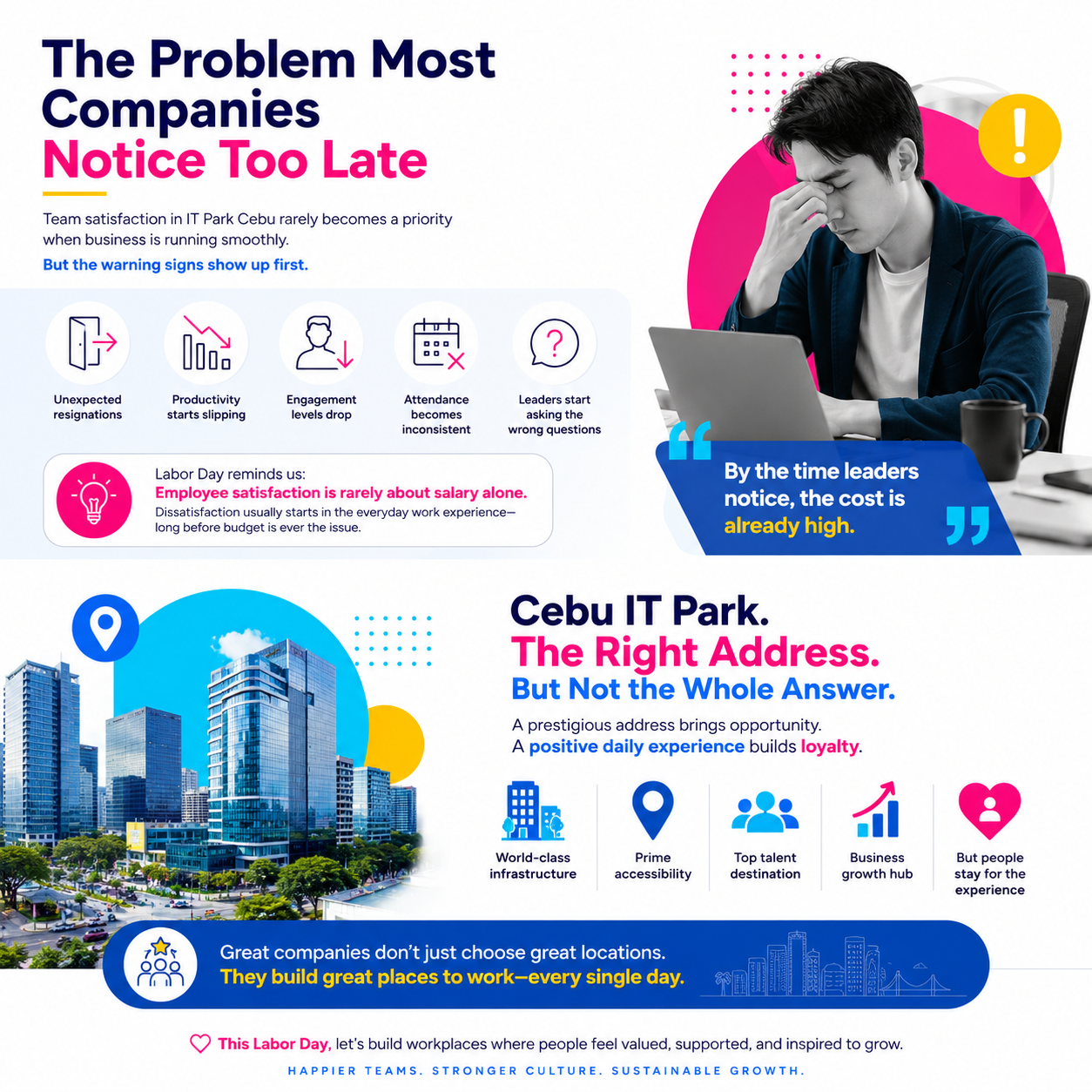
Team satisfaction in IT Park Cebu rarely becomes a priority when business is running smoothly. Most leaders only start paying attention when warning signs begin appearing across the organization. An employee unexpectedly resigns. Productivity starts slipping. Engagement levels drop. Attendance becomes inconsistent. Suddenly, management begins asking difficult questions about compensation, benefits, and retention. But Labor Day serves as a timely reminder that employee satisfaction is rarely determined by salary alone. While compensation matters, many businesses discover that dissatisfaction begins long before budget concerns ever arise. More often than not, the issue is rooted in the daily work experience itself.
For years, Cebu IT Park has been the preferred destination for startups, BPOs, remote teams, and multinational companies. The location offers strong infrastructure, accessibility, and a reputation as one of the country’s leading business districts. Moving into IT Park often feels like a milestone for growing companies. It signals credibility, growth, and long-term ambition. Yet as workplace expectations continue evolving, businesses are learning an important lesson. A prestigious office address does not automatically create a positive employee experience. Employees may appreciate the location, but if the day-to-day work environment creates friction, satisfaction begins to decline long before leadership notices the effects on the bottom line.
Why Team Satisfaction Matters More Than Ever in 2026
The workplace has changed dramatically over the past several years. Employees today evaluate their work environment very differently than previous generations did. In the past, an office was simply where work happened. Employees came in, completed their responsibilities, and went home. The conversation around employee satisfaction in IT Park Cebu has evolved significantly over the past few years.
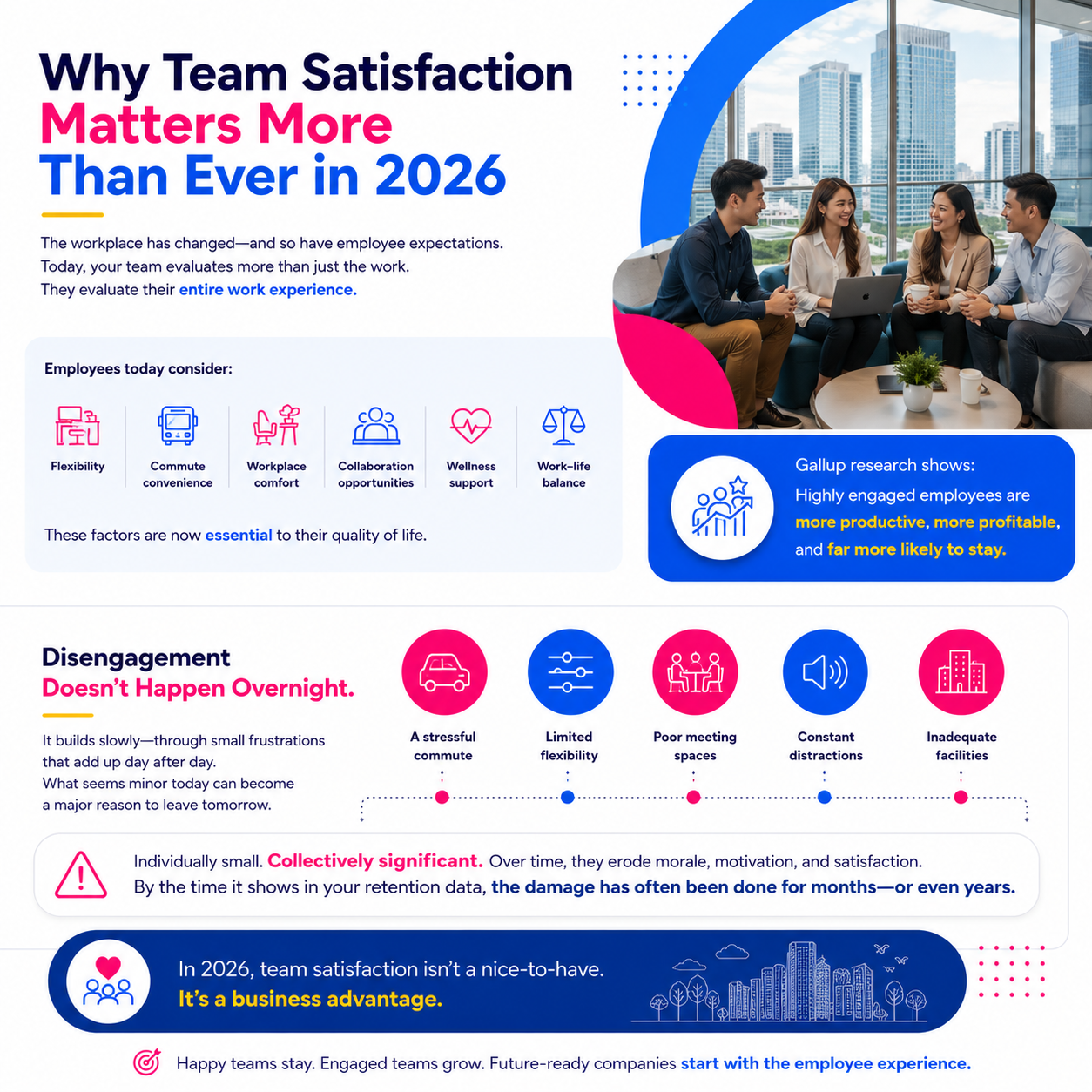
Today, employees view the workplace as part of their overall quality of life. They assess factors such as flexibility, commute convenience, workplace comfort, collaboration opportunities, wellness support, and work-life balance. These considerations have become increasingly important as hybrid work, remote work, and flexible work arrangements continue reshaping professional expectations.
Research from Gallup consistently shows that highly engaged employees are more productive, more profitable, and significantly more likely to stay with their organizations. The challenge for employers is that disengagement rarely arrives all at once. Instead, it develops gradually through small frustrations that accumulate over time. A stressful commute. Limited flexibility. Poor meeting spaces. Constant distractions. Inadequate facilities. Each issue may seem minor on its own. But when experienced every day, they slowly erode morale, motivation, and satisfaction. By the time these problems appear in retention metrics, they have often existed beneath the surface for months or even years.
The Hidden Cost of Workplace Friction
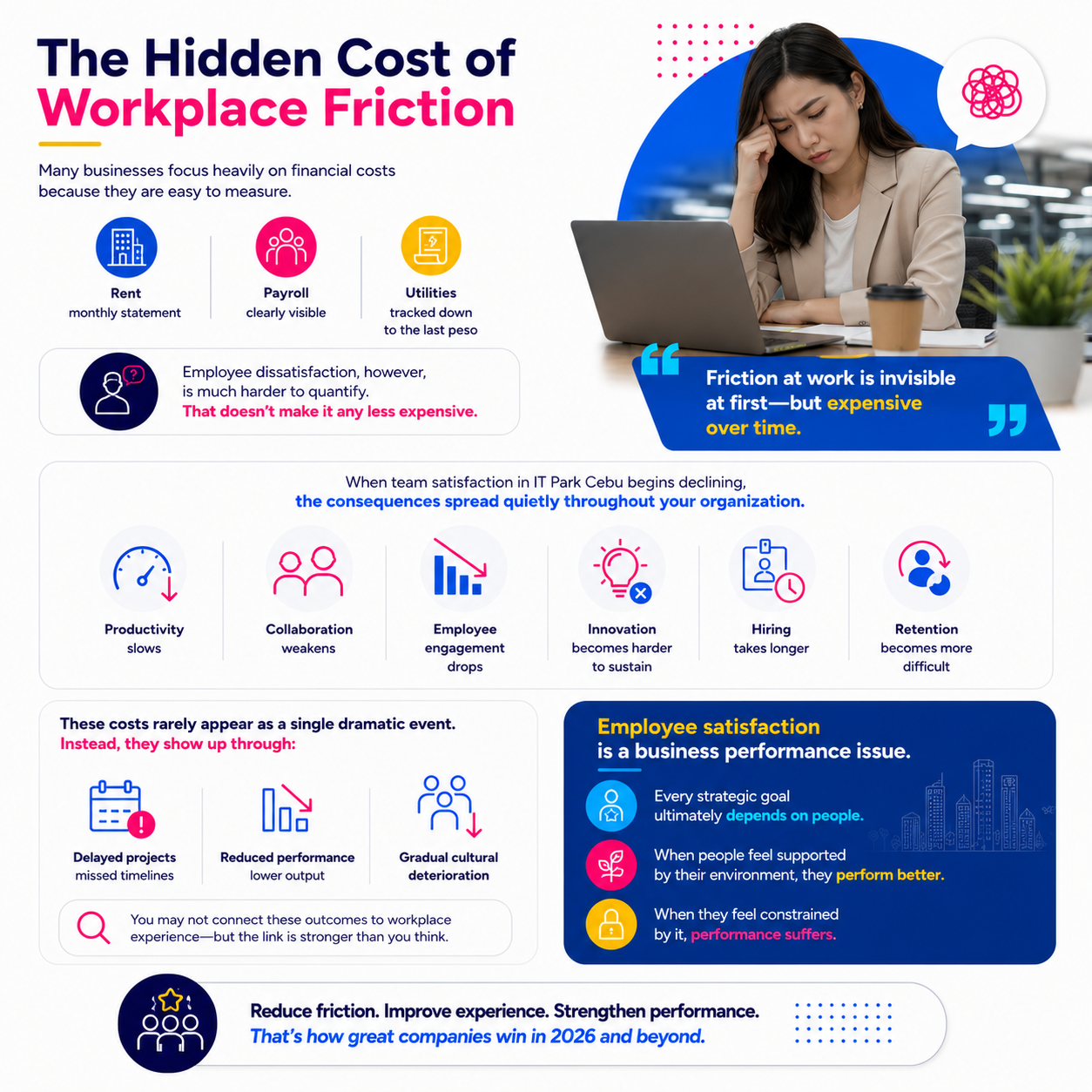
Many businesses focus heavily on financial costs because they are easy to measure. Rent appears on a monthly statement. Payroll expenses are clearly visible. Utilities can be tracked down to the last peso. Employee dissatisfaction, however, is much harder to quantify.
That doesn’t make it any less expensive.
When team satisfaction in IT Park Cebu begins declining, the consequences spread quietly throughout an organization. Productivity slows. Collaboration weakens. Employee engagement drops. Innovation becomes harder to sustain. Hiring takes longer. Retention becomes more difficult.
These costs rarely appear as a single dramatic event. Instead, they show up through delayed projects, reduced performance, and gradual cultural deterioration. A company may not immediately connect these outcomes to workplace experience, but the relationship is often stronger than leaders realize.
The most successful organizations understand that employee satisfaction is not simply an HR concern. It is a business performance issue. Every strategic goal ultimately depends on people. When people feel supported by their environment, they perform better. When they feel constrained by it, performance suffers.
The Commute Factor Few Companies Fully Consider
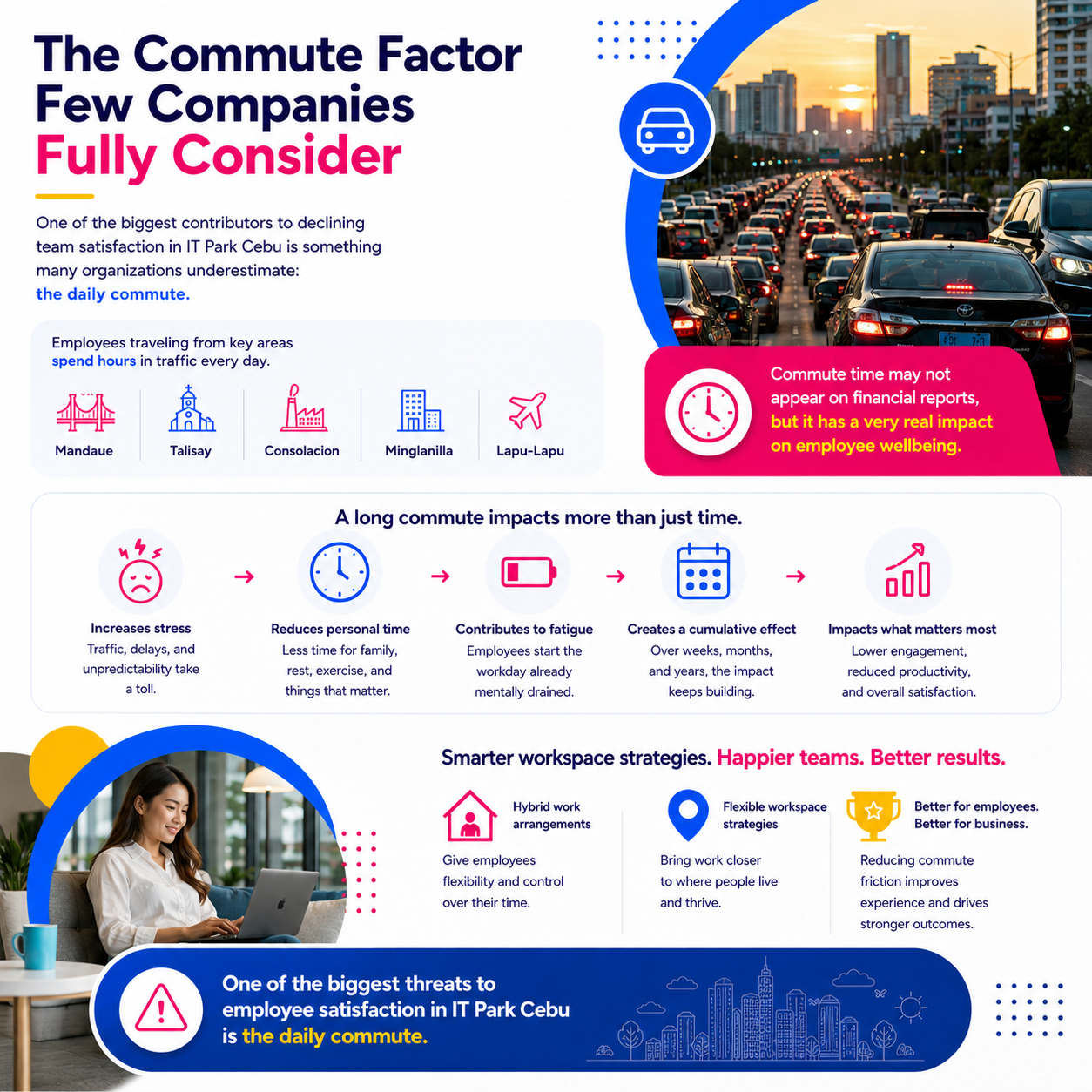
One of the biggest contributors to declining team satisfaction in IT Park Cebu is something many organizations underestimate: the daily commute.
Employees traveling from Mandaue, Talisay, Consolacion, Minglanilla, or Lapu-Lapu often spend hours navigating traffic before and after work. While commute time may not appear on financial reports, it has a very real impact on employee wellbeing.
A long commute increases stress, reduces personal time, and contributes to fatigue before the workday even begins. Employees arrive already mentally drained. Over weeks, months, and years, this creates a cumulative effect that influences engagement, productivity, and overall satisfaction.
This is one reason why hybrid work arrangements and flexible workspace strategies continue gaining momentum. Companies are recognizing that reducing commute-related friction improves employee experience while supporting better business outcomes. One of the biggest threats to employee satisfaction in IT Park Cebu is the daily commute.
Many business leaders view commuting as a personal issue rather than an organizational one. However, the reality is that commute-related stress directly affects workplace performance. Employees who spend two to four hours on the road every day often have less energy available for collaboration, creative thinking, and problem-solving.
The Rise of Flexible Workspaces
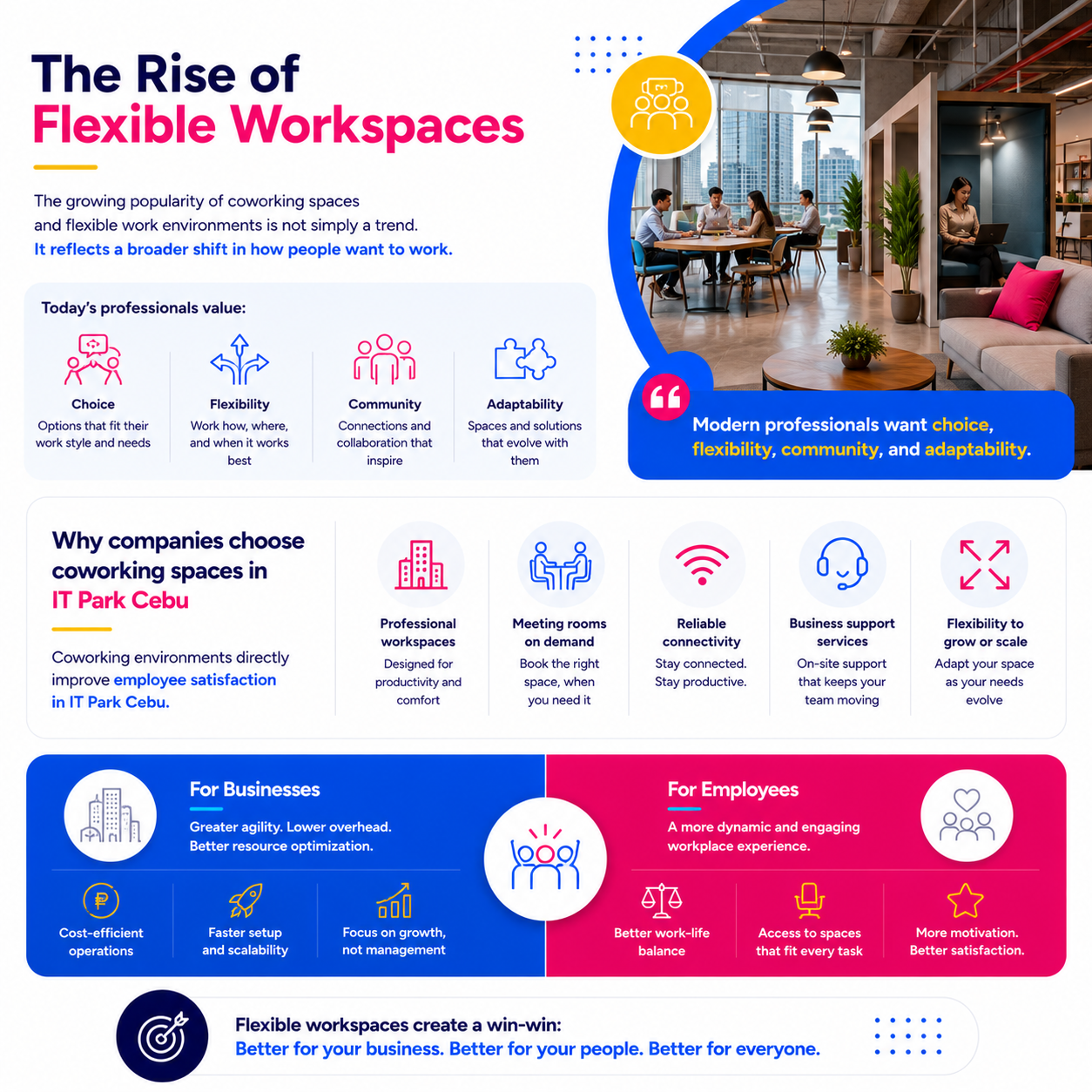
The growing popularity of coworking spaces and flexible work environments is not simply a trend. It reflects a broader shift in how people want to work.
Modern professionals increasingly value choice, flexibility, community, and adaptability. They want access to collaborative spaces when teamwork is required and quiet areas when focused work matters most. They want professional infrastructure without unnecessary rigidity.
Many companies are turning to coworking space IT Park Cebu environments because they directly improve employee satisfaction in IT Park Cebu. Teams gain access to professional workspaces, meeting rooms, reliable connectivity, and business support services while maintaining flexibility as their needs evolve.
For businesses, this flexibility creates significant operational advantages. For employees, it creates a more dynamic and engaging workplace experience. Both contribute positively to overall satisfaction.
The popularity of coworking and flexible workspace models reflects a broader shift in workplace priorities. Employees increasingly value environments that adapt to their needs rather than forcing them into rigid structures. This flexibility contributes significantly to employee satisfaction in IT Park Cebu because it gives professionals greater control over how and where they work.
What Labor Day Should Remind Employers
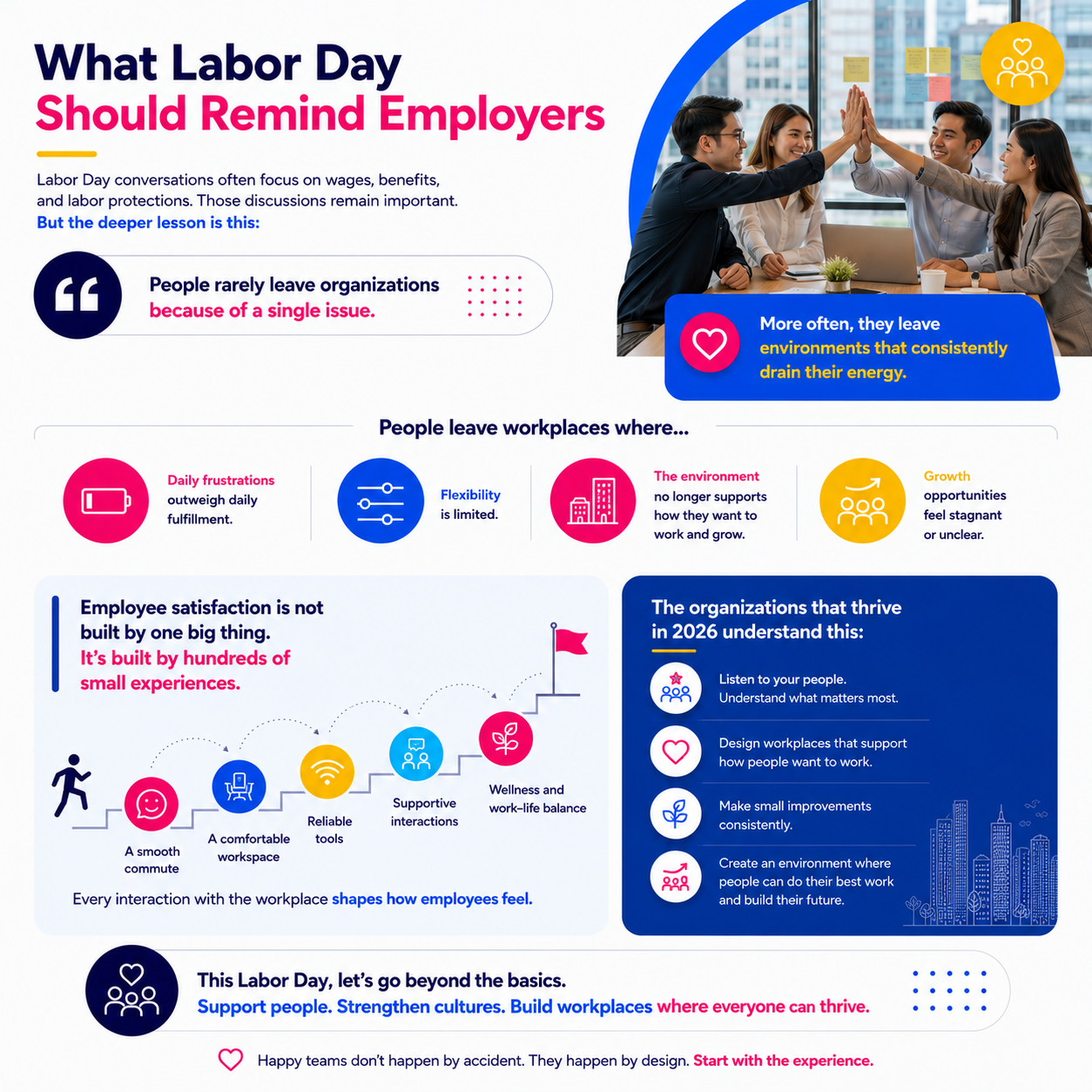
Labor Day conversations often focus on wages, benefits, and labor protections. Those discussions remain important. But perhaps the deeper lesson for employers is that people rarely leave organizations because of a single issue.
More often, they leave environments that consistently drain their energy.
They leave workplaces where daily frustrations outweigh daily fulfillment. They leave cultures where flexibility is limited. They leave environments that no longer support how they want to work and grow professionally.
The organizations that thrive in 2026 will understand that employee satisfaction is built through hundreds of small experiences rather than one large initiative. Every interaction with the workplace contributes to how employees feel about their jobs.
Labor Day serves as a reminder that every business outcome is ultimately driven by people. Revenue growth, customer satisfaction, innovation, and operational excellence all depend on engaged employees who feel supported by their environment. When organizations invest in employee satisfaction in IT Park Cebu, they are not simply improving workplace morale—they are strengthening the foundation of long-term business performance.
Final Reflection
This Labor Day 2026, the most important question may not be whether your company can afford higher salaries or larger benefits packages.
The more important question may be whether your workplace actually supports the people who power your business every day.
Because budgets often reveal problems last.
Team satisfaction reveals them first.
The organizations that listen early will be the ones that retain top talent, strengthen culture, improve productivity, and build sustainable growth. As workplace expectations continue evolving, companies that prioritize flexibility, employee wellbeing, and workplace experience will gain an increasingly valuable competitive advantage.
Ultimately, successful businesses are not built solely on strategy, technology, or capital. They are built by people. And people perform at their best when the environment around them helps them succeed.
Businesses that prioritize employee satisfaction in IT Park Cebu today will be far better positioned to attract and retain top talent tomorrow.
Ready to Rethink Your Workspace?