7 Hiring Mistakes Overseas Employers Make in the Philippines — and How to Avoid Them

Hiring in the Philippines is more accessible than it has ever been for overseas employers — more information available, more EOR providers to choose from, more Filipino professionals with overseas employment experience who can hit the ground running. And yet the same set of mistakes appears, reliably, across companies of different sizes and industries, from first-time overseas hirers to organisations that have been building Philippine teams for years.
These are not obscure mistakes. They are predictable ones — the kind that look obvious in retrospect and that cost real money, real time, and real relationships to fix. This article names them plainly, explains why they happen, and describes what to do instead.
Mistake 1: Competing on Salary Alone
The most common hiring mistake in the Philippines is also the most intuitive one to make: assuming that the best way to attract and retain good candidates is to offer the highest salary. Salary matters — obviously. But it is rarely the only thing that determines whether a strong candidate accepts an offer, and it is almost never the primary reason a good employee stays.
Filipino professionals at the mid-to-senior level are evaluating employers on multiple dimensions simultaneously: the working environment, the professional development opportunity, the stability of the arrangement, the quality of the management relationship, and the sense of community and belonging that the role provides. An employer who offers a market-leading salary but provides no professional environment, no career pathway, and no sense that the employee is part of something real and lasting will lose that employee to a competitor who offers slightly less money but more of everything else.
The practical implication is that employers should invest their hiring budget across the full employment proposition — not just the salary line. A professional office environment, a clear onboarding process, a genuine commitment to the employee’s development, and the stability signals that come with a proper EOR arrangement collectively constitute a more compelling offer than salary alone. Employers who understand this hire better candidates at sustainable rates and retain them longer.
Mistake 2: Using Contractor Arrangements to Avoid Employment Compliance
This mistake is extremely common among first-time overseas employers, and it is also one of the most legally dangerous. The logic is superficially appealing: rather than navigate the complexity of Philippine employment law, simply engage the worker as an independent contractor. Pay them via invoice. Avoid the statutory contributions, the regularisation obligations, the separation pay requirements. Keep it simple.
Philippine labour law does not recognise this arrangement when the reality of the working relationship looks like employment. The legal test is not what the contract says — it is the nature of the relationship. An worker who works regular hours, follows the employer’s direction, uses the employer’s tools, and works exclusively or predominantly for one overseas employer is, under Philippine law, likely an employee regardless of what their contract calls them.
The consequences of misclassification in the Philippines are serious. A misclassified worker who files a complaint with the National Labour Relations Commission can claim regularisation, back-payment of all statutory benefits, damages, and legal costs. These claims are routinely successful, and the liability can be substantial — particularly if the misclassification has been running for years. Overseas employers who discover this exposure often find that the cost of resolving it is many times the cost of having done it correctly from the start.
The fix is straightforward: use an Employer of Record. The EOR provides compliant employment without requiring the overseas employer to establish a local entity, at a cost that is modest compared to the liability it eliminates.
Mistake 3: Defaulting to Remote Without Considering the Alternative
Remote-only hiring is the default for many overseas employers because it feels like the lean, uncomplicated option. No office to find, no facilities to manage, no long-term workspace commitment. Just a laptop, a Slack account, and a monthly salary transfer.
The problem is that this default is made without examining what it actually costs — in productivity, in the quality of candidates it attracts, and in retention. Home working environments in the Philippines are genuinely variable: internet reliability, power stability, noise levels, and the availability of a proper workspace are all significantly less consistent in residential settings than in managed professional environments. The productivity gap between an office-based employee and an unsupported home worker is real and compounds over time.
Beyond productivity, the remote-only default filters out a significant portion of the best candidates in the market — the professionals who have built their careers in structured environments and who actively prefer working in a professional setting. These candidates apply for roles that offer office access. They often don’t apply for remote-only roles, even when the compensation is comparable.
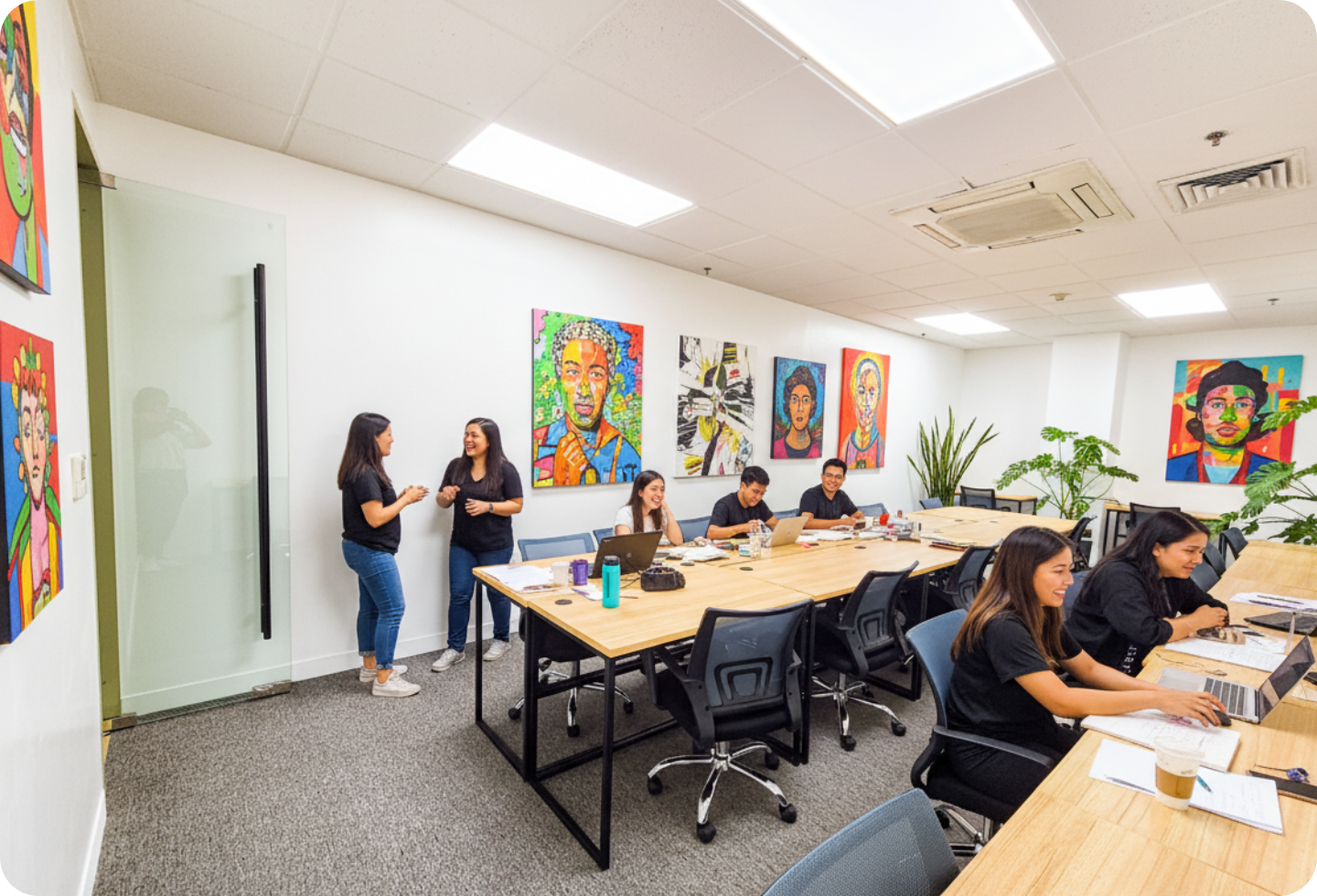
The alternative — pairing EOR employment with access to a managed office workspace — is not significantly more expensive, and the return in productivity, hiring quality, and retention more than covers the cost. Employers who have made this shift consistently report that it was one of the better decisions they made in building their Philippines operation.
Mistake 4: Misreading Filipino Communication in Interviews and at Work
Filipino communication culture is indirect, relationally warm, and conflict-avoidant in ways that produce consistent misreadings by overseas employers who are used to more direct communication styles.
In interviews, “yes” is often closer to “I have heard you” than to genuine agreement or certainty. A candidate who describes every previous employer positively and every experience as entirely successful is performing cultural politeness, not necessarily describing reality. Enthusiasm and warmth are standard social expressions, not reliable indicators of fit or commitment. Overseas employers who take these signals at face value hire candidates whose actual skills, concerns, and working preferences were never surfaced in the interview.
In the working relationship, the same patterns continue. A Filipino team member who does not raise a concern directly may still have that concern — expressed as missed deadlines, declining engagement, or eventual departure. A manager who mistakes the absence of direct pushback for agreement and satisfaction will be surprised when problems that were never surfaced become visible in outcomes.
The fix is not to try to make Filipino employees communicate differently — it is to build working relationships and interview processes that make honest communication feel safe and valued. Asking specific follow-up questions. Creating regular check-in structures where concerns can be raised without direct confrontation. Responding to indirect signals with curiosity rather than assumption. These are learnable adjustments that consistently improve both hiring quality and team management.
Mistake 5: Skimping on Onboarding
Many overseas employers treat onboarding as an administrative process — get the access sorted, send the relevant documents, introduce the new hire to the team on a video call, and then get on with the work. This approach consistently produces the same outcome: a new hire who takes longer to become productive than necessary, who feels isolated and uncertain in their first weeks, and who is statistically more likely to leave within the first year.
The first thirty days of a Filipino professional’s employment with an overseas employer set the trajectory for the entire relationship. An employee who feels genuinely welcomed, professionally integrated, and supported in those thirty days arrives at the one-month mark ready to invest in the role long-term. An employee who arrives at thirty days feeling isolated, unclear on expectations, and uncertain about whether they made the right choice is already reconsidering.
A good onboarding process for a Philippine-based hire is not complicated, but it is intentional: a clear first-week structure, regular check-ins in the first month, access to a professional working environment where informal learning can happen, and the kind of early relationship-building with colleagues and managers that creates the social foundation for a long-term working relationship. Employers who invest thirty days in getting this right typically save themselves the cost of a replacement hire twelve months later.
Mistake 6: Hiring Without a Scale Plan
The first hire is straightforward enough that many employers don’t think carefully about what they are building toward. They hire one person, set up the arrangement that works for one person, and then discover six months later that they need to hire three more — and that the arrangement they built for one doesn’t extend cleanly to four.
The most common version of this is the remote-only arrangement that becomes a problem at scale. One remote employee is manageable. Three remote employees spread across Metro Manila with no shared environment, no team culture, and no local management structure is a different proposition. By the time the employer recognises the problem, they have three established employees whose working model they now need to change — which is significantly harder than building the right model from the start.
Building with scale in mind from the beginning does not mean anticipating every future hire — it means choosing infrastructure that can grow. An EOR provider who can accommodate a team of fifteen as easily as a team of one. A workspace arrangement that can scale from a co-working desk to a private office to a larger suite without a disruptive relocation. A management structure that adds a local team lead at the right moment rather than as a crisis response. These are the architectural decisions that determine whether a Philippines operation scales well or scales painfully.
Mistake 7: Choosing an EOR on Price Alone
The EOR market in the Philippines has expanded significantly, and the range of providers — from premium full-service operations to low-cost basic compliance services — is wider than it has ever been. This is mostly good news for overseas employers. But it has introduced a specific mistake: choosing the cheapest option without examining what “cheap” actually includes and excludes.
A low-cost EOR typically provides the minimum viable compliance service: employment contracts, payroll processing, and statutory contribution filing. What it often does not provide is workspace, HR support, local management infrastructure, or the capacity to handle more complex situations — disciplinary processes, terminations, misclassification cleanup, entity transitions. These are the situations where EOR value is highest, and where a low-cost provider’s limitations become most visible.
The cost of EOR is real, and managing it matters. But the right comparison is not the EOR fee against zero — it is the EOR fee against the full cost of the alternatives, including the cost of things going wrong. A provider who costs more but includes workspace, robust HR support, and the capacity to manage complex employment situations provides better total value than one who costs less but creates exposure in exactly the areas where the risk is highest.
Choosing an EOR provider is choosing a long-term partner in one of the most consequential operational decisions an overseas employer makes. It deserves the same level of scrutiny as any other significant vendor relationship — which means evaluating on capability, track record, and total value, not just the monthly fee.
The Common Thread
Looking across all seven mistakes, the pattern is consistent: they are all the product of treating Philippines hiring as a cost-optimisation exercise rather than a long-term investment. The employers who make these mistakes are trying to get the cheapest possible hire, the simplest possible arrangement, the most minimal possible commitment — and they end up paying more, in total, than the employers who made better decisions from the start.
The employers who build successful, durable Philippines operations are those who invest in getting the fundamentals right: compliant employment, a professional working environment, a genuine onboarding process, and a management approach that accounts for how Filipino professionals actually communicate and what they actually value. None of this is complicated. It just requires doing it deliberately rather than defaulting to the path of least resistance.
The Company provides EOR services and professional workspaces across Makati, Cebu IT Park, and Mandaue — the infrastructure overseas employers need to build Philippines teams that work well from the start. Learn more about how EOR and office access work together here.