The Real Cost of Remote-Only Hiring in the Philippines — and What Filipino Professionals Actually Want

Remote-only hiring in the Philippines feels like the smart, lean choice. No office lease. No facilities overhead. No long-term property commitment in a market the overseas employer doesn’t fully understand. Just a talented professional, a laptop, and a Slack channel connecting two countries across a time zone gap.
The problem is that this model carries costs that don’t show up in the initial spreadsheet — costs that accumulate quietly over months and years, and that only become visible when something breaks. Turnover. Underperformance. A failed hire. A position that takes six months to fill again. These are expensive events, and remote-only arrangements make them significantly more likely than most overseas employers account for.
This article looks at the real cost of remote-only hiring from two directions: what it costs the employer when the model fails, and what it costs the employer in the quality of candidates they never attract in the first place. Both arguments lead to the same conclusion — and the same practical solution.
Part One: The Employer’s Perspective — What Remote-Only Actually Costs
The Turnover Calculation
Employee turnover is expensive everywhere. In the Philippines, where the BPO and overseas employment sectors are competitive and candidates have real options, it is particularly expensive — and particularly common in remote-only arrangements.
The fully-loaded cost of replacing a mid-level professional is typically estimated at between 50% and 200% of annual salary, depending on the role. For a Filipino employee earning the equivalent of AUD $25,000 per year — a reasonable benchmark for an experienced developer or senior support specialist — that means a replacement cost of between $12,500 and $50,000 per turnover event. This includes recruitment costs, lost productivity during the vacancy, onboarding time for the replacement, and the productivity ramp-up period that follows every new hire.
Remote-only arrangements increase turnover risk through several mechanisms. Isolation is the most consistent one: Filipino professionals who work from home without a local team or community report significantly lower job satisfaction over time than those with access to a professional environment. The absence of colleagues, the blurring of work-life boundaries, the lack of informal support — these accumulate into disengagement. An employee who is disengaged is an employee who is looking.
The competitive market compounds this. A Filipino professional with two years of experience working for an Australian company is an attractive candidate. They have cross-cultural communication skills, proven ability to work across time zones, and a track record that overseas employers value. Other employers are recruiting them continuously. If your remote-only arrangement is not providing them with something that competing offers cannot — community, professional development, stability, a sense of belonging — your retention position is weak.
The Productivity Gap
Turnover is the visible cost. Underperformance is harder to see, but it compounds over a longer period and often goes unaddressed until it has already done significant damage.
Filipino home working environments are genuinely variable in ways that most overseas employers never investigate. Unreliable broadband is common in residential areas throughout Metro Manila and regional cities — not uniformly or constantly, but frequently enough to affect any role that involves real-time communication, video calls, or continuous system access. Power interruptions are a regular occurrence. The physical workspace — a dedicated room with a proper desk, ergonomic chair, and controlled noise environment — is the exception rather than the norm for most professionals renting or living in extended family households.
An employee working in suboptimal conditions is not operating at full capacity. They are managing around their environment rather than focusing entirely on their work. This is not a reflection on their professionalism — it is a structural consequence of asking someone to do professional work from an environment that was not designed for it. The overseas employer who does not provide an alternative is, in effect, absorbing the productivity cost of that gap without realising it.
The Management Overhead
Managing a remote employee who is underperforming or disengaged is significantly more time-intensive than managing one in a structured environment. Performance issues that would be visible and addressable early in an office context become invisible until they reach a point of crisis. The manager in Australia, operating across a time zone gap and unable to observe their team member’s working conditions directly, is working with incomplete information.
The administrative overhead of remote management — the additional check-ins, the documentation requirements, the effort to maintain visibility across a distributed arrangement — is a real but rarely quantified cost. It is typically absorbed by the overseas manager as additional work rather than accounted for as a cost of the remote model. When it is quantified — even conservatively, at one to two hours per week of additional management time — it adds up meaningfully over a year.
The Candidate Pipeline You Are Not Seeing
This is the most underappreciated cost of remote-only hiring, because it is entirely invisible: the candidates who do not apply.
The Filipino professional labour market is not uniformly seeking remote work. A significant proportion of experienced professionals — particularly those who have built their careers in established multinational companies, BPO operations, or professional services firms — actively prefer structured, office-based environments. They have built professional identities in those environments. They value the community, the mentorship, the visibility, and the professional culture that an office provides. When they see a remote-only job posting, they often do not apply. Not because they cannot do the work remotely, but because they have enough options that they do not need to accept an arrangement they do not prefer.
The employer who posts remote-only is, without knowing it, filtering out a substantial portion of their best potential candidates before the recruitment process has even begun. The candidates who remain — those who are actively seeking remote work — are a real pool of talent, but it is not the full market. And in a competitive hiring environment, access to the full market matters.
Part Two: The Candidate’s Perspective — What Filipino Professionals Actually Look For
The conversation about what Filipino professionals want from overseas employers tends to focus on compensation. Salary is important — obviously — but it is rarely the sole deciding factor for candidates with genuine options, and it is almost never the reason a good employee leaves a role they otherwise valued.
What experienced Filipino professionals consistently say they want from an overseas employer goes well beyond the monthly rate. Understanding these priorities is not just good for recruitment — it is good for retention, and for building the kind of long-term working relationship that produces real business value.
A Professional Environment That Matches Their Self-Image
Filipino professionals who have invested seriously in their education and career development — and there are many of them — have a strong professional self-image that remote work often fails to reflect back at them. Working from a bedroom or a kitchen table, taking video calls in a domestic environment, missing the social and cultural infrastructure of a workplace: these things feel like a step down, not a step forward. The feeling is not trivial — it affects daily engagement and long-term career satisfaction in ways that compound over time.
An overseas employer who provides access to a properly equipped, professionally designed office is telling their employee something important: we take your working environment seriously. We want you to be able to do your best work. We see you as a professional, not just a remote resource. This message lands differently than a monthly salary transfer with no accompanying investment in the quality of the working experience.
Community and Belonging
Filipino workplace culture places high value on community — the concept of pakikisama, or social harmony and belonging, runs deep in professional contexts. The absence of colleagues is not simply an inconvenience for Filipino remote workers; it is a meaningful absence of something that most people working in this culture consider fundamental to job satisfaction.
This does not mean that every Filipino professional needs to work alongside their immediate team. A co-working environment — even one shared with professionals working for other overseas employers — provides the ambient social infrastructure that pure home working removes. The presence of other working professionals, shared spaces, the informal rhythms of a working day with other people around: these matter more than overseas employers typically appreciate, and they show up clearly in engagement and retention data.
Stability and Legitimacy
The overseas employment market in the Philippines includes a spectrum of arrangements: from fully compliant employment with a registered local employer, through informal contractor relationships, to arrangements that are legally ambiguous at best. Filipino professionals have become sophisticated consumers of this market. They can read the signals of a legitimate employer versus a transactional one, and they weight stability and legitimacy heavily in their decision-making — particularly those with families, mortgages, or long-term financial commitments.
An employer who provides proper EOR employment — with SSS and PhilHealth contributions, a regularisation pathway, a proper employment contract — and who also provides a physical workspace signals legitimacy at multiple levels. The combination says: we are here for the long term. We have invested in a proper infrastructure for our Philippine team. We are not going to disappear after six months and leave you scrambling for your next role.
Career Development and Visibility
Ambitious Filipino professionals think about where a role will take them, not just what it pays today. Remote work, by its nature, limits the visibility and mentorship opportunities that drive career development. A remote employee cannot be observed handling difficult situations and rewarded for their professionalism. They cannot absorb the informal knowledge that circulates in a physical workspace. They cannot build the professional relationships — with colleagues, with visiting clients, with the broader professional community in their city — that open doors over a career.
Overseas employers who provide an office environment are offering something that pure remote cannot match: a space where professional development actually happens, not just work execution. The best Filipino candidates understand this distinction and factor it into their choices.
Where Both Perspectives Lead: EOR Plus Office
The employer who has read this far has two problems: they are paying too much for turnover and underperformance, and they are not attracting the best candidates their budget could reach. The candidate who has read this far has two criteria: they want an employer who takes their working environment seriously, and they want the stability and community that remote-only cannot provide.
Both problems have the same solution.
An Employer of Record arrangement paired with access to a professionally managed office addresses every item on both lists. The employer gets compliant, fully structured employment without setting up a Philippine entity. The employee gets a proper workplace, a professional community, and an employer who has demonstrably invested in making the arrangement work long-term. The cost — structured as a per-person monthly fee that covers both legal employment and workspace access — is predictable, manageable, and lower than the cost of getting any of the alternative arrangements wrong.
The Company: EOR and Office Across Manila and Cebu
The Company operates professionally designed workspaces at three locations in the Philippines — Makati in Metro Manila, IT Park in Cebu City, and Mandaue in northern Cebu — all integrated with a full Employer of Record service.
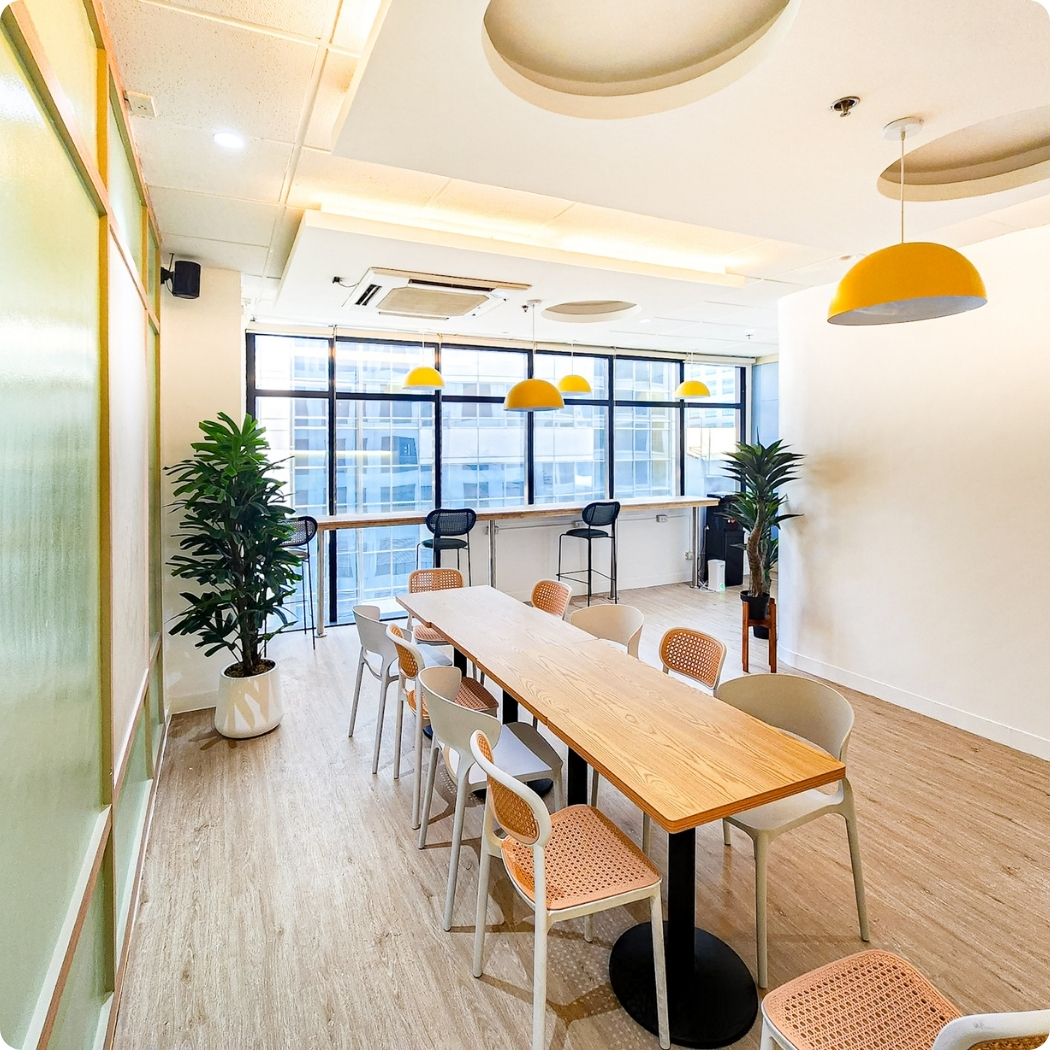
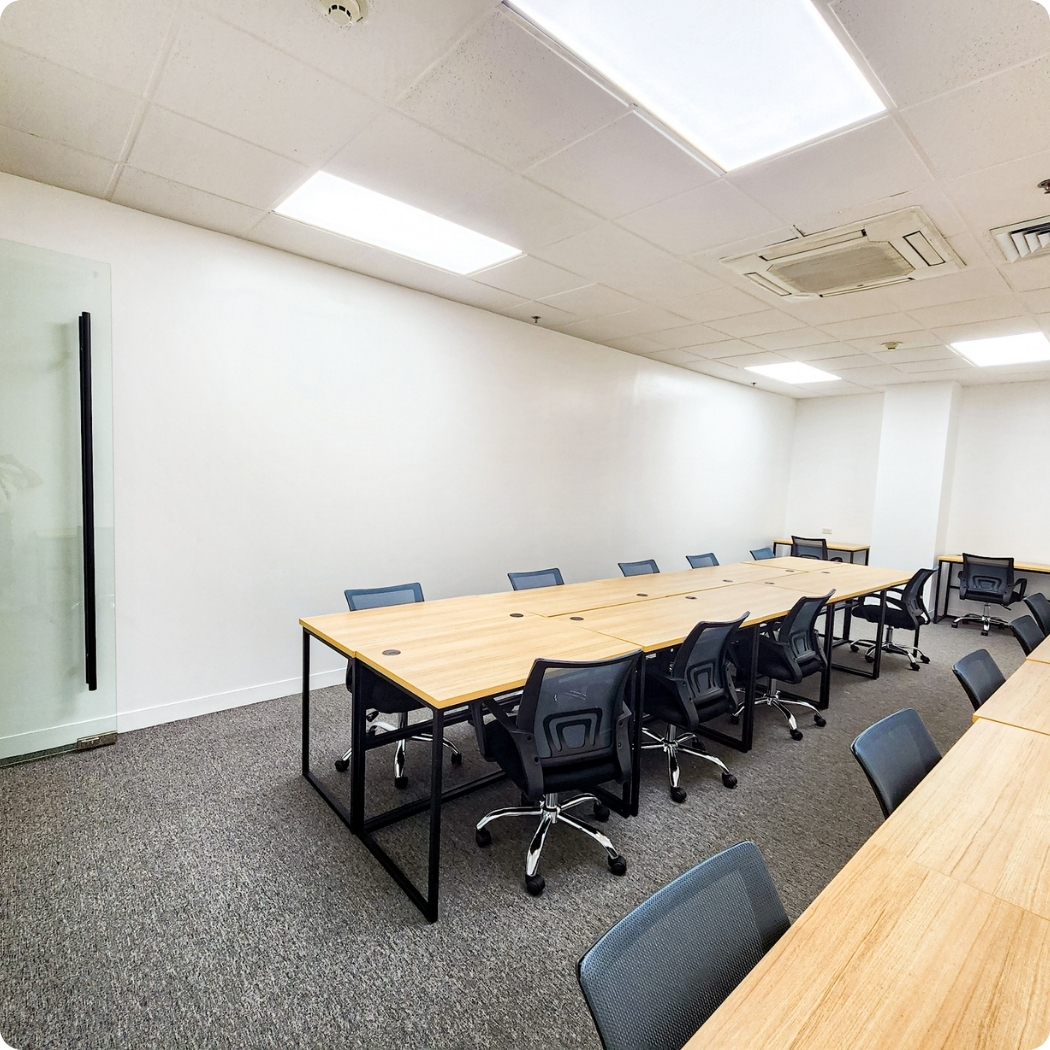
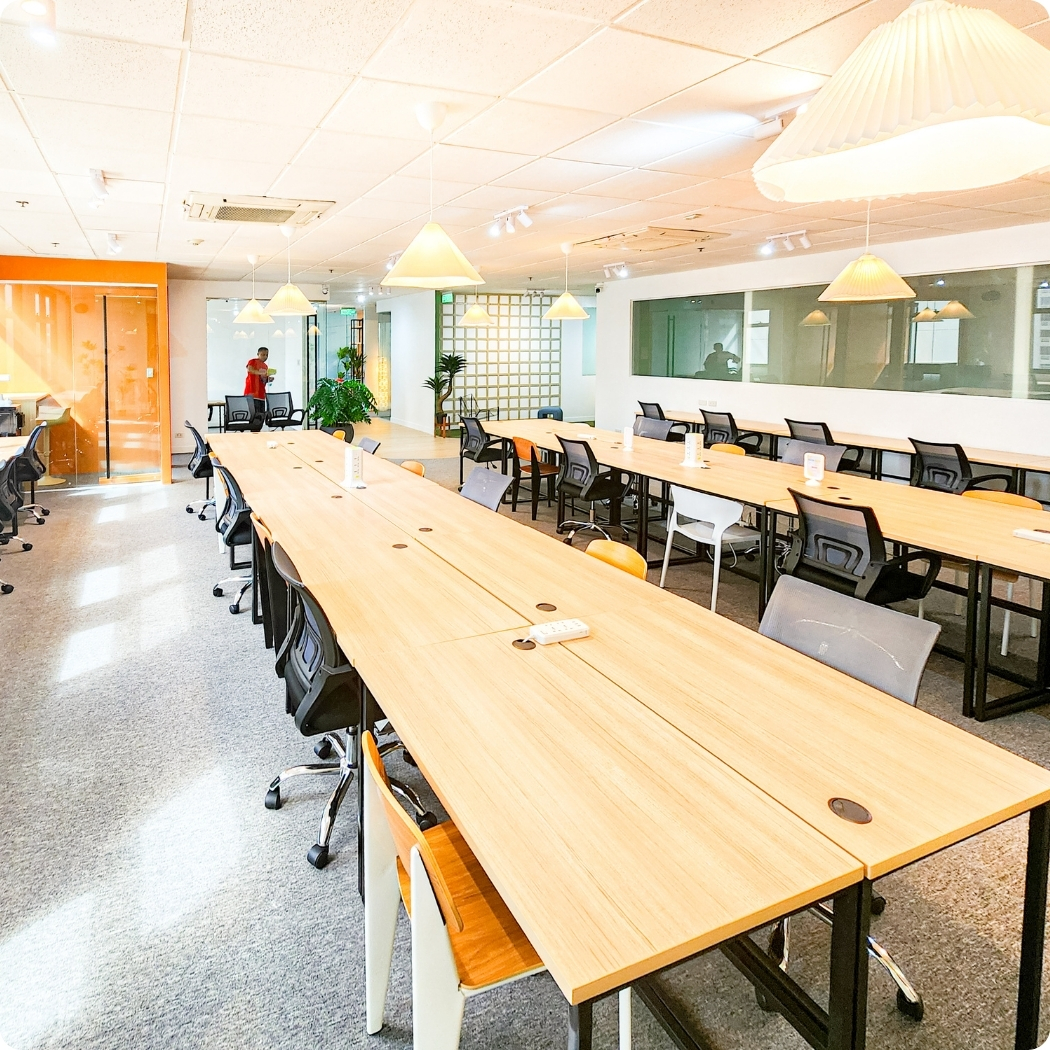
The Makati space occupies the 11th floor of Frabelle Business Center on Rada Street in Legazpi Village — 862 square metres holding 13 private offices, 50 dedicated desks, two conference rooms, soundproofed phone booths, and a full suite of amenities including high-speed Wi-Fi, a staffed pantry, shower facilities, and a quiet zone. It sits in one of Metro Manila’s most accessible and well-serviced business districts, within walking distance of Greenbelt and the Ayala Avenue commercial corridor.
In Cebu, the IT Park location in Mabuhay Tower sits at the centre of the city’s technology and professional services hub — the address that tech-oriented candidates in Cebu recognise and value. The Mandaue location at JDN Square serves the northern Cebu market, with practical accessibility for teams whose work connects to the broader commercial activity of Mandaue City.
Across all three locations, the offer is the same: fully equipped professional workspaces bundled with compliant EOR employment, managed by a single provider, billed at a predictable per-person rate. For a team of twenty, the combined cost comes in at around USD $350 per person per month — less than the cost of separate commercial leasing, a standalone EOR provider, and the management overhead that comes with running those two things independently.
For overseas employers who want to stop paying the hidden costs of remote-only hiring — and for Filipino professionals who want an employer who has thought carefully about their working environment — this is what a better arrangement looks like.
To learn more about how EOR combined with workspace access works in practice, visit The Company’s EOR service page or explore our Makati workspace.