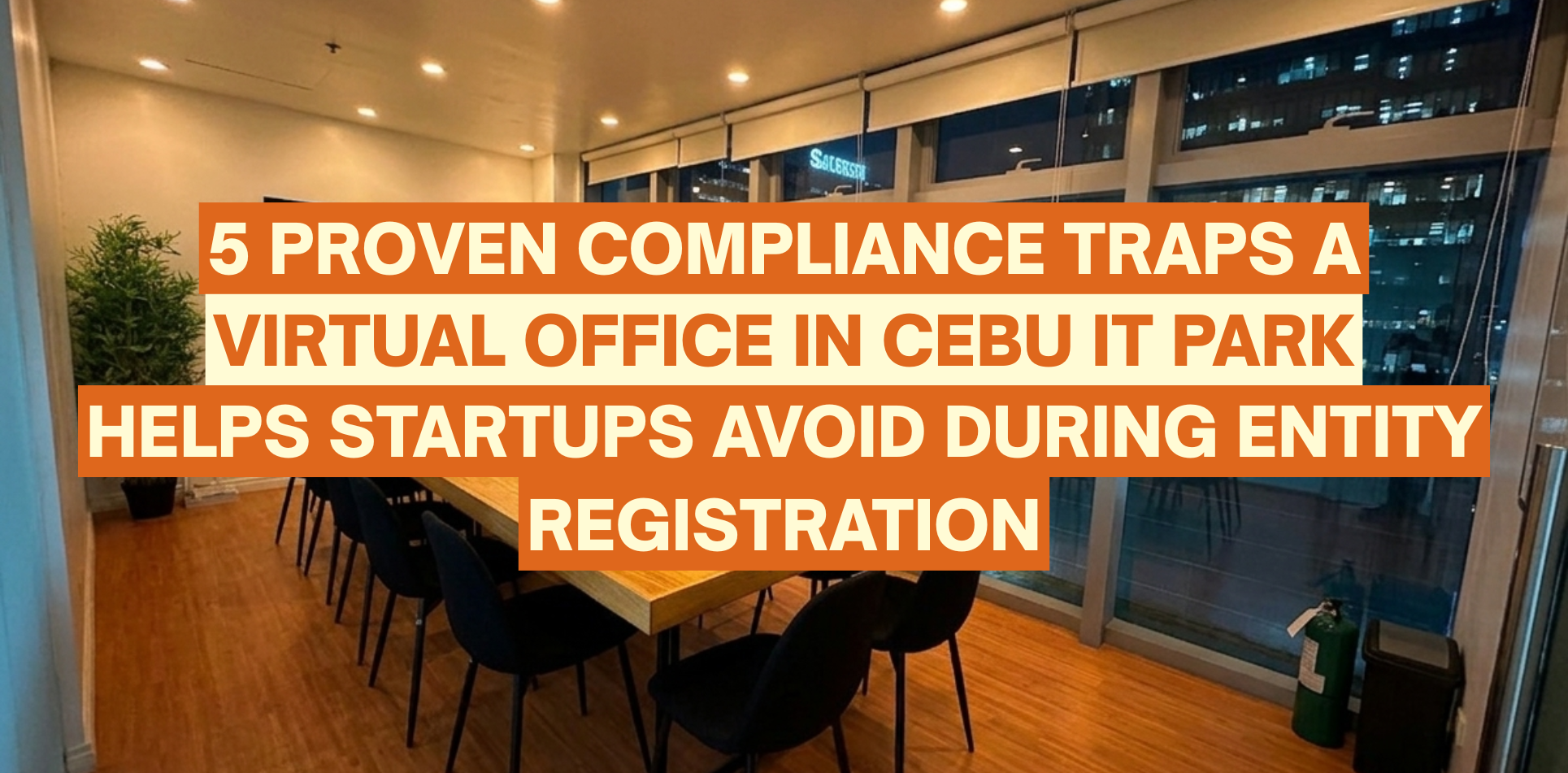
5 Hidden Compliance Traps a Virtual Office in Cebu IT Park Helps Startups Avoid During Entity Registration

Registering a company in the Philippines is an exhilarating milestone. For foreign tech founders, it represents the first strategic step toward tapping into one of Southeast Asia’s fastest-growing talent pools and most dynamic digital economies. For local entrepreneurs, it marks the official transition from a passionate side-hustle into a legitimate, scalable business entity.
During this high-energy launch phase, most founders spend their days optimizing products, interviewing early hires, mapping out market opportunities, and refining revenue projections. Few spend enough time thinking about their corporate business address.
At first glance, an address seems like a minor administrative detail—just a string of text to fill out on government forms. However, during the entity registration process, the address you choose affects far more than where your mail arrives. It fundamentally influences your regulatory compliance requirements, government correspondence, corporate credibility with banking partners, tax structures, and long-term operational flexibility.
Many startups discover this reality far too late. They lock themselves into expensive commercial leases before they even hire their first local employee, or they attempt to register using a residential address, triggering an avalanche of zoning and tax complications.
This is why securing a virtual office in Cebu IT Park has become the smartest strategic decision for modern startups, international subsidiaries, and newly registered small and medium-sized enterprises (SMEs). Rather than bleeding capital into unnecessary physical real estate overhead during the volatile early stages of growth, savvy founders leverage a prestigious business address to maintain lean operations while remaining fully compliant with Philippine laws.
Here is an in-depth breakdown of the five hidden compliance traps that frequently catch startups off-guard during entity registration, and how a premium virtual office in Cebu IT Park helps you bypass them completely.
The Compliance Landscape for Startups in the Philippines
To understand why a business address is so critical, one must look at the regulatory framework governed by theSecurities and Exchange Commission (SEC), Local Government Units (LGUs), and the Bureau of Internal Revenue (BIR)operate. Setting up a business in the Philippines requires navigating a strictly sequential, multi-tiered registration funnel. Each agency acts as a gatekeeper, requiring approved documents from the previous step before you can proceed.
If your primary corporate address encounters a compliance bottleneck at the first tier, the entire operational timeline stalls. Choosing a reliable, commercial-grade workspace ecosystem from day one ensures that documentation flows seamlessly across every municipal and national department.
The Domino Effect of an Address Bottleneck
Because this funnel is completely linear, a single address mistake at the SEC level will paralyze your entire timeline:
-
The LGU Blockade: If you register using a residential home or an un-zoned property, the SEC might initially accept it. However, the local Barangay or LGU will flatly reject your application during the municipal phase if the location violates local commercial zoning laws.
-
The Operational Freeze: Without an LGU Mayor’s Permit, you cannot register with the BIR via its Online Registration and Update System (ORUS). Without your BIR Certificate of Registration (Form 2303), you cannot legally open a corporate bank account, issue official receipts, or hire legal local talent.
If your address is rejected midway through, you cannot simply update it online. You must halt operations, pay heavy legal fees, and undergo a formal, multi-month SEC Amendment process to change your principal office address across national records.
Anchoring your entity with a verified virtual office in Cebu IT Park from day one eliminates this risk. It guarantees a commercially zoned, legally compliant address that ensures your paperwork moves seamlessly and rapidly through every government tier.
Compliance Trap #1: Registering With an Address That Doesn't Support Business Operations
When first filling out registration paperwork, many founders default to whatever address is most readily available. This could be a residential home, a friend’s existing office, a temporary coworking hot desk, or a rented residential apartment. While this feels like a practical, cost-saving shortcut, it quickly creates friction once the business interacts with government regulators, banking institutions, and corporate vendors.
The Friction of Inconsistent Records
Regulators expect businesses to maintain a legitimate, verifiable, and permanent operating address. When your corporate address shifts frequently or is rejected by local zoning boards, administrative bottlenecks ripple through your entire infrastructure. If your documentation becomes inconsistent across your SEC certificate, local government permits, Bureau of Internal Revenue (BIR) tax records, and corporate bank accounts, your business can face sudden operational freezes.
Establishing Stability from Day One
A virtual office in Cebu IT Park provides a rock-solid, legally compliant address from the absolute start of your registration journey. Instead of executing messy, expensive address modifications with the SEC and BIR as your company grows, your startup establishes institutional consistency across all government portfolios.
For foreign tech founders establishing a Philippine entity remotely, this structural stability is invaluable. It grants your enterprise a permanent local corporate footprint long before you onboard local teams or invest in physical infrastructure.
Compliance Trap #2: Overcommitting to Long-Term Commercial Leases Too Early
One of the most capital-intensive mistakes a growing startup can make is operating under the assumption that a traditional physical office is a Day 1 requirement. The trap usually unfolds like this: A founder visits Cebu, tours a gleaming, Grade-A commercial office tower, and falls in love with the view. Eager to project success, they sign a commercial lease agreement.
Suddenly, before the company has achieved product-market fit or generated a single dollar of local revenue, they are legally bound to:
-
Multi-month security deposits and advance rental payments.
-
Extensive capital expenditure for office fit-outs, interior design, and construction.
-
Long-term contracts for commercial internet lines, utilities, and facility insurance.
-
Ongoing monthly maintenance fees and dedicated office administrative salaries.
For an early-stage company, this massive allocation of fixed capital introduces extreme, unnecessary financial pressure.
Agility as a Strategic Business Asset
According to global real estate and workplace insights from JLL, high-growth companies are increasingly prioritizing agile, flexible workspace frameworks over traditional fixed real estate commitments. Locking valuable capital into long-term commercial leases dramatically reduces a startup’s runway and operational agility.
Key Startup Insight: In the modern economy, a startup does not need to own or lease a vast physical room on day one. It needs regulatory legitimacy, airtight government compliance, and a highly professional corporate presence.
By setting up a virtual office in Cebu IT Park, founders gain this exact trifecta without tying up working capital in real estate liabilities. By keeping your fixed costs near zero, you can strategically redirect your capital toward high-ROI initiatives like top-tier talent acquisition, localized marketing campaigns, and core product development.
Compliance Trap #3: Missing Government Notices and Regulatory Correspondence
An often overlooked operational and compliance hazard in the Philippines is the management of official government communication. Regulatory bodies like the SEC, BIR, Social Security System (SSS), and local municipal offices do not typically communicate via email or SMS; they rely heavily on physical mail, registered couriers, and official written notices.
If your business address is unmanaged, unstaffed, or located in an inaccessible residential area, critical correspondence can easily be lost, returned to sender, or left sitting in a pile of junk mail.
The Escalation of Administrative Penalties
Missing a time-sensitive government notice can lead to severe consequences, including:
-
Automatic Statutory Penalties: Accruing hefty financial fines for failure to respond to compliance updates.
-
Delayed Permit Renewals: Missing localized deadlines for annual business permit renewals, leading to late-fee surcharges.
-
Tax Status Escalations: Failure to receive assessment notices from the BIR can cause simple inquiries to escalate into formal tax disputes or sudden audits.
-
Corporate Blacklisting: Prolonged failure to answer regulatory mandates can cause the SEC to flag your corporation as inactive or non-compliant.
This risk is magnified ten-fold for international founders who manage their Philippine operations across different time zones. A professional virtual office in Cebu IT Park provider acts as your dedicated local gatekeeper. With structured mail handling, real-time scanning, and immediate digital notification systems, your leadership team is instantly informed the moment a piece of official mail arrives.
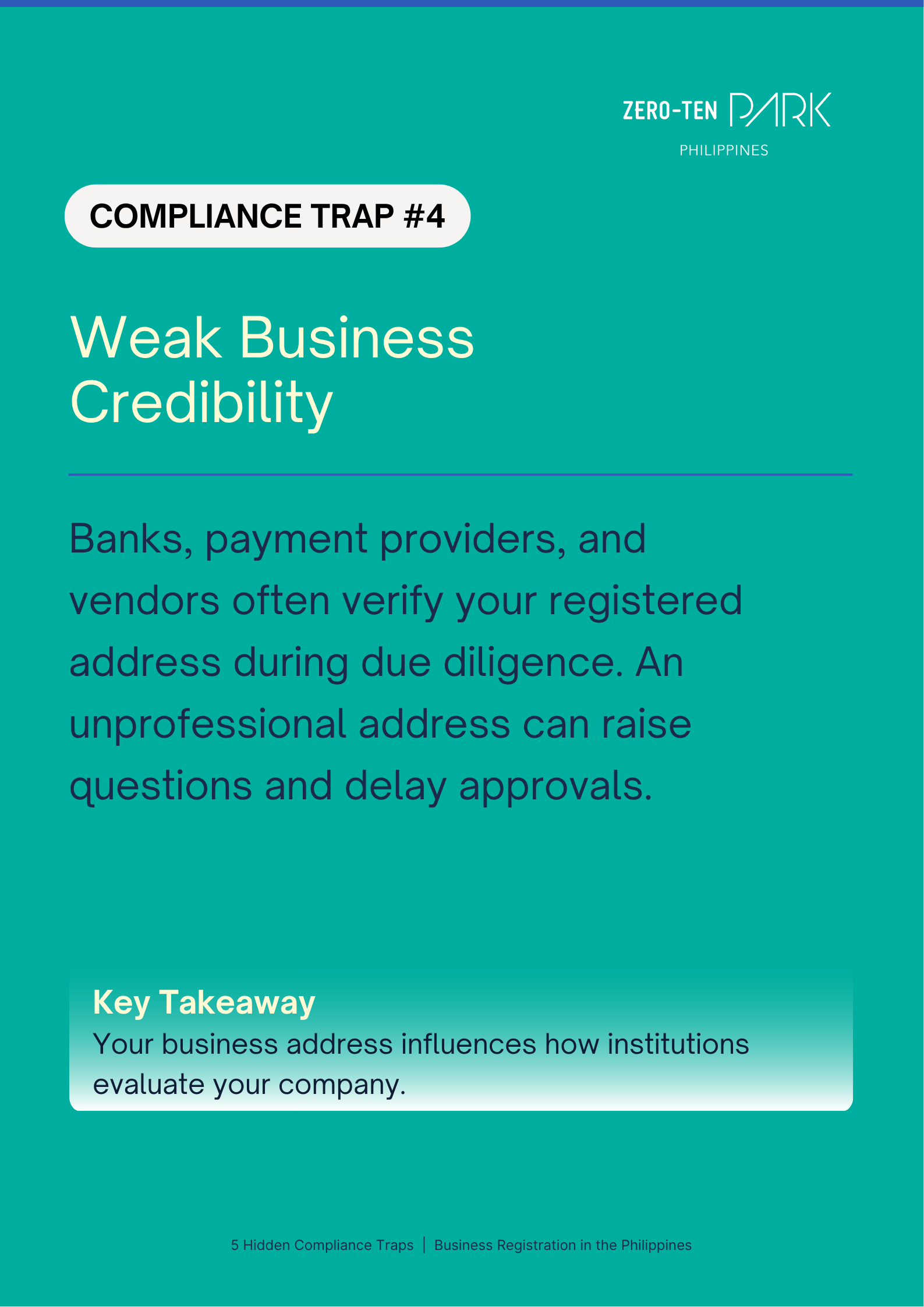
Compliance Trap #4: Weak Business Credibility During Banking and Vendor Reviews
Compliance is about more than satisfying government checkers—it is also about engineering trust with commercial institutions. Once you secure your SEC registration, your next hurdle is passing corporate bank account opening protocols and anti-money laundering (AML) background checks.
Modern corporate banks, international payment gateways (such as Stripe or PayPal), and tier-one vendors execute deep due diligence on newly registered entities. If their verification teams search your registered address and see a suburban residential home, a crowded apartment building, or an obscure, generic building location, it raises immediate red flags.
The Power of a Prestigious Business Address IT Park
Conversely, establishing your corporate home base within a globally recognized business district dramatically accelerates institutional trust. Utilizing a prestigious business address IT Park gives your business an immediate injection of corporate authority.
Cebu IT Park is universally acknowledged as the primary economic hub of the southern Philippines. It is the chosen home of Fortune 500 multinationals, major global BPO conglomerates, technology innovators, and premier financial organizations. When your business card, website, and bank application forms bear a Cebu IT Park address, your business is instantly perceived as a serious, well-capitalized, and permanent market participant.
Trust in a Borderless, Distributed World
Some tech founders make the mistake of thinking physical location is irrelevant because their product lives in the cloud and their team works remotely. The reality is that in an increasingly digital, borderless business landscape, verified trust has become the ultimate currency. Clients, investment funds, banking officers, and strategic partners require tangible validation that your company is legitimate. Your corporate address is one of the clearest signals you can send, which is why utilizing a premium virtual office in Cebu IT Park creates an immediate competitive advantage.
Compliance Trap #5: Failing Future Expansion Requirements
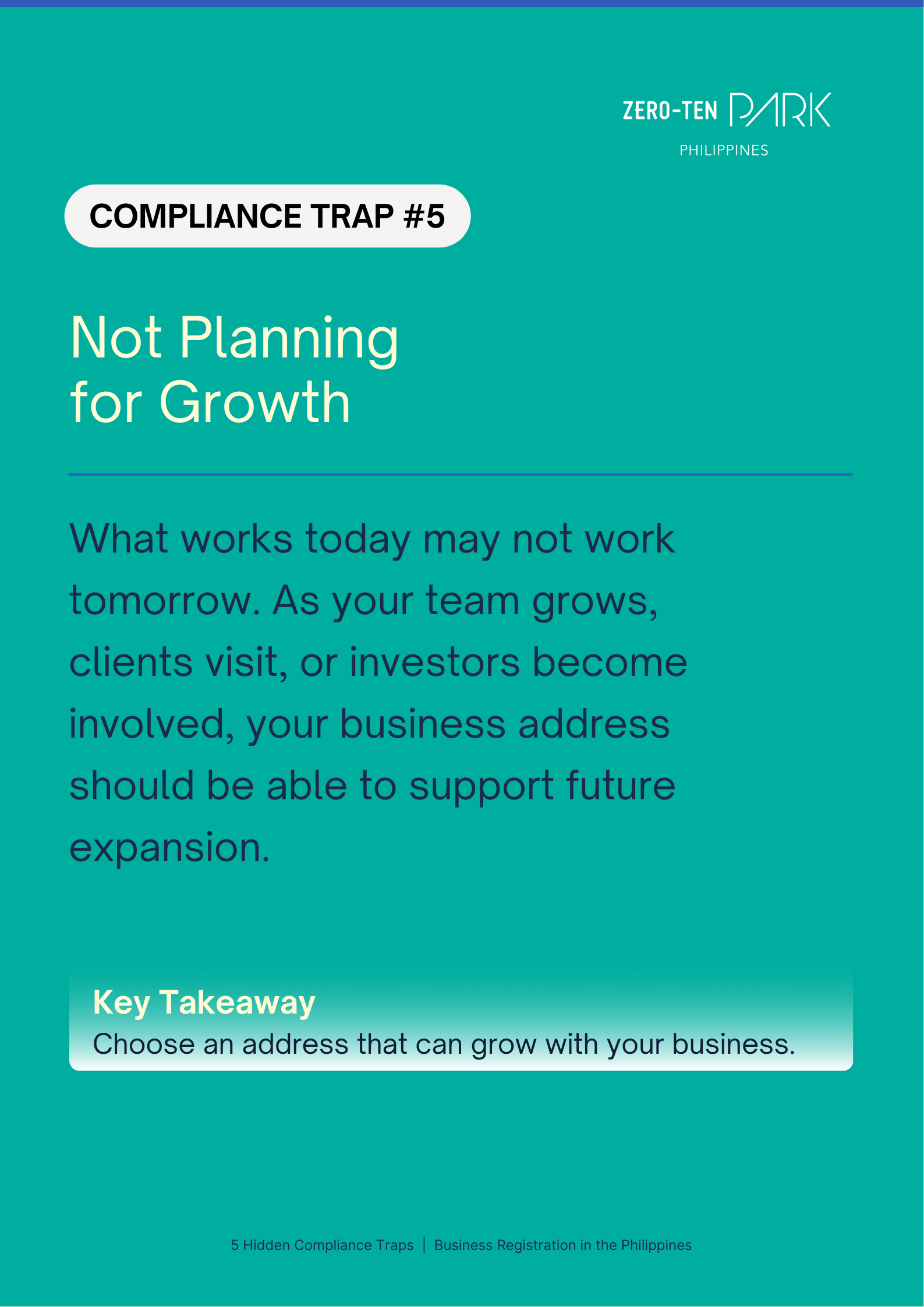
Many startup founders choose a corporate address based solely on their immediate, bare-minimum needs on day one of registration. This short-sighted approach builds a restrictive glass ceiling over the business that shatters the moment expansion begins.
Consider what happens when your business reaches its next growth milestones:
-
You raise a seed round and need an executive room to host a formal board meeting.
-
You onboard your first cluster of local engineers who require a collaborative hub.
-
An international client or enterprise partner requests an in-person audit of your setup.
-
You need to scale up operations rapidly to support a sudden project launch.
If your registered entity is tied to an inflexible, standalone virtual address or an isolated residential zone, you cannot easily scale. You are forced to undergo a complex, multi-month legal process to officially change your address across all government agencies, a process that consumes significant time, legal fees, and administrative focus.
Seamless Scalability Within an Integrated Ecosystem
An agile virtual office in Cebu IT Park stationed within a comprehensive business center provides an instantaneous upgrade path. When your startup is ready to grow, you don’t change your address; you simply expand your access within the exact same workspace ecosystem. This structural continuity allows your business to scale its physical presence dynamically, moving smoothly from a lean virtual footprint into dedicated desks or a private corporate office suite, without ever disrupting your registered compliance framework.
Why Foreign Founders Are Choosing Virtual Offices First
For international companies entering the Philippine market, navigating the local corporate ecosystem presents unique operational challenges. Securing a traditional commercial space requires deep local knowledge, navigating complex lease laws, making large international wire transfers for multi-month deposits, and assigning local power-of-attorney representatives just to sign real estate paperwork.
By leveraging a flexible virtual office in Cebu IT Park as their primary market entry strategy, foreign tech firms remove friction from their expansion. They secure their necessary SEC registrations, establish airtight local tax structures, and build immediate local credibility, all while keeping their international expansion strategy incredibly lean, fast, and agile.
The Financial Realities: OpEx vs. CapEx
To truly evaluate the strategic value of a virtual office, founders must look beyond the basic monthly price tag and look closely at the total cost of business flexibility.
When you choose a traditional commercial lease, you are heavily investing in Capital Expenditure (CapEx):
-
Buying office furniture, ergonomic desks, and chairs.
-
Installing networking hardware, firewalls, and server racks.
-
Paying upfront security deposits that remain locked for years.
A virtual office shifts your corporate real estate entirely into a predictable, optimized Operating Expense (OpEx). Every single cent saved by avoiding real estate overhead can be directly allocated toward driving growth, improving your product, and building your team.
Cebu IT Park: The Silicon Valley of the South
Location will always influence institutional perception. Cebu IT Park remains the undisputed economic engine of the Visayas region. By positioning your startup inside this thriving technology district, you are placing your business directly in the path of opportunity.
The district’s robust infrastructure boasts 24/7 backup power grids, multiple redundant telecommunication fiber-optic lines, and access to premium lifestyle centers and transit hubs. It is an ecosystem engineered specifically to support high-growth digital companies. This makes it the absolute gold standard for founders seeking an SEC compliance workspace Cebu can offer.
Zero-Ten Park's Virtual Office Solutions: Designed for Your Startup's Journey
At Zero-Ten Park, our Virtual Office Packages are crafted specifically to empower startups, foreign entities, and expanding SMEs navigating the complexities of Philippine entity registration.
Our members gain an immediate, high-authority business presence in the heart of Cebu IT Park while completely neutralizing the risks, overhead, and long-term liabilities of standard commercial leases. If you are also managing distributed or hybrid teams across different locations, you can seamlessly look into our workspace options in Mandaue to keep your geographic footprint flexible.
As your enterprise scales, our shared infrastructure scales along with you. You can seamlessly transition from a virtual presence into shared coworking spaces, access professional meeting rooms for high-stakes investor pitches, or move your growing team into fully managed private office suites—all under a single, unchanging corporate address.
We handle the real estate logistics, local mail management, and address compliance support, freeing your leadership team to focus entirely on what truly matters: scaling a successful company.
Why Startups Fail Compliance Audits During Their First Year
Many founders assume compliance ends once the SEC registration is approved. In reality, registration is only the beginning. The first twelve months are often where businesses encounter their biggest regulatory challenges. A common issue occurs when a company registers using an address that later becomes unavailable, inaccessible, or inconsistent with other government records. This creates discrepancies across permits, tax registrations, and banking documentation that can trigger additional scrutiny during audits or renewal periods.
A virtual office in Cebu IT Park helps prevent these issues by providing a stable and professional address that remains consistent throughout the company’s growth journey. Instead of constantly updating records across multiple agencies, businesses maintain continuity from registration through expansion. This is particularly valuable for startups seeking a SEC compliance workspace Cebu entrepreneurs can rely on long term. Address consistency reduces administrative risk and allows founders to focus on growth rather than paperwork.
The Growing Importance of Business Address Verification
Over the past few years, regulators, banks, payment processors, and financial institutions have increased verification requirements for newly registered companies. Today, it is not unusual for banks to verify the legitimacy of a company’s registered location before approving a corporate account. Payment platforms and international vendors may also conduct address checks as part of their onboarding procedures. This is where a prestigious business address IT Park creates a meaningful advantage.
A recognized address inside Cebu IT Park immediately communicates professionalism and legitimacy. It demonstrates that the company operates within a recognized commercial district rather than from an informal residential location. For foreign founders expanding into the Philippines, a virtual office in Cebu IT Park often becomes one of the simplest ways to establish local credibility without taking on the cost of a traditional office lease. As trust becomes increasingly important in a digital-first economy, the value of a verified business address continues to grow.
Virtual Office vs Traditional Office During Registration
One of the biggest misconceptions among new founders is that business registration automatically requires a physical office. For most startups, this simply isn’t true. During the earliest stages of growth, companies typically need compliance, credibility, and flexibility far more than they need permanent office space. A traditional office often introduces unnecessary expenses before revenue has stabilized. A virtual office in Cebu IT Park provides the compliance foundation startups need while keeping operating costs manageable.
Traditional Office:
- Long-term lease commitment
- Large security deposits
- Utility expenses
- Office maintenance
- Furniture investment
- Internet installation
Virtual Office:
- Professional business address
- Mail handling services
- Lower overhead
- Faster setup
- Flexible scalability
- Access to workspace solutions when needed
For startups focused on preserving runway, the difference is significant. Capital that would have been spent on office infrastructure can instead be invested in hiring, product development, and customer acquisition. This is one reason demand for SEC compliance workspace Cebu solutions continues growing among both local and foreign entrepreneurs.
Frequently Asked Questions
Can I legally use a virtual office address for SEC and BIR registration in the Philippines?
Yes. A virtual office address provided by a legitimate, commercially zoned workspace provider like Zero-Ten Park is fully recognized by the SEC, BIR, and local government units for official corporate entity registration.
What happens when my business receives official mail or tax notices?
Our dedicated onsite team receives, logs, and signs for all incoming courier packages, bank correspondence, and official government notices. We immediately notify you via digital channels and can provide secure document scans upon request.
Can I book physical meeting spaces if I have a virtual office package?
Absolutely. Our virtual office ecosystem is fully integrated. Whenever you need to host an in-person client presentation, team sync, or board meeting, you can easily book our fully equipped, high-speed internet-connected meeting rooms on an on-demand basis.
Final Thoughts
Successfully registering your startup is an incredible corporate milestone, but the tactical choices you make during this critical foundational phase will echo throughout your company’s life cycle.
The corporate address you commit to on your registration forms isn’t just an administrative line; it is a long-term decision that dictates your regulatory compliance, institutional credibility, financial runway, and eventual operational agility.
A virtual office in Cebu IT Park offers far more than a premium digital mailbox. It serves as a compliance shield, a capital preservation tool, and an institutional launchpad. By choosing flexibility over fixed overhead, you position your startup to navigate the local market with agility, speed, and confidence.
Don’t let traditional real estate commitments slow down your growth. Contact the Zero-Ten Park team today to explore our tailored Virtual Office Packages and anchor your startup in Cebu’s most prestigious technology district.
Making the Smart Strategic Choice?