5 Ways to Boost Employee Engagement in Your Philippine Team

When you manage a team from the other side of the world, engagement is not a nice-to-have. It is the difference between a team that quietly delivers and one that quietly exits.
The Philippines has one of the most talented, English-fluent, and work-ready workforces in Asia. But Filipino professionals — like any skilled workers — stay where they feel valued, seen, and connected. For overseas employers who rely entirely on Slack messages and quarterly Zoom calls, attrition is almost inevitable.
This article walks through five practical, proven ways to boost engagement in your Philippine team — and explains why the structure you build around your people matters just as much as the perks you offer them.
Why Engagement Is Harder (and More Important) in Offshore Teams
Employee engagement measures how emotionally invested someone is in their work and their organisation. High engagement correlates with better productivity, lower absenteeism, stronger retention, and higher quality output. Low engagement quietly drains all four.
In a domestic team, engagement happens organically. People share a kitchen, overhear corridor conversations, read body language, and pick up culture through proximity. In an offshore arrangement, none of that exists by default. Everything must be designed.
Filipino workers, in particular, place enormous value on relationships. The cultural concept of pakikisama — roughly translated as smooth interpersonal relationships and group harmony — shapes how Filipino professionals experience the workplace. A team that feels disconnected from its employer, invisible in decision-making, or undervalued relative to domestic counterparts will not tell you they are unhappy. They will simply leave when a better offer arrives.
The good news is that engagement in Philippine teams is highly responsive to relatively simple changes. You do not need a large HR budget. You need consistency, visibility, and structure.
1. Create Regular, Meaningful One-on-Ones — and Make Career Paths Visible
The single most common complaint among Filipino professionals working for overseas employers is a lack of visibility into their future. They are hired for a specific role, given tasks, and left to wonder whether they are progressing — or standing still.
Regular one-on-one conversations between managers and direct reports solve this problem at its root. Not a weekly status update call. A genuine conversation about how the person is feeling, what challenges they are navigating, and where they want to go.
For overseas employers managing teams in the Philippines, a weekly or fortnightly 30-minute one-on-one is the single highest-return management investment you can make. It signals that the employee matters as a person, not just a resource. It catches dissatisfaction before it becomes a resignation. And it gives you the information you need to develop that person over time.
Alongside the one-on-one, make career progression visible and explicit. Filipino professionals are ambitious. Many hold strong educational credentials and are motivated by growth. If they cannot see a clear path from their current role to something more senior, more specialised, or better paid, they will find a company that offers one.
Even a simple two-page career framework — showing what skills are needed to move from Junior to Senior, or from Specialist to Team Lead — dramatically improves retention. Pair it with an annual review process that gives honest feedback and links it to salary progression, and you have a retention engine that most competitors cannot match.
2. Invest in Your Physical Office Environment
This is the engagement lever that most remote-first employers overlook entirely — and it may be the most powerful one available to you.
Filipino workers do not want to work from home indefinitely. Survey after survey of Philippine professionals shows that the majority prefer a structured office environment, at least for part of the week. The reasons are practical as well as social: home environments are often small, shared, and poorly equipped; internet connections at residential addresses are frequently unreliable; and the isolation of full-time remote work takes a psychological toll that office culture can directly address.
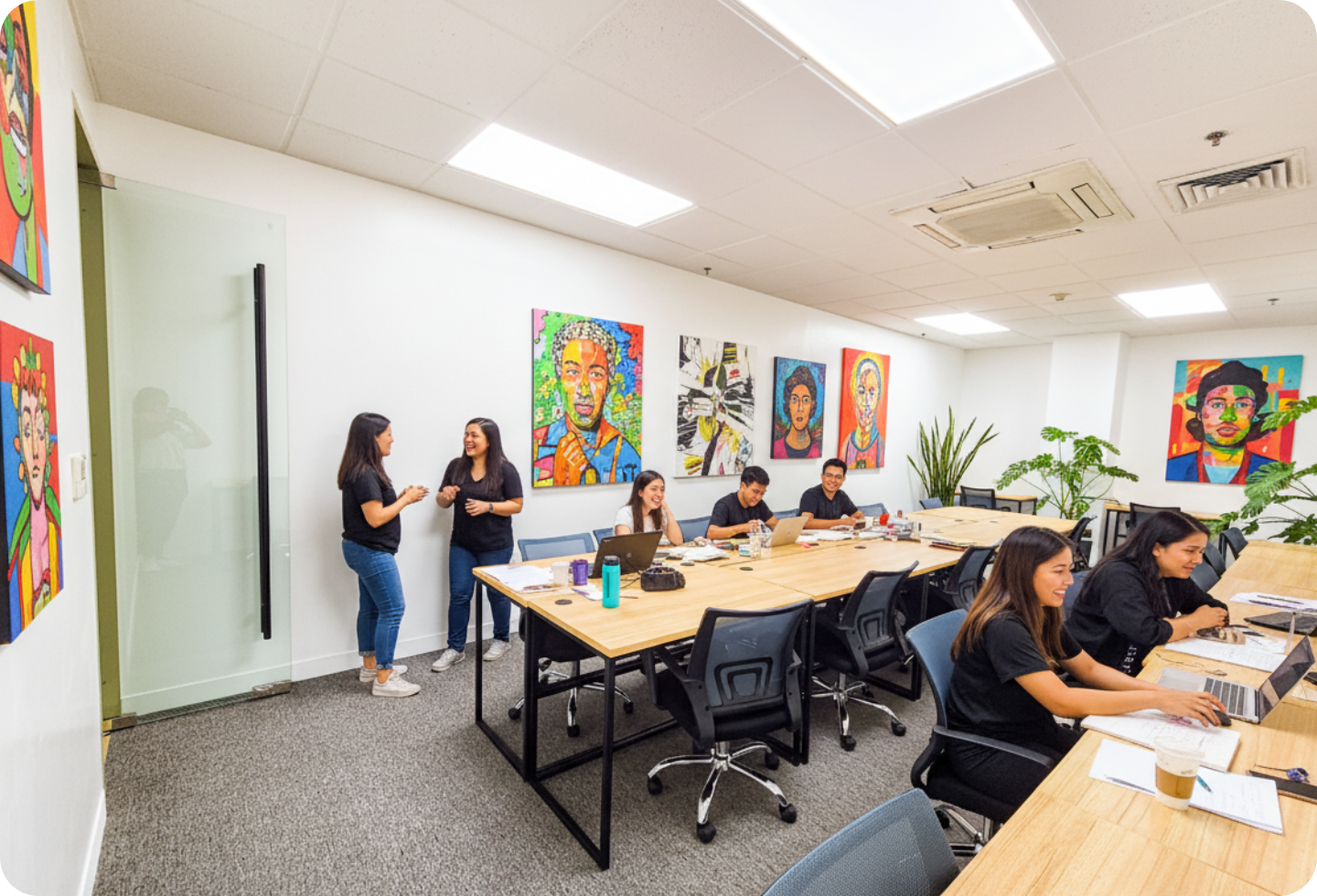
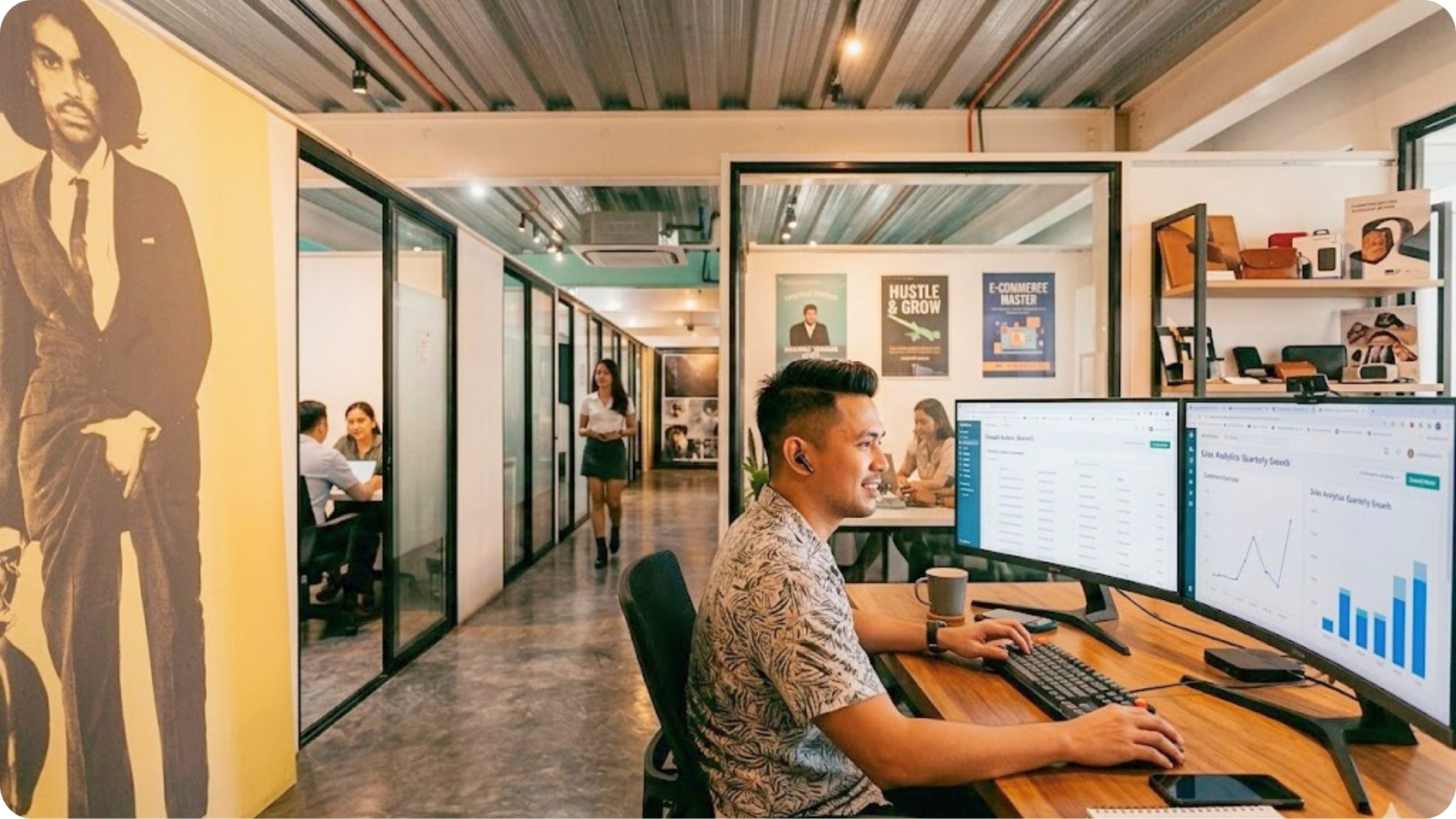
When your Philippine team has access to a professional, well-equipped, comfortable office space, several things happen simultaneously. Collaboration improves because informal conversations become possible. Productivity increases because the environment is optimised for work. Professional identity is strengthened because employees feel they work for a real, serious company — not a remote contractor arrangement where they are kept at arm’s length.
There is also a powerful signalling effect. Providing an office says, clearly and non-verbally: we take you seriously. You are part of something. You belong here.
For companies that are not ready to lease and manage their own dedicated space, serviced co-working environments and managed office suites offer all of the cultural and productivity benefits without the operational overhead. At The Company, we see this effect directly. Teams that move into our managed office spaces in Manila and Cebu consistently report higher team cohesion, lower turnover, and stronger individual performance compared to their prior remote setups.
3. Build a Recognition Culture That Filipino Professionals Actually Feel
Recognition is not a bonus cheque. It is a system of signals, large and small, that tells people their work is seen and valued.
Filipino culture places significant emphasis on public acknowledgement. Being recognised in front of peers is genuinely meaningful — more so than in many Western workplace cultures, where public praise can sometimes feel performative. For Filipino professionals, it is often a deep motivator.
This means that the recognition systems you design should include public components. A shout-out in the team Slack channel when someone delivers exceptional work. A mention in the all-hands meeting. A written commendation that goes into their personnel file and feeds into their performance review.
The 13th month pay — a mandatory benefit in the Philippines — is a baseline, not a differentiator. What sets employers apart is additional performance bonuses, anniversary gifts, and the small but consistent gestures that accumulate into a feeling of being valued: a birthday message from the CEO, a care package during a difficult period, a small gift on a work anniversary.
4. Fund Learning and Development
The Filipino workforce is young, educated, and hungry to grow. The average age of a Filipino professional is significantly lower than their counterparts in Australia, the US, or the UK. They are at a stage in their careers where learning opportunities are a genuine competitive differentiator for employers.
Learning and development does not require a large budget or a formal training programme. It starts with the small signals: a manager who explains the reasoning behind a decision rather than just issuing an instruction. A company that shares its strategy with the whole team. A subscription to an online learning platform that employees can use at their discretion.
Beyond the informal, consider structured development investments that directly benefit both the employee and the business. A customer service team member who receives communication training will handle clients better. A data analyst sponsored through a certification will deliver more sophisticated insight. For overseas employers, sponsoring skills development has an added benefit: employees who feel their employer is investing in their future are significantly less likely to leave for a marginally higher salary elsewhere.
5. Design Communication Systems That Make Everyone Feel Included
The most common source of disengagement in offshore teams is simple: people feel like they are not in the loop.
Decisions get made in the Australian or US office and communicated to the Philippine team as faits accomplis. Strategy discussions happen in meetings that the Philippine team is not invited to. Over time, the Philippine team begins to feel like executors of instructions rather than genuine members of the company.
This is fixable — but it requires deliberate communication design. Start with asynchronous documentation. If a decision is made, write it down and share it. Then build synchronous touchpoints that the Philippine team can actually attend — scheduling at least some all-hands meetings at times that work for Manila or Cebu time. Finally, create informal communication channels: a #watercooler Slack channel, a monthly virtual coffee roulette, small things that create the texture of a real team relationship.

The Multiplier Effect: How a Physical Presence Amplifies All Five
All five of the engagement strategies above become significantly easier to execute when your Philippine team is based in a shared, professional office environment. One-on-ones are more natural when colleagues share a space. Recognition lands harder in person. Learning happens organically when people can turn to each other with questions. Communication is smoother when someone can walk over and ask, rather than send a message and wait.
This is the strategic case for the physical office in a remote-capable world. It is not that remote work is impossible. It is that the systems required to maintain engagement at distance are complex, fragile, and expensive to manage. A well-run office simplifies all of them at once.
Putting It Together
Building an engaged Philippine team is not complicated. It is consistent. The five approaches above — regular one-on-ones with visible career paths, a professional physical workspace, a genuine recognition culture, learning investment, and inclusive communication — create the conditions in which talented Filipino professionals choose to stay, grow, and do their best work.
If you are building a Philippine team and want to give them the best possible environment to work in, we can help. The Company provides managed office spaces in Manila and Cebu, with flexible setups designed for overseas employers who want to offer their Filipino teams a professional, supported workspace without the complexity of managing it themselves.