How to Manage a Hybrid Team Across Australia and the Philippines

The hybrid model — part of your team in Australia, part in the Philippines — is now one of the most common structures for Australian businesses with offshore operations. It offers real advantages: cost efficiency, extended coverage, access to specialised skills, and the ability to scale without the overheads of domestic hiring.
It also, if managed poorly, creates confusion, resentment, and the quiet disengagement that leads to unexpected turnover. This guide is for Australian business owners and managers who are running or building hybrid teams. It covers what actually works — and where most businesses go wrong.
What Hybrid Really Means in This Context
When we talk about a hybrid team between Australia and the Philippines, we are not talking about a two-days-in, three-days-out arrangement. We are talking about a team that is geographically split across two countries, two time zones, two currencies, and — in many cases — two very different professional cultures.
The Australian side of the team typically handles strategy, client relationships, senior decision-making, and locally regulated functions. The Philippine side typically handles execution, support, operations, and the high-volume work that would be prohibitively expensive to run domestically. Done well, this arrangement creates a team that is genuinely complementary. Done poorly, it creates a two-tier system where the Philippine team feels like outsourced labour rather than real colleagues.
Why Pure Remote Fails Philippine Teams
The Philippines has practical infrastructure challenges that make work-from-home less reliable than in Australia. Home internet connections in Metro Manila and Cebu are frequently unstable, particularly during peak hours or bad weather. Home environments are often small and shared, with limited space for a dedicated work setup.
Beyond the practical, there is a cultural dimension. Filipino professionals broadly prefer working in a structured, social environment. The workplace — and the relationships formed within it — is a significant part of professional identity in the Philippines. A fully remote setup strips away the social texture that many Filipino workers find motivating and sustaining. The result is that fully remote Philippine teams frequently experience higher turnover, more variable performance, and more communication breakdowns than their office-based counterparts.
Getting the Structure Right
A well-run hybrid AU/PH team needs clarity on three structural questions before anything else.
Who sits where, and why? The roles on each side of the operation should be deliberate, not accidental. Australian team members should own the functions that genuinely require Australian presence: client-facing roles, regulatory compliance, senior management. Philippine team members should own the functions where their skills, time zone, and cost structure create genuine advantage: operations, support, data work, finance processing, digital marketing execution.
How does authority flow? In many hybrid teams, the Philippine side has no local decision-making authority at all. Every question goes to Australia. Every approval waits for the next business day. This creates bottlenecks and implicitly communicates that the Philippine team is not trusted. Establish clear decision rights — define what the Philippine team lead can decide independently, what requires consultation, and what escalates to senior management.
Who owns the Philippine team’s day-to-day experience? Appoint a team lead in the Philippines who has a direct line to senior management in Australia. Give them real authority over day-to-day decisions and a clear mandate to surface problems. This person is the connective tissue between the two halves of your business.
Communication Rhythms That Work
The single biggest source of hybrid team dysfunction is communication that was designed for one location and applied to two. Time zones between Australia and the Philippines are manageable — Manila is one to three hours behind Australian eastern states — but relative manageability does not mean automatic alignment. You need to design your communication rhythms with both teams explicitly in mind.
Weekly all-hands or team stand-up: Hold a brief weekly meeting that includes both the Australian and Philippine teams. Keep it short — 20 to 30 minutes — and focused on priorities, blockers, and cross-team coordination. Schedule it at a time that works for both sides. Early morning in Australia (before 9:30am AEDT) typically falls within normal hours in Manila.
Asynchronous documentation as a default: For any decision, strategy update, or priority change, write it down and share it. A weekly written update from the Australian side — even a five-bullet summary — maintains alignment and reduces clarification questions.
Informal communication channels: Create space for non-work conversation that builds relationships across distance. A #general Slack channel, a monthly virtual team quiz — small things that make the team feel like a team rather than two separate businesses sharing a workspace.
Managing Performance Without Micromanaging
Overseas managers often fall into one of two failure modes: disappearing entirely or micromanaging. Neither works well. The answer is outcomes-based management. Define clearly what success looks like for each role and each project. Agree on measurable metrics — response times, output volumes, quality standards, completion rates. Then manage to the outcomes, not the activity.
One cultural note: Filipino professionals tend to avoid direct confrontation and may not surface problems proactively, particularly to overseas managers they see infrequently. Build feedback channels into your communication rhythms — regular pulse surveys, anonymous feedback options, and one-on-ones where your team lead actively creates space for honest input.
Tools and Systems for Hybrid Success
You do not need a sophisticated technology stack to run a hybrid team well. You need a small number of tools used consistently. For communication: Slack or Microsoft Teams. For project management: a single shared tool both teams use — Asana, Monday.com, or ClickUp. For documentation: a shared knowledge base (Notion, Confluence, or a well-structured Google Drive) where processes, decisions, and team information live. For HR and payroll: if your Philippine team is employed through an Employer of Record (EOR), your provider will handle payroll, compliance, and employment administration.

The Role of a Manila or Cebu Anchor Office
One of the most underutilised levers in hybrid team management is the physical office for the Philippine side. When your Philippine team is distributed and working from home, coordination happens across multiple individual setups with no shared physical environment and no collective team culture.
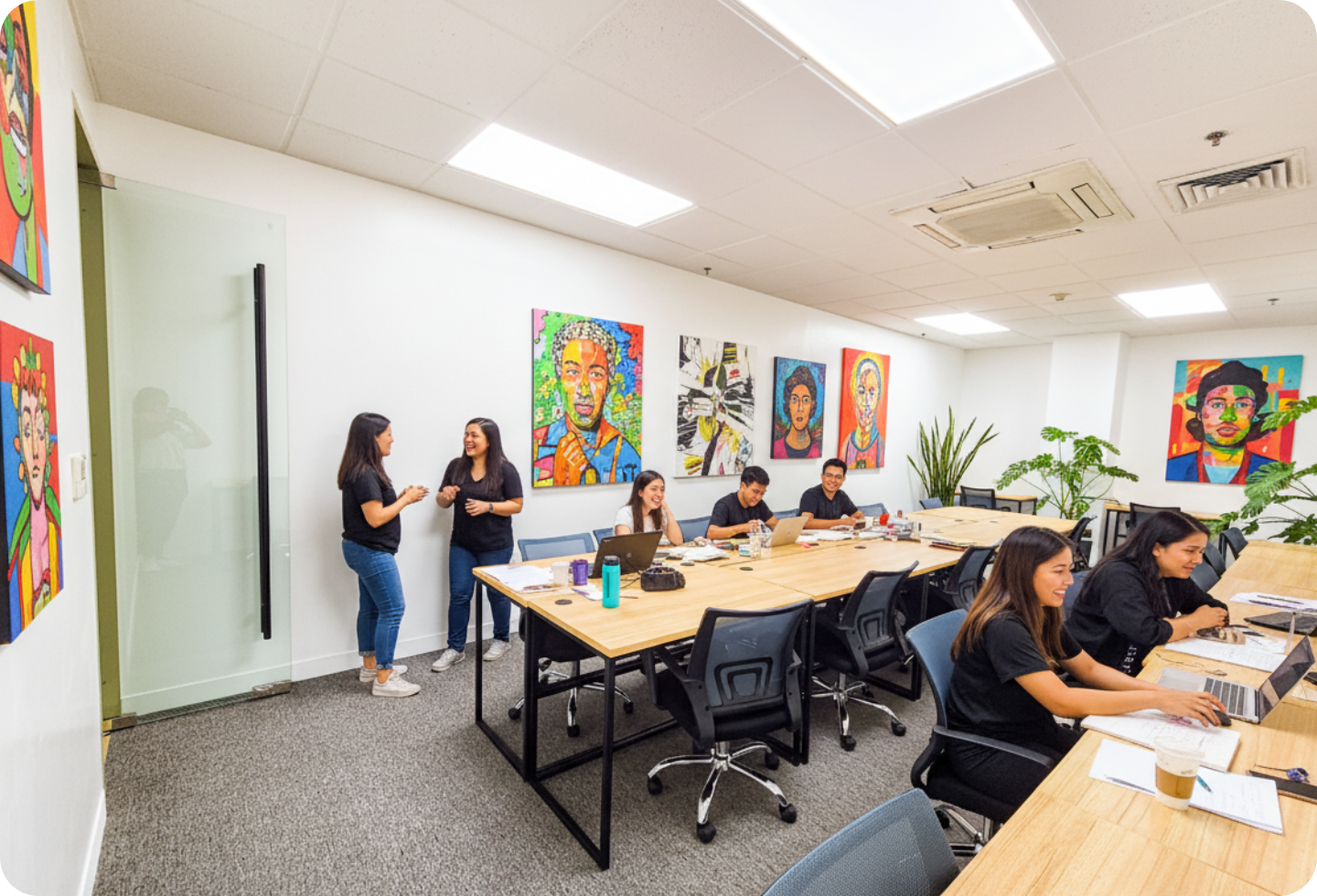
When your Philippine team is based in a shared, professional office — whether a co-working space, a serviced suite, or a dedicated managed office — several things improve at once. Communication becomes more reliable. Team cohesion increases. Performance is more consistent. And your Australian management team gains a clearer picture of what the Philippine operation actually looks like.
The Company provides managed office solutions in Manila (Makati) and Cebu (IT Park, Mandaue) specifically designed for overseas employers building Philippine teams. Our spaces offer professional infrastructure, flexible sizing, and the operational support that makes running a hybrid team significantly simpler.
Common Hybrid Mistakes — and How to Avoid Them
Treating the Philippine team as a vendor rather than a team. If your communication is limited to task assignments and deliverable reviews, you have not built a hybrid team. Invest in relationship, context-sharing, and inclusion.
Never visiting. There is no substitute for in-person connection. Australian managers who visit the Philippine office — even once or twice a year — consistently report stronger relationships and better performance.
Assuming Australian management styles transfer directly. Direct, low-context communication styles that work well in Australia can feel brusque to Filipino colleagues. Invest a small amount of time in understanding Filipino professional culture — particularly around hierarchy and the importance of personal relationships.
Ignoring the infrastructure question. If your Philippine team is working from unreliable home setups, you are accepting a productivity and reliability tax every day. Solve the infrastructure question — with a proper office — and watch the other problems get easier.
Making Hybrid Work
The hybrid AU/PH model works well when it is designed well. Clear structural choices about who sits where and why, communication systems that serve both sides, outcomes-based performance management, the right technology stack, and a physical anchor for your Philippine team — these create the conditions for a genuinely high-performing hybrid operation.
If you are building or restructuring a hybrid team in the Philippines, we would love to help. The Company provides managed office space and operational support for overseas employers across Manila and Cebu — the physical foundation your hybrid team needs to perform at its best.