A Filipino App Developer’s Daily Routine Working for an Overseas Employer

It’s 7:45am on a Tuesday in Makati. Ramon is already on his second coffee, headphones on, waiting for the standup to start. In forty-five minutes, his Australian manager will join from Melbourne — it’s 10:45pm there — and the team will run through what’s in progress, what’s blocked, and what needs to move today. Then Ramon will have the next five hours largely to himself before the day winds down and the handoff begins.
This is what the daily rhythm looks like for a lot of Filipino app developers working for overseas clients. It’s not glamorous in the way that remote work gets described in tech lifestyle content. But it works — and for developers who’ve figured out how to make it work well, it’s one of the better career positions available in the Philippines right now.
| Time | Activity | Mode |
|---|---|---|
| 7:00 – 8:00 | Morning focus time Check Slack and email, review overnight messages, tackle the hardest tasks first. | Async |
| 8:00 – 8:15 | Daily standup Share what’s done, in progress, and blocked. The Australian team joins at ~11pm their time. | Meeting |
| 8:15 – 11:00 | Overlap window with employer Sprint planning, 1-on-1s, product reviews. The only window for real-time questions and decisions. | Overlap |
| 11:00 – 13:00 | Core development (morning) Feature work, bug fixes, code reviews. Australia goes offline — best deep focus window of the day. | Deep work |
| 13:00 – 14:00 | Lunch and break A proper stop. Easy to skip when working from home — but important for sustained output. | — |
| 14:00 – 16:00 | Core development (afternoon) Continue sprint work, respond to async reviews, local team collaboration if applicable. | Deep work |
| 16:00 – 17:00 | Handover prep Log progress, blockers, and next steps in Slack/Jira before the Australian team’s morning begins. | Async |
| 17:00 – 18:00 | End-of-day update Post a brief summary to the team channel. This becomes the Australian team’s morning briefing. | Async |
| Evening (optional) | After hours New tech, side projects, professional development. Not an obligation — a long-term career investment. | — |
The Morning Setup: Before the Team Wakes Up
Most Filipino developers working for Australian companies start somewhere between 7am and 9am. The overlap window — the hours when both Manila and the Australian east coast are online at the same time — runs from roughly 7am to 11am Manila time, depending on the season and whether Australia is in daylight saving. During Australian winter (April to October), the gap narrows to two hours. During summer, it stretches to three. Either way, it’s limited, and experienced developers have learned to use it strategically.
The first hour of the day tends to be quiet and productive in a way the rest of the day isn’t. Before the Australian team is fully online, before Slack fills up with questions, before the first meeting kicks in — there’s a window of uninterrupted focus time that experienced remote developers protect carefully. Ramon uses it to work through whatever requires the most concentration: complex logic, debugging, architectural decisions. The things that get derailed the moment notifications start arriving.
The physical setup matters more than people admit. Developers who’ve been doing this for two or three years tend to have invested seriously in their workspace — a proper external monitor, a good chair, a mechanical keyboard, a reliable fibre connection with a mobile backup for outages. Not because it’s a luxury, but because a dropped connection during a deployment or a back injury from bad posture are real costs that compound over years. The companies that actually think about their overseas team often contribute to this: a home office stipend, reimbursement for equipment, or a subsidised desk at a co-working space. If a company hasn’t thought about this at all, it tells you something about how seriously they’ve invested in making the arrangement sustainable.
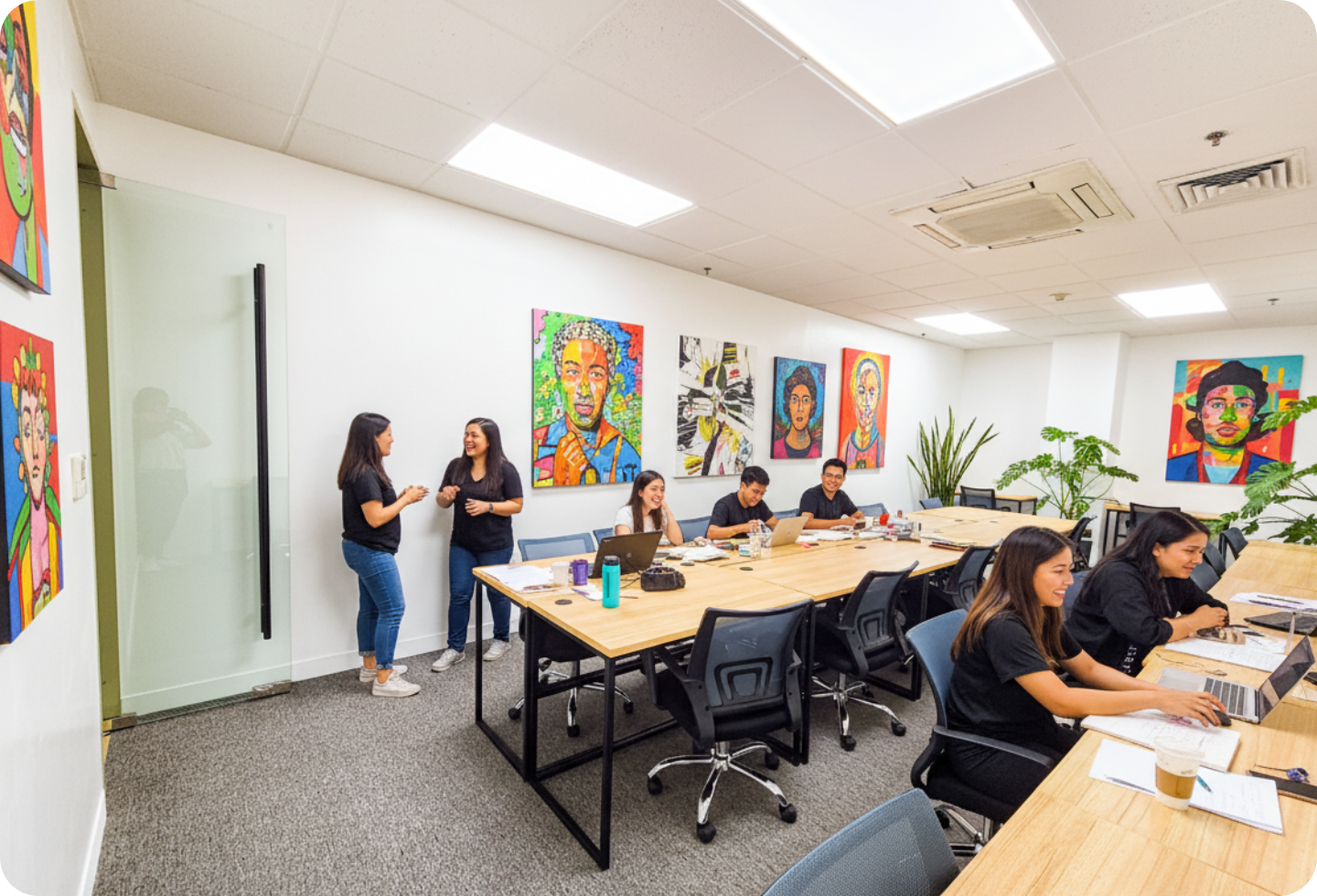
The choice between working from home and a co-working space is one of the more personal decisions in this lifestyle. Working from home offers total control over the environment — no commute, no shared noise, no interruptions unless you allow them. Co-working gives you the social infrastructure that remote work quietly removes: other people, ambient activity, the physical separation between “at work” and “not at work” that a home desk can blur. Many developers split their week — home for deep focus days, co-working on days with multiple meetings or when the isolation starts to weigh on them.
The Daily Standup: Short, Structured, and Cross-Timezone
Daily standups in cross-timezone teams are almost always at an awkward hour for someone. Ramon’s team runs at 8am Manila time — which is 11pm in Melbourne, late but workable for his manager who runs a flexible schedule. Teams with US clients often push this even earlier: a 7am Manila standup puts it at a reasonable afternoon slot on the US West Coast, but it means the Manila-based developer is online before most of the city has started moving.
The standup itself runs about fifteen minutes. What’s done, what’s in progress, what’s blocked. The format is tight because both sides are used to it and because nobody — the Australian manager included — wants a fifteen-minute meeting to stretch to forty-five. There’s a discipline that remote teams develop around meeting efficiency that co-located teams often lack. When everyone is on a screen and one person is at the end of their workday while another is at the start, brevity is a courtesy.
What doesn’t fit into the standup goes into Slack threads or Jira comments — documented, searchable, available to whoever needs them at whatever hour they’re working. This documentation habit is one of the things that distinguishes experienced remote developers from those who are still learning how distributed teams work. If it’s not written down, it doesn’t exist for the other half of the team. A verbal decision made in a quick voice call that never gets captured in a ticket or a message is a decision that will be relitigated in two weeks when no one can remember what was agreed.
Meetings With the Employer: Less Is More, But They Matter
Beyond the daily standup, most Filipino developers working for overseas employers have somewhere between two and four scheduled meetings per week with their Australian counterpart or team. These are different from the standup — longer, more substantive, and serving a different purpose.
Sprint planning usually happens once a week and typically runs 45 minutes to an hour. This is where the upcoming work gets scoped and prioritised. For Ramon, it’s one of the most important meetings of the week — not just because it sets the direction for the next sprint, but because it’s one of the few moments where he can surface questions, flag scope concerns, and have a real conversation about tradeoffs before the work is already underway. Developers who treat sprint planning as a passive exercise — listening, nodding, accepting the tickets as handed — tend to find themselves implementing requirements that don’t quite make sense. The ones who engage actively, who ask why before they ask how, produce better work and build more credibility with their overseas clients over time.
One-on-ones with the direct manager or team lead happen roughly fortnightly in most setups. These meetings are where the relationship actually gets built — beyond tasks, beyond tickets, beyond sprint velocity. A good one-on-one covers not just what’s in progress but how things are going more broadly: workload, blockers, anything that’s been unclear or frustrating, and what the developer is working toward professionally. Managers who run these well create the conditions for their Filipino team members to raise issues before they become problems.
Occasional product or design reviews bring the wider team together — sometimes including Australian stakeholders who aren’t part of the day-to-day development team. These meetings require different preparation. Ramon learned early that being able to speak to why a technical decision was made — not just what was implemented — changed how he was perceived. Australian stakeholders who rarely interact with the Philippines-based team form impressions quickly. A developer who can handle a question from a non-technical stakeholder clearly and confidently is one who gets remembered and trusted with more responsibility.
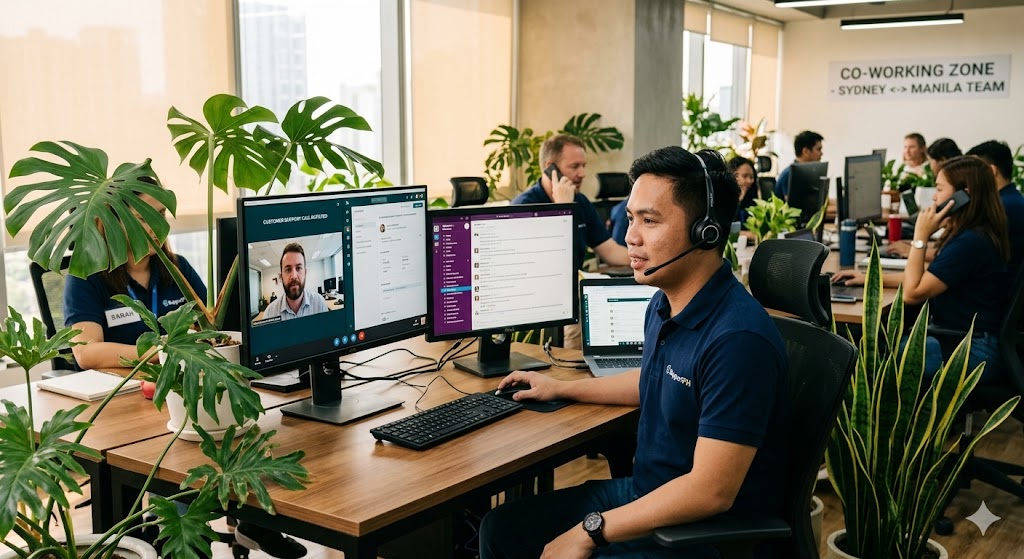
The unscheduled conversations matter too. A quick voice call when something is complex enough that Slack messages won’t cut it. A video check-in when a project hits an unexpected obstacle. The willingness to jump on a call at short notice — when the timing works on both sides — signals something about how invested you are in the outcome. It’s not about always being available. It’s about being reachable when it actually matters.
Core Development Hours: Where Most of the Work Happens
After the standup and any morning meetings, Ramon’s calendar is typically clear until early afternoon. This is the core development window — the part of the day he protects most carefully and where the meaningful work happens.
The work itself looks like any other developer’s work: features, bug fixes, code reviews, testing, deployment prep. What’s different is the context. Ramon is building software for users who are mostly in Australia or New Zealand. The product decisions are made in Melbourne. The design feedback comes from someone who hasn’t been to the Philippines. The sprint priorities reflect a market he experiences entirely through Jira tickets and user research documents.
This requires a particular kind of professional translation. Understanding not just what to build but why — what the user need is behind the ticket, what the business context is, what “done” looks like from the client’s perspective. Developers who treat their work as pure execution — implement the spec, close the ticket — plateau early. The ones who build long careers in these roles are the ones who develop genuine product intuition, who push back when a spec doesn’t make sense, and who think about the end user even when they’ve never met one.
Communication during this window is mostly asynchronous. The Australian team is asleep or winding down. Slack messages get responses in hours, not minutes. Ramon has learned to frame his questions in ways that don’t require real-time back-and-forth — enough context that the Australian end can answer once, fully, rather than triggering a five-message chain that spans two time zones and takes all day to resolve.
The Middle of the Day: Rhythm and Recovery
Lunchtime in Manila — noon to 1pm — is generally quiet on the work front. The Australian team is well into its evening. There are no meetings. Ramon takes a proper break: a meal, a walk, occasionally a short rest. The discipline of actually stopping for lunch is something a lot of remote workers struggle with, especially when the line between “break” and “still at my desk, sort of working” gets blurry when your office is a corner of your apartment.
The afternoon is often a mix of focused work and collaboration prep. Reviewing the morning’s commits. Responding to Slack messages that accumulated while Manila was working and Australia was sleeping. Writing up anything that needs context before the Australian morning standup — the handover notes, the status updates, the questions that need answers before tomorrow’s sprint work can continue.
For developers on a team with Filipino colleagues — which is increasingly common as overseas employers build out Philippines-based headcount — the afternoon can also involve local team dynamics: pair programming, informal code reviews, shared lunch if they’re co-working in the same space. This local community is one of the things that makes the overseas employer model sustainable: you’re part of an international team, but you’re not isolated from colleagues who understand your context day-to-day.
The End-of-Day Handover: The Habit That Builds Trust
Somewhere between 4pm and 6pm Manila time, the Australian team starts coming online for their morning. This is the handover window — one of the highest-leverage moments in a distributed developer’s day, and one that’s handled poorly more often than it should be.
A good handover is brief, specific, and useful. What was completed today. What’s in progress and where it stands. What’s blocked and what would unblock it. Any decisions that need to be made before tomorrow. Anything the Australian team needs to know before they start their sprint day. Five to eight sentences in a shared Slack channel or project management tool.
A bad handover is no handover — or a vague one that leaves the Australian team piecing together status from commit messages and Jira updates. The cost of a poor handover isn’t just inconvenience: it’s a half-day of lost momentum, and a slow erosion of the trust that makes cross-timezone collaboration work at all.
Ramon writes his end-of-day update in a shared channel before he closes his laptop. It takes ten minutes. Over three years of working this way, he’s come to see it as one of the most important habits in his professional practice — not because the content is always significant, but because the consistency of it tells his Australian manager something about how he works. Reliable communication builds the kind of trust that creates autonomy, and autonomy is what makes this working model genuinely good long-term rather than just financially advantageous.
After Hours: Staying Sharp Without Burning Out
The workday ends, but the professional investment often continues — selectively and sustainably. Filipino developers in overseas roles who stay technically current tend to invest their evenings with intention: a specific course, a side project, following the corners of the developer community that are most relevant to their current work. Not obsessively, and not at the expense of actual rest, but enough to keep the technical edge sharp in a field where the landscape shifts quickly.
This is one of the underappreciated advantages of the income stability that comes with a well-paying overseas role. The financial pressure that forces some developers into freelance project-hopping — taking any work that comes in, rarely having time to invest in skills outside of immediate client requirements — is reduced. There’s enough runway to be selective about what you learn and how you build your technical direction.
The developers who sustain long careers in overseas roles are almost always the ones who kept building technically while building professionally. They didn’t coast on the skills that got them hired. They learned new frameworks when their current stack started showing its age. They developed opinions about architecture and product that went beyond implementation. By the time they’ve been in a role for three or four years, they’re a materially different developer than the one who was hired — which is exactly what a good overseas employer wants to see.
What Makes It Work — and What Doesn’t
The developers who thrive in overseas roles over a multi-year period tend to have a few things in common. They’ve got a solid technical foundation and keep investing in it. They communicate proactively, not reactively. They’ve learned to make their work visible across time zones. They understand the product well enough to make good judgment calls when the Australian team isn’t available. And they’ve figured out how to maintain a genuine separation between work and non-work time — which is harder than it sounds when your desk is ten steps from your bed.
The developers who struggle tend to have different patterns. Waiting to be told what to do rather than filling gaps proactively. Letting communication slip during the quiet periods when the overseas team isn’t online. Treating the overseas nature of the role as a reason to be less engaged rather than more. The distance cuts both ways — it creates autonomy, but it also makes it easier to disengage in ways that go unnoticed until they don’t.
The employment structure matters too, in ways that aren’t immediately obvious. A developer in a proper employment arrangement — with a local employer of record, regular SSS and PhilHealth contributions, a regularisation timeline — has a different relationship to the work than one operating as a contractor on a month-to-month invoice basis. The former creates the stability that allows someone to invest in a role long-term. The latter creates a different kind of psychological relationship to the work: more transactional, more contingent, less conducive to the deep investment that makes overseas employment genuinely career-building.
The daily routine itself — the early mornings, the structured standups, the protected focus windows, the end-of-day handovers, the meetings with the Australian employer — isn’t glamorous. But it’s the infrastructure that makes everything else work: the career growth, the income, the professional development, the long-term stability. For Filipino app developers who’ve built that infrastructure deliberately and work for employers who’ve invested in making it sustainable, this isn’t just a job. It’s a career that travels well.