Why Your Philippine Team Works Better in an Office: Productivity, Hiring, and the EOR Advantage

When Australian companies hire their first Filipino employee, the default assumption is usually “remote.” It’s cheaper, simpler to set up, and fits the image of what overseas hiring is supposed to look like. The employee works from home, communicates via Slack, and joins standups on a laptop from their bedroom.
That arrangement works — sometimes. But for a growing number of overseas employers, the question isn’t whether remote is possible. It’s whether remote is actually the best setup for their team. The answer, more often than the industry talks about, is no. And the solution — pairing an Employer of Record arrangement with a real office environment — is both more accessible and more impactful than most employers realise.
The Reality of Working From Home in the Philippines
The Philippines has one of the highest rates of remote work adoption in Southeast Asia, and the enthusiasm for overseas employment is genuine. But the infrastructure that makes remote work function well in Australia or the US — reliable broadband, stable power, a quiet home workspace — is far less consistent here.
Internet connectivity is a persistent issue. The Philippines ranks among the lower performers in Southeast Asia for fixed broadband speed and reliability. Brownouts — unannounced power interruptions — are common in Metro Manila and significantly more frequent in regional areas and Cebu outside of IT Park. A developer mid-deployment, or a customer support specialist on a live call, has very little recourse when the power goes out.
The housing situation compounds the problem. A significant proportion of Filipino professionals live in extended family households — multigenerational homes where multiple people share limited space. A dedicated home office is a luxury that most workers in their twenties and early thirties simply don’t have. Working from a shared bedroom, a kitchen table, or a converted corner of a living room is the reality for a large share of the Filipino remote workforce.
None of this makes remote work impossible. Many Filipino professionals manage these constraints with considerable ingenuity — mobile data as backup, carefully scheduled work hours around household noise, noise-cancelling headphones as a tool of survival. But it does mean that the productivity baseline for a well-supported office worker and an unsupported home worker is not the same. And for overseas employers who don’t see the environment their team is operating in, the gap is easy to miss until it becomes a problem.
WFH vs Office: A Productivity Comparison
The productivity debate around remote versus in-office work has generated more heat than light globally, but in the Philippines context, a few things are fairly clear.
Concentration and deep work. Tasks that require sustained focus — coding, writing, analysis, detailed financial work — are directly affected by environment. An office with a quiet zone, noise-insulated phone booths, and ergonomic seating creates conditions for deep work that a shared home simply can’t replicate. The psychological effect of a commute, however short, also matters: physically leaving home and arriving at a workspace triggers a shift in mental mode that many remote workers report missing. The transition is part of the preparation.
Communication quality. Asynchronous communication works well for planned interactions, but distributed teams consistently underestimate the value of the informal, unplanned exchanges that happen in a shared physical space. A question that would take two Slack messages and a four-hour wait gets resolved in thirty seconds when two team members are in the same room. For Filipino teams where several members are working for the same overseas employer, an office creates this ambient collaboration — the kind that doesn’t get captured in sprint velocity metrics but significantly affects the quality of outcomes.
Self-management and accountability. This is the area that’s hardest to discuss without sounding critical of remote workers — but it’s real. The structure that an office provides is not trivial. Fixed hours, physical presence, the social expectation of productivity, the visibility of colleagues working around you — these are genuine inputs to sustained, consistent output. They matter more for some roles and personality types than others, and they matter more at certain career stages. A highly experienced senior developer with years of remote discipline is a different case from a junior hire in their first professional role. Overseas employers often don’t distinguish between these profiles when setting up their team’s working model.
Which roles benefit most from office environments. Customer-facing roles — support, account management, sales — perform measurably better in structured environments with technical reliability. Developer teams of two or more benefit from in-person collaboration that accelerates onboarding, code review, and problem-solving. Roles involving sensitive data — finance, legal support, compliance — operate more securely in a managed office environment than in a home setting. The more the role involves coordination with others, the stronger the case for a shared physical space.
Why Having an Office Makes You a Better Employer — From the Candidate’s Perspective
The productivity argument matters to employers. But there’s a parallel argument that matters just as much, and it operates from the other direction: what does the candidate see when they evaluate your opportunity?
Filipino professionals have options. The overseas employment market has matured significantly — there’s no shortage of Australian, American, and European companies hiring remotely in the Philippines, and candidates at the senior and mid-level have real leverage. When two opportunities are broadly comparable in compensation, the details of the working environment become deciding factors. And office access, consistently, is one of those details.
The legitimacy signal. An overseas employer who provides a proper office environment communicates something important: this is a real company that invests in its people. The contrast with pure remote setups — where the employer is sometimes hard to verify, the working arrangement can feel transactional and impermanent, and the employee has no local anchor — is significant. Filipino professionals, particularly those with experience in BPOs or established multinational companies, are accustomed to a professional environment as the baseline. An office matches that expectation.
Isolation is a real retention risk. Remote work isolation is well-documented globally, but it operates with particular force in the Philippines, where professional identity and community are deeply intertwined. Filipino workplace culture emphasises connection, camaraderie, and collective experience in ways that pure remote arrangements systematically remove. Employees who feel isolated are more likely to disengage, and more likely to accept a competing offer that comes with a physical community. Turnover in fully remote setups is not an accident — it’s a structural outcome of removing the social infrastructure that keeps people engaged.
Career development requires visibility. A remote employee is functionally invisible in ways that an office-based employee is not. They cannot be mentored informally. They cannot observe how senior colleagues handle difficult situations. They cannot build the professional relationships that open doors — whether inside the organisation or in the broader professional community. Filipino professionals who are thinking seriously about their careers understand this. An employer who offers a structured environment — with real colleagues, real mentorship opportunities, and a professional community — is offering something that a purely remote employer cannot match.
The quality of candidates who choose office-supported roles. This is perhaps the most commercially significant point for overseas employers: the candidate pool for office-supported positions skews toward more experienced, more professionally ambitious individuals. The best Filipino talent is not uniformly seeking remote work. Many of the most capable professionals — those who have built careers in established institutions — actively prefer structured environments. If your hiring model is fully remote by default, you are systematically missing a significant portion of the highest-quality candidates in the market.
EOR Plus Office: What the Combination Actually Means
Most overseas employers understand, at least in principle, what an Employer of Record does: it provides the legal infrastructure to hire Filipino employees compliantly — SSS, PhilHealth, Pag-IBIG contributions, regularisation, proper employment contracts — without requiring the overseas company to establish a Philippine legal entity. The EOR is the employer on record; the overseas client directs the work.
What fewer employers realise is that EOR and office access can be bundled into a single, integrated solution. The same provider who handles the legal employment infrastructure can also provide the physical workspace — eliminating the need for the overseas employer to source, negotiate, fit out, and manage a separate office arrangement. For a company hiring five people in Manila, this is not a trivial consideration: leasing commercial office space in Makati involves security deposits, long-term commitments, fitout costs, facilities management, and ongoing administration that a small overseas employer is rarely equipped to handle.
A bundled EOR and workspace solution removes all of that friction. The employer pays a predictable per-person fee. The employees have a professional, fully-equipped workspace from day one. The legal employment is handled compliantly. And the overseas employer can focus on the actual work, rather than the administrative overhead of operating a remote outpost in a country where they have no direct presence.
The economics are better than most employers assume. A dedicated desk in a premium Makati coworking space, bundled with full EOR compliance, can come in at around USD $350 per person per month for a team of twenty. That is significantly less than the cost of a comparable arrangement attempted piecemeal — separate commercial lease, separate EOR provider, separate HR administration — and it includes amenities that a standalone leased office at that price point would not: meeting rooms, event space, phone booths, high-speed internet with redundancy, on-site support.
The Company’s Offices in Manila and Cebu
The Company operates professionally designed workspaces across three locations in the Philippines — Makati in Metro Manila, and two locations in Cebu — purpose-built for teams working in partnership with overseas employers.
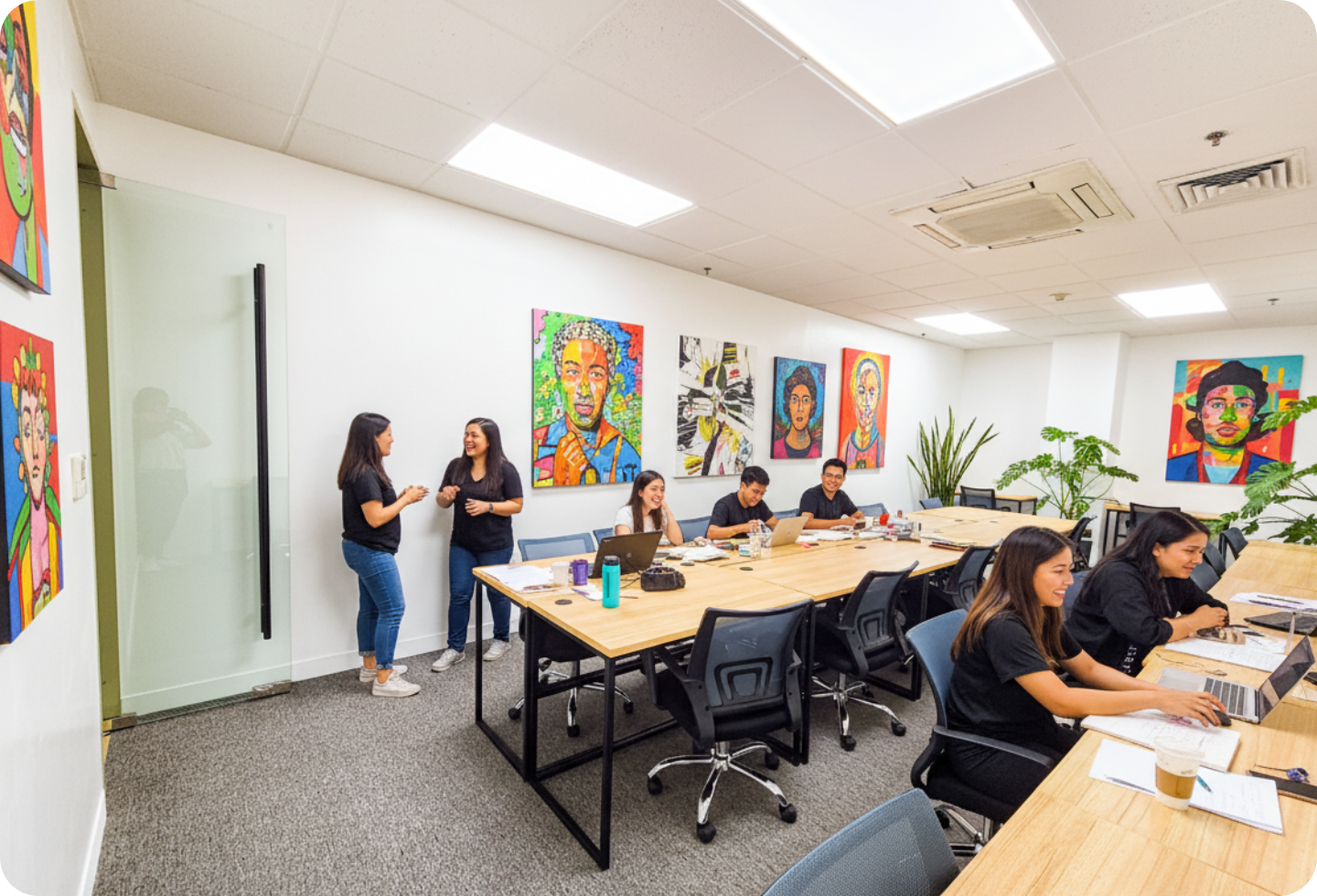
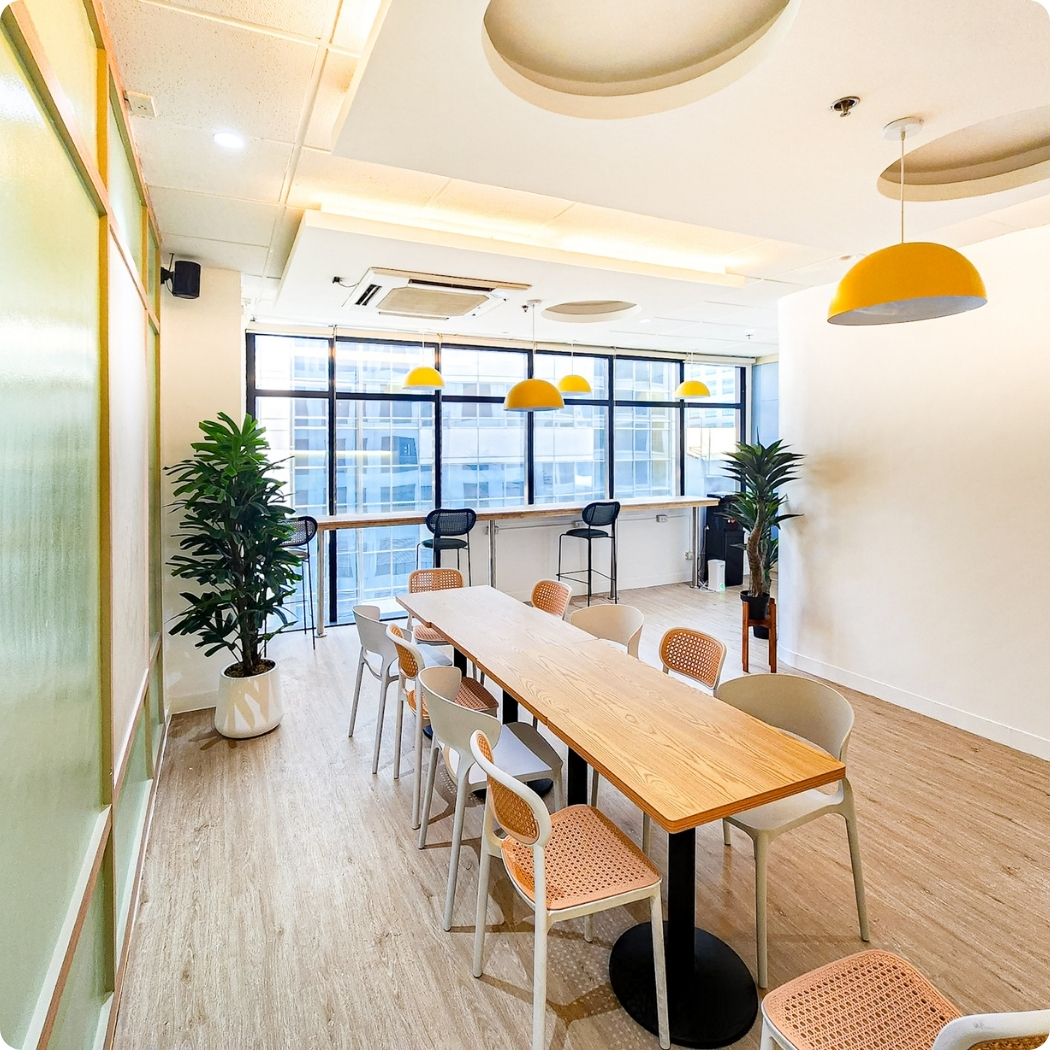
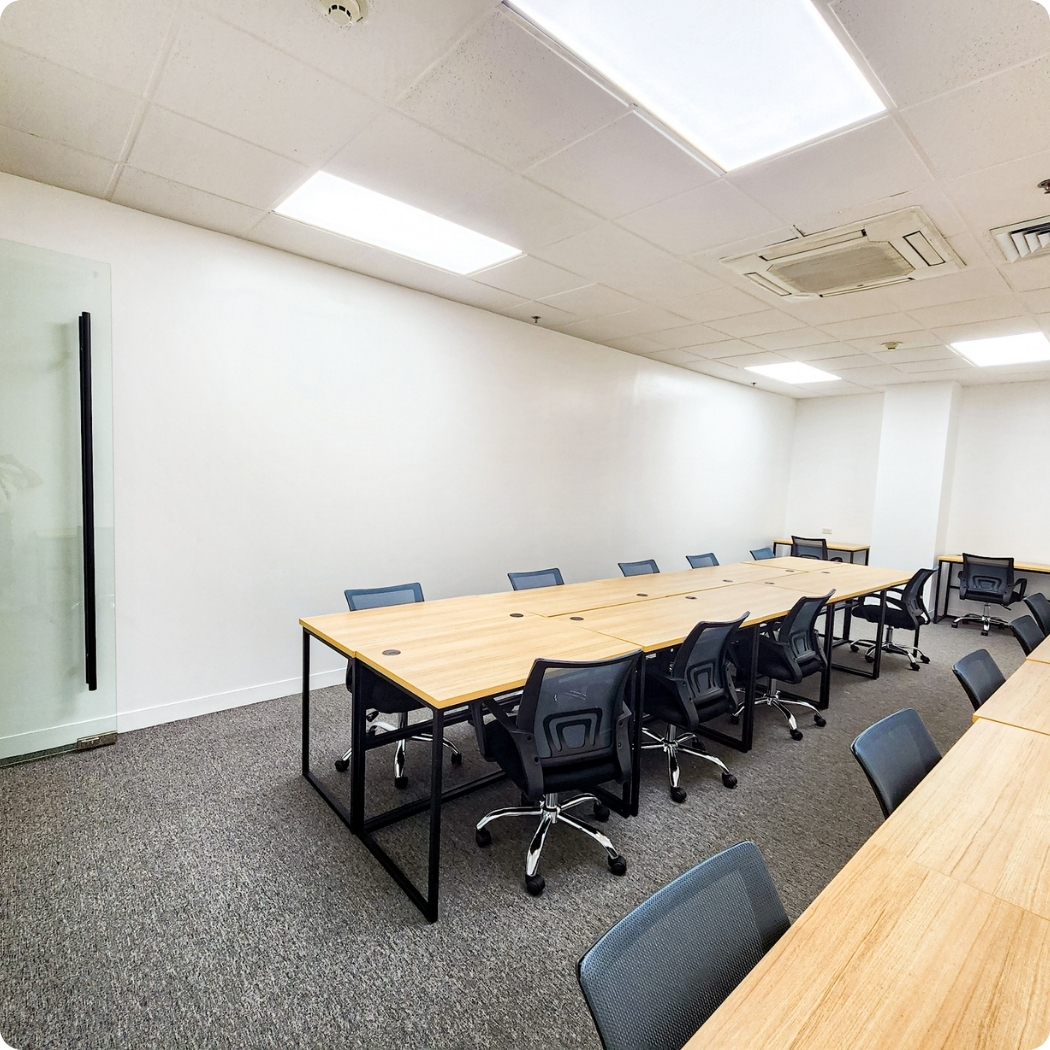
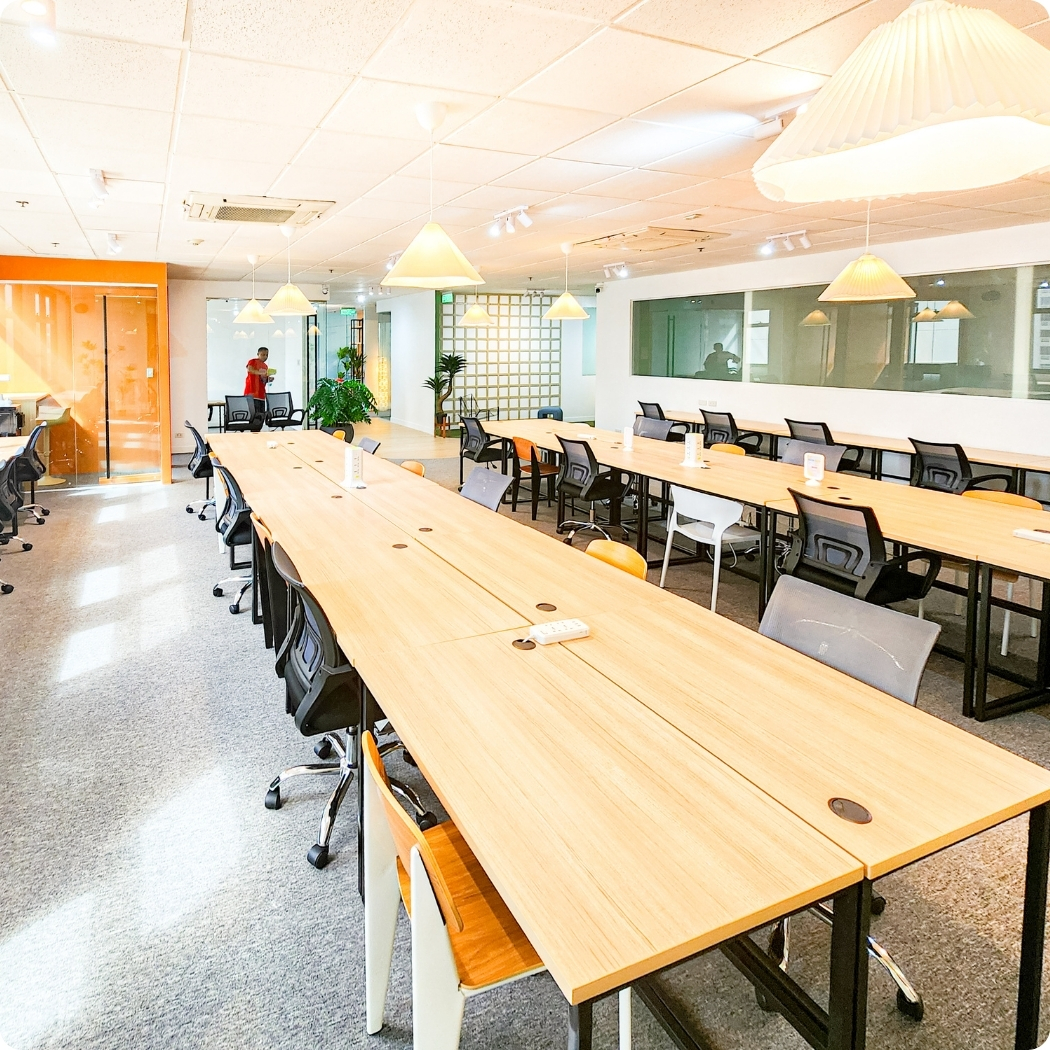
Makati, Metro Manila. The Company’s Makati space occupies the entire 11th floor of Frabelle Business Center on Rada Street, in the heart of Legazpi Village — one of the most walkable, well-serviced business districts in Metro Manila. The 862-square-metre floor holds 13 private offices ranging from executive suites for one or two people up to full-team offices accommodating fifteen to twenty, alongside fifty dedicated desks in a well-designed coworking environment. Amenities include two conference rooms, three soundproof phone booths for private calls and video meetings, a shower room, a fully equipped pantry with free-flowing coffee and tea, and a quiet zone for deep focus work. High-speed Wi-Fi runs throughout the space with on-site tech support. The location puts the team within walking distance of Greenbelt, Ayala Avenue, and dozens of cafés and restaurants — a meaningful quality-of-life factor that employees notice.
Cebu IT Park. The Cebu IT Park location sits on the 6th floor of Mabuhay Tower, inside one of Cebu City’s premier technology and business hubs. IT Park has established itself as the anchor of Cebu’s BPO and technology industry, with a dense concentration of multinational companies, technology professionals, and supporting infrastructure. For overseas employers building teams in Cebu — a market with strong technical talent and a lower cost base than Metro Manila — IT Park provides a professional address and a community that tech-oriented employees recognise and value.
Mandaue, Cebu. The Mandaue location at JDN Square on P. Remedio Street serves the northern Cebu market, offering a well-positioned alternative for teams that prefer accessibility to Mandaue City’s commercial and industrial hub. For businesses with logistics, manufacturing, or supply chain components alongside their remote workforce, Mandaue’s location provides practical advantages that a purely Cebu City address does not.
Across all three locations, the workspace offer includes the same core infrastructure: ergonomic seating, high-speed internet, meeting room access, printing and scanning, phone booths, lounge areas, and a multilocation pass that allows members to use any of The Company’s spaces. For teams that split between Manila and Cebu, or whose members commute between locations, this cross-site flexibility is a genuine operational advantage.
All three spaces are also integrated with The Company’s EOR services — meaning that the same provider handling the legal employment of your Filipino team is also managing the physical workspace they operate from. Single point of contact, single billing relationship, aligned interests.
The Case for Rethinking Your Default
The conversation about remote work has, understandably, been dominated by its benefits: flexibility, cost savings, access to global talent, reduction in office overhead. Those benefits are real, and for some roles and some teams, fully remote is genuinely the optimal arrangement.
But “remote is possible” and “remote is best” are different claims, and they have been conflated in a way that has cost some overseas employers real value — in productivity, in the quality of hires they attract, in retention, and in the long-term engagement of their Filipino team members.
The employers who are getting the most out of their Philippine teams are not the ones who defaulted to fully remote because it was the path of least resistance. They’re the ones who thought carefully about what their team actually needs to do their best work — and who invested in providing it. In many cases, that investment is an office. Not a home office allowance. Not a vague promise of “we support remote work.” An actual professional environment where their team can show up, do serious work, and build the kind of professional community that sustains long careers.
With EOR and office access available as a bundled, managed service, the barrier to providing that environment has never been lower. The question is no longer whether you can afford it. The question is whether you can afford not to.
If you’re building a team in the Philippines and want to understand how EOR combined with workspace access works in practice, The Company’s EOR service covers the full picture — from compliance and contracts through to the physical environments your team will work in every day.