Why US SaaS Companies Are Building QA and Support Teams in the Philippines

SaaS is a people-intensive business at the operational layer, even when the product itself is largely automated. Customer support, quality assurance, customer success, technical implementation, and data operations all require skilled human work — and for most US SaaS companies, those functions are expensive to staff domestically at the scale the business needs.
The Philippines has become one of the primary locations where that problem gets solved.
What’s Driving the Shift
The economics of US SaaS have tightened significantly. Investors are focused on burn rate and path to profitability. And one of the most visible lines in any SaaS cost structure is the operational headcount that runs support, QA, and customer success.
A tier-1 customer support specialist in Manila earns $1,200–$2,000 per month. The same role in Austin or Denver runs $4,500–$6,500. A QA engineer with two years of experience and solid test automation skills in Cebu earns $1,500–$2,500. In San Francisco, that’s a $90,000+ annual salary before benefits and overhead. The math is stark — and the difference isn’t about quality. It’s about market structure. The Philippines has been building deep, specialised talent pools in exactly these functions for over two decades.
Customer Support: Where the Philippines Has the Deepest Track Record
The Philippines has been a global hub for English-language customer support since the early 2000s. The country’s BPO industry — which employs over a million people — is built largely on US companies’ outsourcing of customer-facing functions. What that history means for SaaS companies today is a talent market with genuinely deep experience: Filipino support professionals understand Zendesk, Intercom, Freshdesk, and Help Scout; they know ticket triage, escalation protocols, and CSAT measurement. This isn’t something you train from scratch — it’s experience the talent pool already has.
For SaaS specifically, the support function often requires a step above pure transactional service. Customers have technical questions. Bugs need to be reproduced and documented. Implementation questions require understanding how the software actually works. Philippine professionals with technical backgrounds combined with strong communication skills handle this level well.
The 12–15 hour time zone offset from the US East Coast gives SaaS companies an operational edge on support coverage. A Philippine team on day shift handles overnight US tickets, meaning the queue is clear when the US team arrives in the morning. Companies combining US-based senior support with a Philippine team for volume and coverage are running some of the most cost-efficient support operations in the industry.
QA Engineering: A Fast-Growing Function in Philippine Tech Teams
Quality assurance is one of the fastest-growing areas of Philippine tech employment, and it’s a role US SaaS companies are filling here in increasing numbers. The shift toward automated testing has actually expanded the role that Philippine QA professionals play. Manual regression testing was always a strong fit — detail-oriented, process-driven work that doesn’t require US time zone presence. But as companies have moved toward Selenium, Cypress, Playwright, and API testing frameworks, the Philippine QA talent pool has moved with them.
A QA engineer in Manila or Cebu who can write test scripts, maintain a test suite, integrate testing into CI/CD pipelines, and document defects clearly is a different kind of hire from a manual tester. The documentation and communication discipline QA requires translates well in cross-timezone teams: when Philippine QA engineers are filing issues at midnight US time, the US dev team wakes up to a well-documented queue rather than a blank board.
Which US SaaS Companies Are Doing This?
While most US SaaS companies don’t publicly detail their offshore team structures, the pattern is well established across the industry. TaskUs — founded in the Philippines and now a publicly listed company — has grown to tens of thousands of employees largely by serving US SaaS and tech companies across AI data labelling, trust and safety, and customer support. Concentrix, which operates at massive scale in Manila and Cebu, runs a significant portion of its business from US software clients. Teleperformance similarly has a large Philippine footprint serving US tech companies.
On the direct-hire side, Canva — the design platform founded in Australia but with significant global operations — has built a substantial Philippines-based team covering operations, support, and engineering functions. The pattern of fast-growing software companies establishing a meaningful Manila or Cebu presence is well documented.
For smaller US SaaS companies that aren’t ready to engage a large BPO, the EOR model has changed the calculation entirely. A Series A company can build a team of three to five people in the Philippines — two support specialists, two QA engineers, one operations coordinator — with the same compliant employment structure that an enterprise would use, without the enterprise contract minimums or the months-long setup.
Customer Success: The Emerging Function
Beyond support and QA, customer success is an area where US SaaS companies are increasingly looking at the Philippines. Historically, CS was considered too relationship-intensive to work in an offshore model. That’s changing. Filipino CS professionals who have worked in US SaaS environments understand product-led growth, health scoring, QBR structures, and the communication rhythms of US B2B relationships.
What tends to work well: SMB and mid-market CS, digital and tech-touch programs, onboarding and implementation support, and renewal and expansion outreach. Enterprise and strategic CS — where deep C-suite relationships are the product — remains harder to manage across a 12-hour offset. But for the volume CS work that most scaling SaaS companies need, the Philippines profile fits.
What the Setup Looks Like
For a US SaaS company building its first Philippine team, a common starting point is two to four people across support and QA. From decision to day one under an EOR model typically runs four to six weeks — no local entity required.
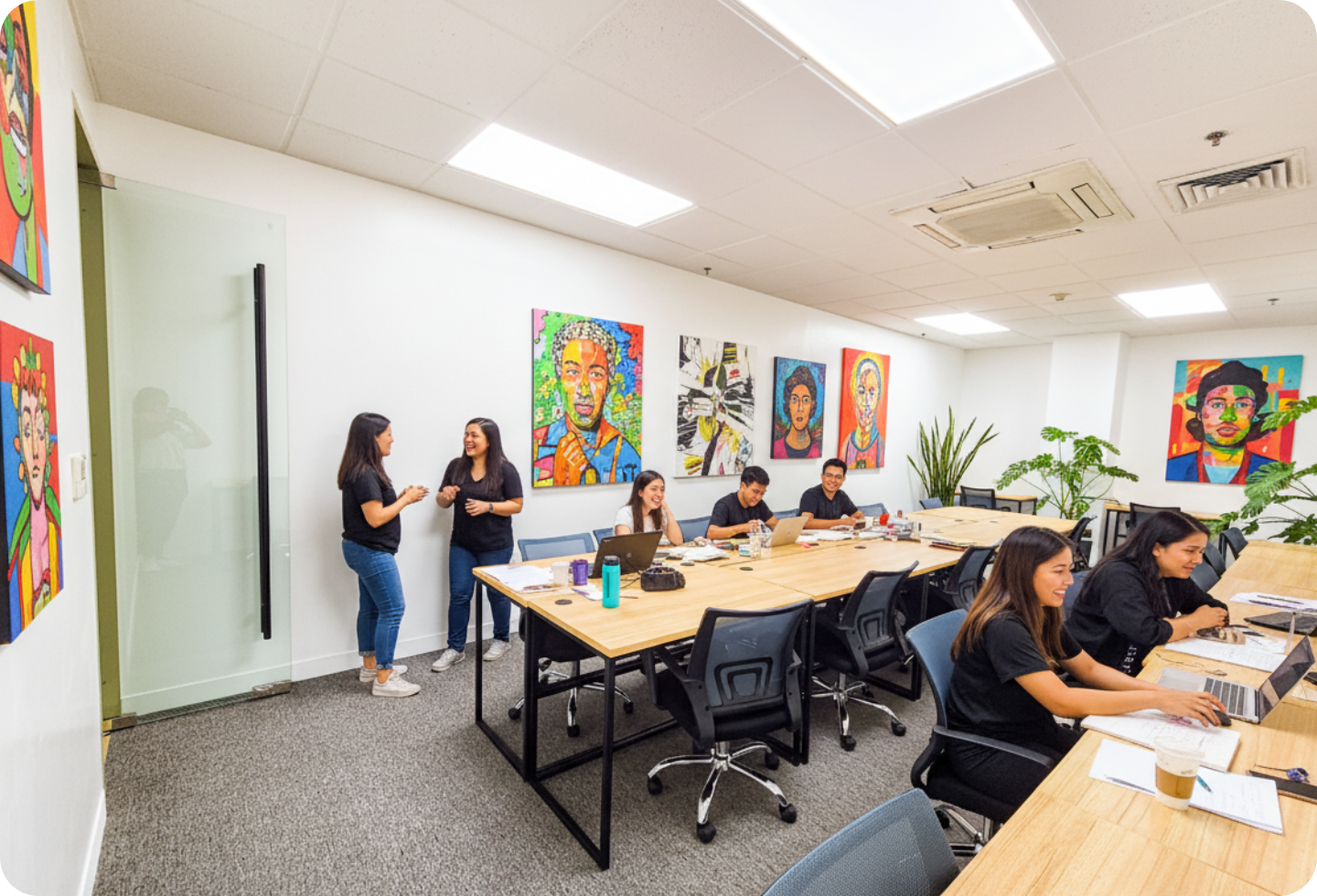
Getting the office question right from the start matters. SaaS operations teams — particularly QA engineers who need stable, fast internet and consistent environments for test execution — perform significantly better in professional office settings than residential setups. A managed office in Cebu IT Park or Makati gives the team a reliable base and makes onboarding new members substantially faster.
As the team grows, the operational leverage increases. A properly structured Philippine support and QA team can handle significantly higher volume than a US equivalent at a fraction of the cost — freeing US-based team members to focus on the high-touch, high-judgement work that genuinely requires their time.
The Company provides EOR employment and managed office space in Manila and Cebu for US SaaS companies building Philippine operations teams. If you’re exploring the Philippines for your support or QA function, get in touch — we’ll walk you through the talent landscape, cost structure, and setup timeline for your specific situation.