What a New Filipino Team Member Gains From an Office in Their First 30 Days

The first thirty days of a new role are disproportionately important. Research on employee retention consistently shows that the onboarding experience is one of the strongest predictors of whether a hire will still be with the organisation at the twelve-month mark. A new team member who feels welcomed, supported, and professionally integrated in their first month is significantly more likely to invest in the role long-term. One who feels isolated, uncertain, or unsupported in those same thirty days often starts looking for alternatives before they have had a chance to demonstrate what they can do.
For Filipino professionals joining overseas employer teams, the onboarding experience is shaped more than most employers realise by the physical environment in which it happens. The difference between onboarding into a professional office — with colleagues, structure, and an ambient sense of organisational life — and onboarding alone at a home desk is not merely a matter of comfort. It is a difference in the quality and speed of integration that compounds across the entire employment relationship.
Days One to Seven: The Impression That Sticks
The first week of a new role forms impressions that are remarkably persistent. A new employee is absorbing signals about the organisation continuously — the quality of the equipment provided, the clarity of the instructions they receive, the responsiveness of their manager, and the environment they are sitting in every day. These signals combine into a first-week answer to the question every new hire is implicitly asking: did I make the right choice?
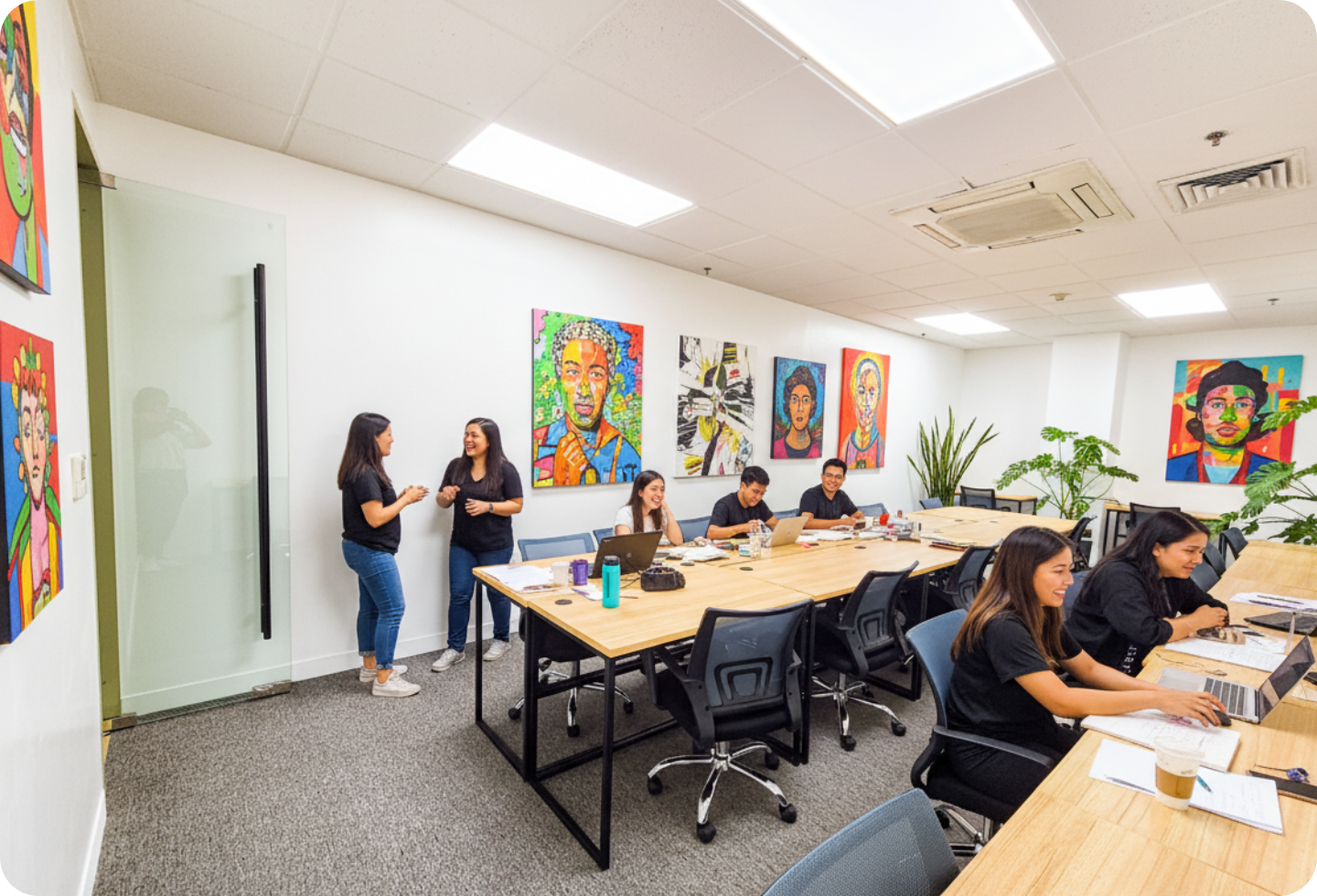
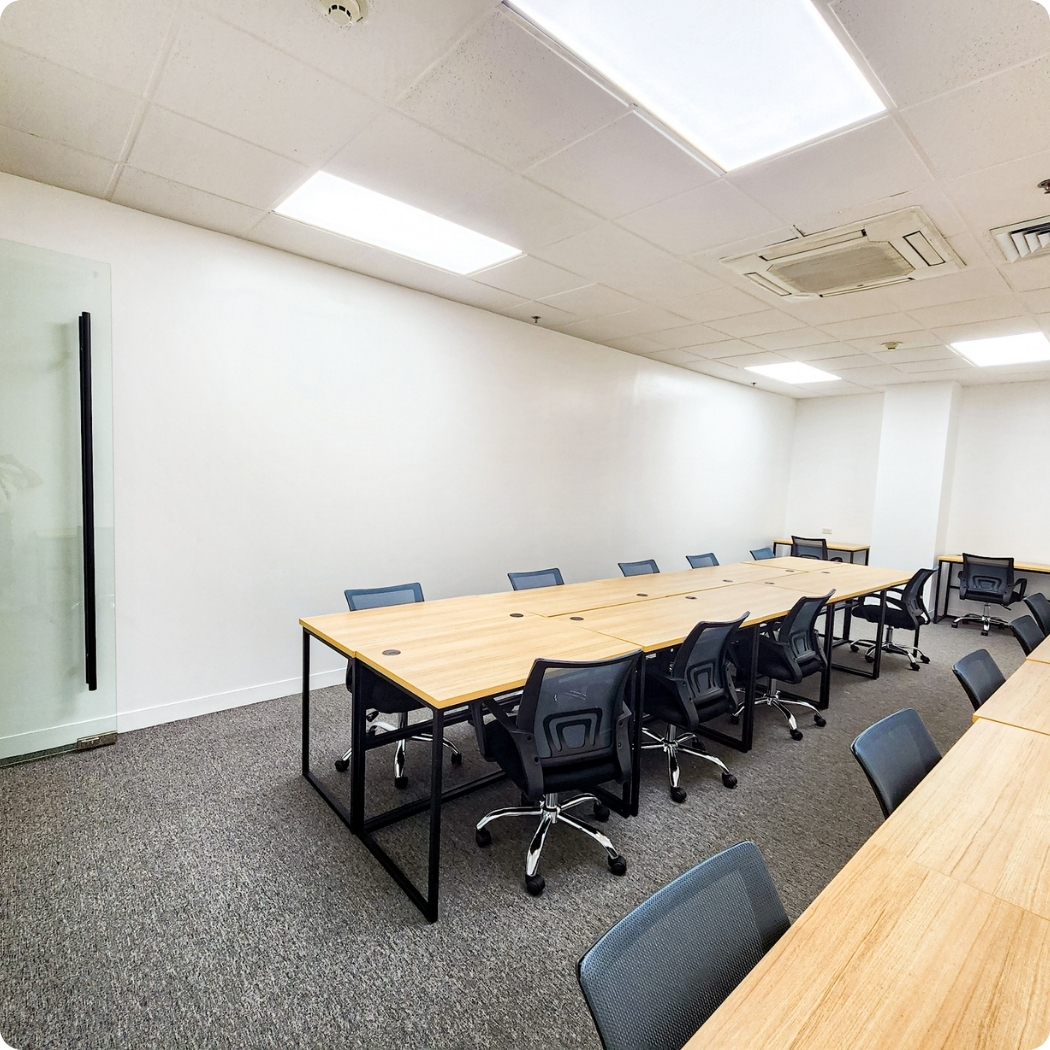
For a Filipino professional starting a new role with an overseas employer in a professional office, the physical environment answers part of that question immediately and positively. Walking into a well-designed, properly equipped workspace on day one — ergonomic seating, fast internet, a quiet zone available, coffee provided, colleagues working nearby — communicates something that no onboarding document can communicate: this employer has invested in making your working life good. That investment is visible before the first task is assigned.
Contrast this with the experience of starting a new overseas employer role from a home desk. The equipment arrives, or it doesn’t. The internet holds, or it doesn’t. The house is quiet, or it isn’t. There are no colleagues to make the first day feel less like a solo administrative exercise. The first Slack message to the overseas manager, sent into a time zone gap, waits hours for a reply. The experience is functional in the narrowest sense but offers almost none of the social and environmental signals that tell a new employee they have joined something real and worthwhile.
In the first week, the office also provides practical onboarding support that remote settings cannot replicate. Questions that arise in real time — about systems, about processes, about the unwritten norms of how the team operates — can be answered immediately when there are colleagues present. In a remote setup, those same questions either go unanswered until the next scheduled call, or generate a trail of Slack messages that require follow-up across a time zone. The friction accumulates, and the new employee’s confidence and competence develop more slowly as a result.
Days Eight to Fourteen: Learning That Doesn’t Show Up in the Handbook
By the second week, the formal onboarding is usually complete — the systems access is sorted, the initial training is done, the first real tasks are underway. What remains to be absorbed is everything that doesn’t appear in an onboarding document: how decisions actually get made, what quality really looks like here, which parts of the role matter most to the people who evaluate performance, how the team manages pressure, what the unspoken standards are.
This tacit knowledge — the kind that experienced employees hold and new employees need — transfers almost entirely through observation and informal interaction. It transfers when a new employee watches how a senior colleague handles a difficult situation. It transfers in a brief conversation over coffee about how a particular client prefers to be communicated with. It transfers when a manager pauses at a new employee’s desk and offers a word of context about something they have been working on.
None of these transfer mechanisms work in a remote setting. The senior colleague is invisible. The coffee conversation doesn’t happen. The manager’s passing observation requires a scheduled meeting to replicate, if it happens at all. New employees in remote settings have to acquire tacit knowledge the hard way — through trial and error, through mistakes that an office colleague would have helped them avoid, through a slower, lonelier learning curve that extends the time before they are operating at full effectiveness.
In an office environment, tacit knowledge transfer is continuous and largely effortless. It happens in the background while the new employee is focused on their work. By the end of the second week, an office-based new hire has absorbed weeks’ worth of contextual understanding that a remote new hire is still missing. The gap in practical competence at the two-week mark is not marginal — it is significant, and it persists for months.
The second week is also when social integration begins in earnest. The initial first-day introductions are done; the question now is whether the new employee is becoming part of the team’s social fabric or remaining a peripheral presence. In an office, this integration happens naturally — shared lunches, incidental conversations, the small acts of collegiality that build professional relationships. In a remote setting, it requires deliberate effort from both sides and rarely achieves the same depth or speed.
Days Fifteen to Thirty: When Belonging Becomes the Foundation
By the third and fourth weeks, a new employee in an office environment has typically crossed a threshold. They know who to ask about what. They have developed working relationships with the colleagues they interact with most. They understand the rhythms of the team — when it is busy, when it is collaborative, when it needs quiet focus. They feel, in the most fundamental sense, like they belong.
This sense of belonging is not a soft, incidental outcome — it is one of the most robust predictors of long-term employee retention and performance. Employees who feel they belong in their organisation are more engaged, more willing to invest discretionary effort, more likely to stay through competitive offers, and more effective at navigating the inevitable challenges that any role presents. Belonging is not separate from performance; it is a precondition for it.
For Filipino professionals specifically, this dimension is particularly significant. Philippine workplace culture places deep value on community, collective identity, and the sense of being part of something larger than an individual employment contract. An employee who has integrated into a physically present team — who has colleagues, a shared environment, and a daily experience of professional community — has their belonging needs met in a way that a remote arrangement simply cannot provide. The difference in retention rates between office-based and remote-only Filipino employees reflects this cultural reality as much as any operational factor.
The thirty-day mark is also the point at which a new employee’s trajectory becomes relatively predictable. Employees who arrive at thirty days feeling integrated, competent, and valued almost always stay long enough to become genuinely productive contributors. Employees who arrive at thirty days feeling isolated, uncertain, or undervalued are already evaluating their options — often without the employer knowing it. The investments made in the first thirty days are not just about making the onboarding pleasant; they are about setting the trajectory for the entire employment relationship.
Remote Onboarding vs Office Onboarding: What the Difference Looks Like
It is worth being specific about what the comparison actually looks like in practice, because the abstract case for office onboarding can feel obvious while the concrete reality is less appreciated.
A new Filipino employee onboarding remotely in a typical overseas employer arrangement spends their first week navigating system access alone, waiting for responses across a time zone gap, and managing the physical uncertainties of a home environment — internet reliability, household noise, the absence of any professional anchor to the working day. Their first interactions with colleagues are all screen-mediated and mostly task-related. By the end of week one, they know their login credentials and have a general sense of their responsibilities. They do not know their colleagues, do not understand the informal culture, and have not yet had a single interaction that felt genuinely welcoming.
The same employee onboarding in a professional office has a structurally different experience. Day one begins in an environment that communicates professional investment. There are colleagues present — even if from other companies sharing the co-working space — who normalise the experience of professional work. There is an on-site team who can assist with practical setup questions. The working day has a shape that mirrors what a professional environment should feel like. By the end of week one, this employee has a baseline of professional integration that the remote employee will take weeks to approach, if they ever do.
The compounding effect over thirty days is substantial. It is not that one employee is happy and the other is not — both may be performing their tasks adequately. The difference is in readiness: the office-based employee at thirty days is ready to operate independently, to handle novel situations with confidence, and to invest in the role. The remote employee at thirty days is still building the foundational understanding that the office employee had by the end of week two.

Building the Onboarding Environment Into Your Hiring Model
The practical implication for overseas employers is that the onboarding environment should be a deliberate design choice, not a default outcome. The decision about where a new Filipino team member will work in their first thirty days is a decision about the quality and speed of their integration — and that decision has downstream effects on performance, retention, and the return on the hiring investment.
For employers who are already providing office access through an EOR-plus-workspace arrangement, the onboarding advantage is built in. New team members arrive into an environment that is already set up, professionally maintained, and socially active. The employer does not need to construct the onboarding infrastructure — it exists.
For employers who have been running fully remote arrangements and are considering the transition to office access, the onboarding improvement is often the most immediately visible benefit — and the one that most clearly justifies the investment. The first new hire who onboards into an office, after a series of remote onboardings, tends to become the clearest demonstration that the working environment was worth changing.
The Company’s workspaces in Makati, Cebu IT Park, and Mandaue are designed with this kind of onboarding environment in mind — professional, fully equipped, socially active spaces where new team members can start on the right footing from day one. Combined with The Company’s EOR service, the arrangement provides overseas employers with everything their Philippine team needs to onboard, integrate, and perform at their best. Learn more about how EOR and workspace access work together.