From One Hire to a Full Team: How to Scale Your Philippines Operation with EOR and Office

The first hire is the easy part. There is a single employment arrangement to manage, a single onboarding to navigate, a single set of expectations to align. It is demanding, and most overseas employers who get it right feel a sense of relief when that first Filipino team member is up and running. Then the business grows, the workload increases, and the question shifts from “how do we hire one person in the Philippines” to “how do we build a team there” — and that is where most overseas employers discover they were not as prepared as they thought.
Scaling a Philippines operation from a single hire to a functioning team of ten, fifteen, or twenty people involves a series of transitions that catch many overseas employers by surprise. The working model that served one person well starts showing its limitations at three. The management approach that worked for a team of five becomes inadequate at ten. The workspace arrangement that was a convenient shortcut at the start becomes a structural problem as the team grows.
This article maps those transitions phase by phase — what changes at each stage, what typically goes wrong, and how to build an infrastructure from the start that scales without breaking.
Phase One: The First One or Two Hires
At this stage, most overseas employers are primarily focused on getting the employment right: compliant contracts, correct statutory contributions, a clear role definition, and a working communication rhythm across the time zone gap. These are the right things to focus on, and getting them right matters more than most employers initially appreciate.
The working environment at this phase is often a hot desk in a co-working space or, more commonly, a home office setup. With one or two people, this is manageable. The employer can maintain direct oversight, communication is relatively simple, and the absence of a local team culture is not yet a problem because there is no team to culture.
The most common mistake at this phase is treating the working model as permanent rather than temporary. Employers who set up a fully remote arrangement for their first hire and never revisit it often find themselves locked into that model when it stops working — because changing the working arrangement for an existing employee is significantly harder than building the right arrangement from the start.
The smarter approach is to build with scale in mind from day one. This means choosing an EOR provider who can grow with you — who has workspace options as well as employment infrastructure, and who can accommodate a team of ten with the same ease as a team of one. It means being intentional about where your first employee is based, knowing that future hires will likely be drawn from the same city, and that their working arrangement will become the template for everyone who follows.
A co-working desk in a professionally managed space is often the right setup at this stage — more professional than home, more flexible than a committed office lease, and already located in an environment that can accommodate future growth without a disruptive relocation.
Phase Two: Three to Six People — When the Team Dynamic Begins
Something shifts when the team reaches three or four people. It is no longer a single employment relationship managed directly by the overseas employer — it is a group of people who interact with each other as well as with the employer, and who collectively form something that starts to resemble a team culture, for better or worse.
This is the phase where the working environment starts to matter in a new way. A team of three people working from separate homes across Metro Manila has no shared identity. They may each have a good individual relationship with their overseas manager, but they have no relationship with each other that is not mediated by work tasks. When one of them encounters a problem, there is no colleague nearby to consult. When a new team member joins, there is no community to integrate into. The onboarding experience is an isolated one-on-one process rather than an immersion into a functioning team.
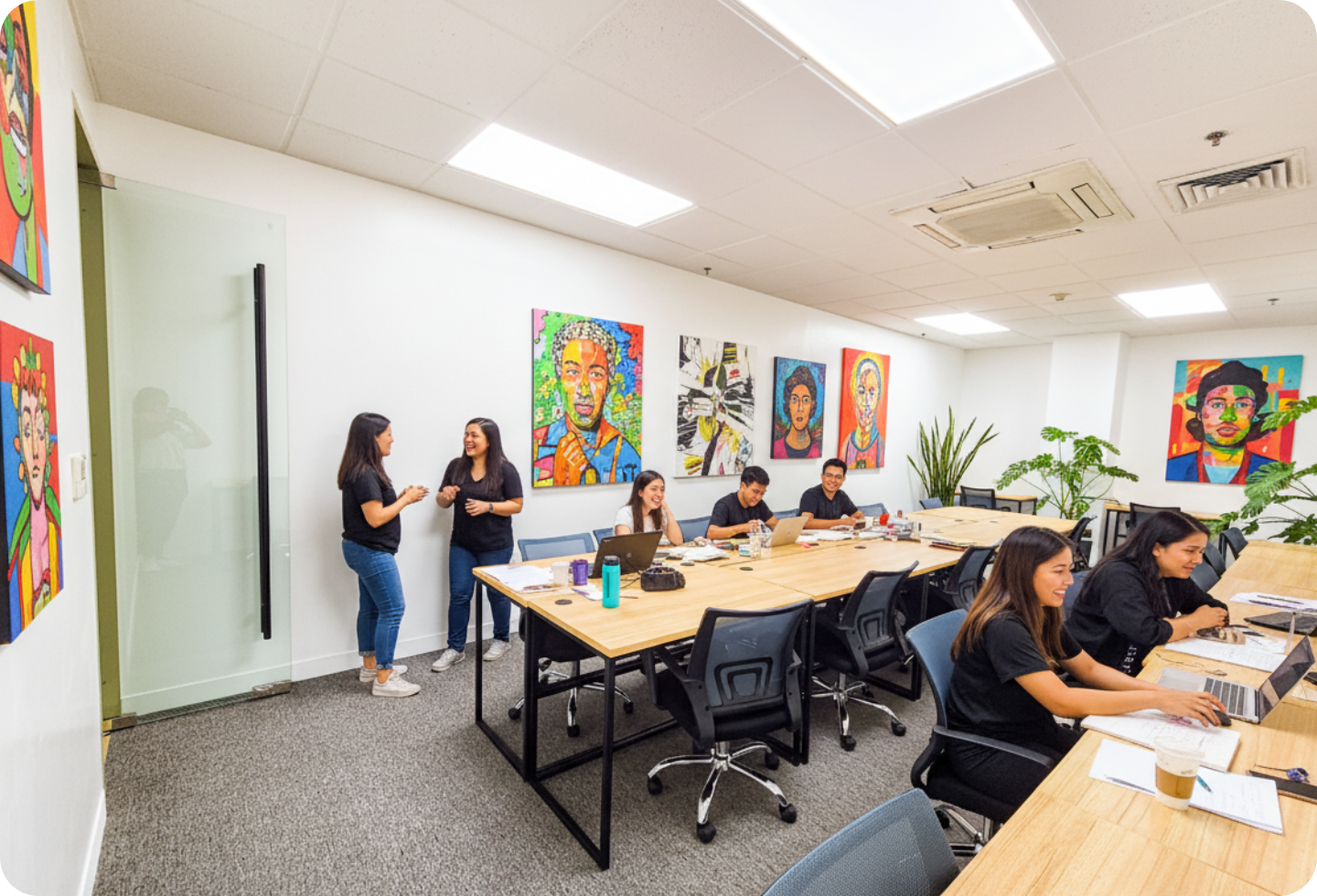
This is the phase at which the transition to a shared physical workspace pays off most clearly. Moving a team of three or four into a dedicated office space — or into a co-working environment where they share a physical location even if not a private room — immediately changes the dynamic. Problems get solved faster. New members integrate more quickly. The team starts to develop shared practices and informal culture that make it function as a unit rather than a collection of individuals.
The most common failure at this phase is the delayed transition — employers who recognise the problem but defer the solution because changing the working arrangement feels disruptive or expensive. In practice, the disruption of transition is significantly smaller than the ongoing cost of a fragmented team that never coheres.
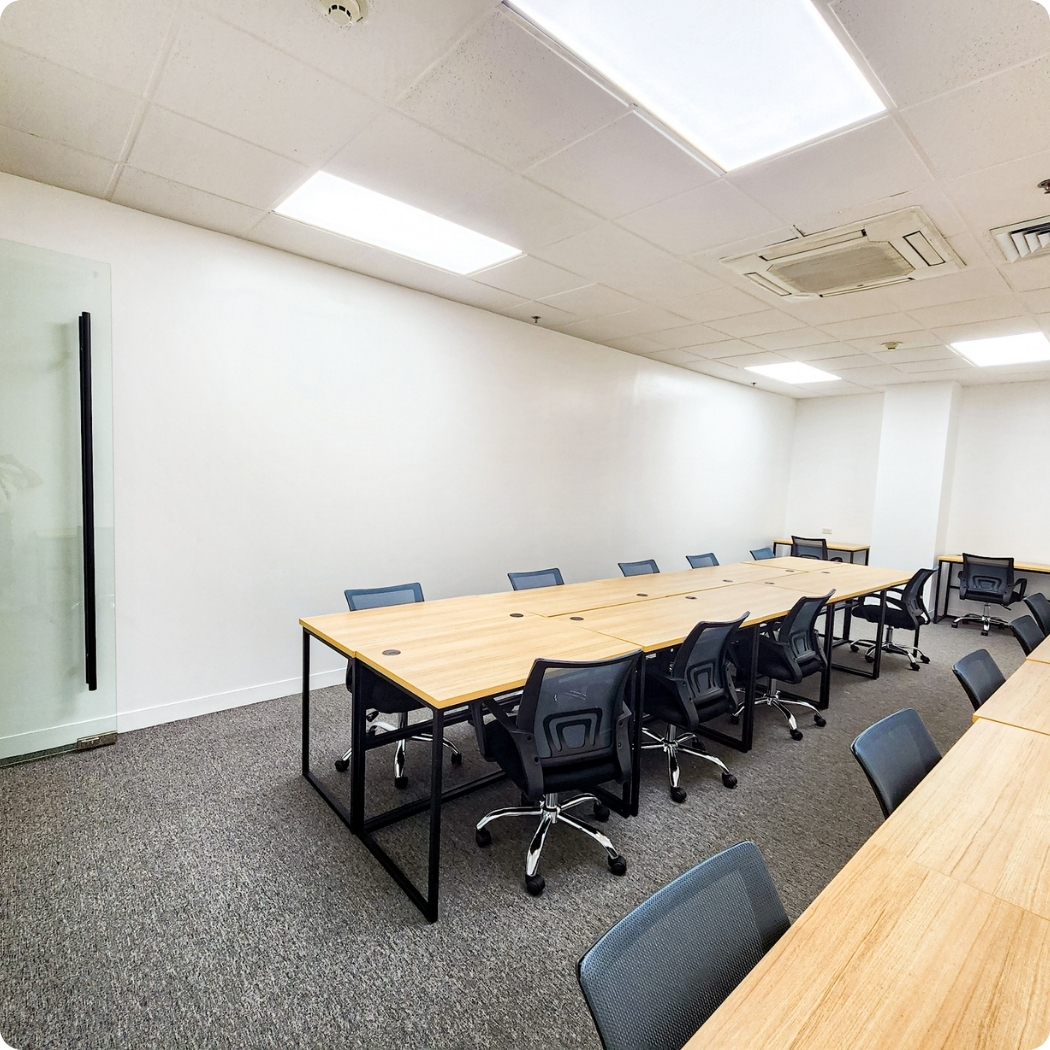
At three to six people, a private office of the executive suite variety — fifteen to twenty square metres, accommodating the full team — is typically the right fit. It provides privacy for focused work, a shared space for team interaction, and a professional address without the overhead of a standalone commercial lease.
Phase Three: Seven to Fifteen People — When Structure Becomes Non-Negotiable
A team of seven to fifteen people in the Philippines is a meaningful operation. It has enough complexity to require deliberate management, enough people to develop subcultures and communication gaps, and enough overhead to justify the investment in proper infrastructure. It is also the phase at which the most significant organisational mistakes happen — because the informal approaches that worked at small scale stop working at medium scale, and the gap between what the employer is managing and what they think they are managing widens.
Management structure is the first challenge. An overseas employer who has been managing five people directly, across a time zone gap, can probably sustain that with effort. Managing twelve people directly from Australia while running a business is a different proposition. This is the phase at which a local team lead or manager in the Philippines becomes necessary — someone who is physically present, who can provide day-to-day oversight and support, and who can act as the bridge between the overseas employer’s direction and the team’s execution.
Onboarding process formalisation becomes critical at this scale. When a team grows from five to twelve over the course of a year, there is a continuous stream of new members who need to understand how the team works, what the standards are, and how to integrate into an existing culture. Without a documented, intentional onboarding process, each new member’s experience is inconsistent — some join when the team has capacity to welcome them properly, others join during busy periods and are left to figure things out independently. The quality gap this creates within the team compounds over time.
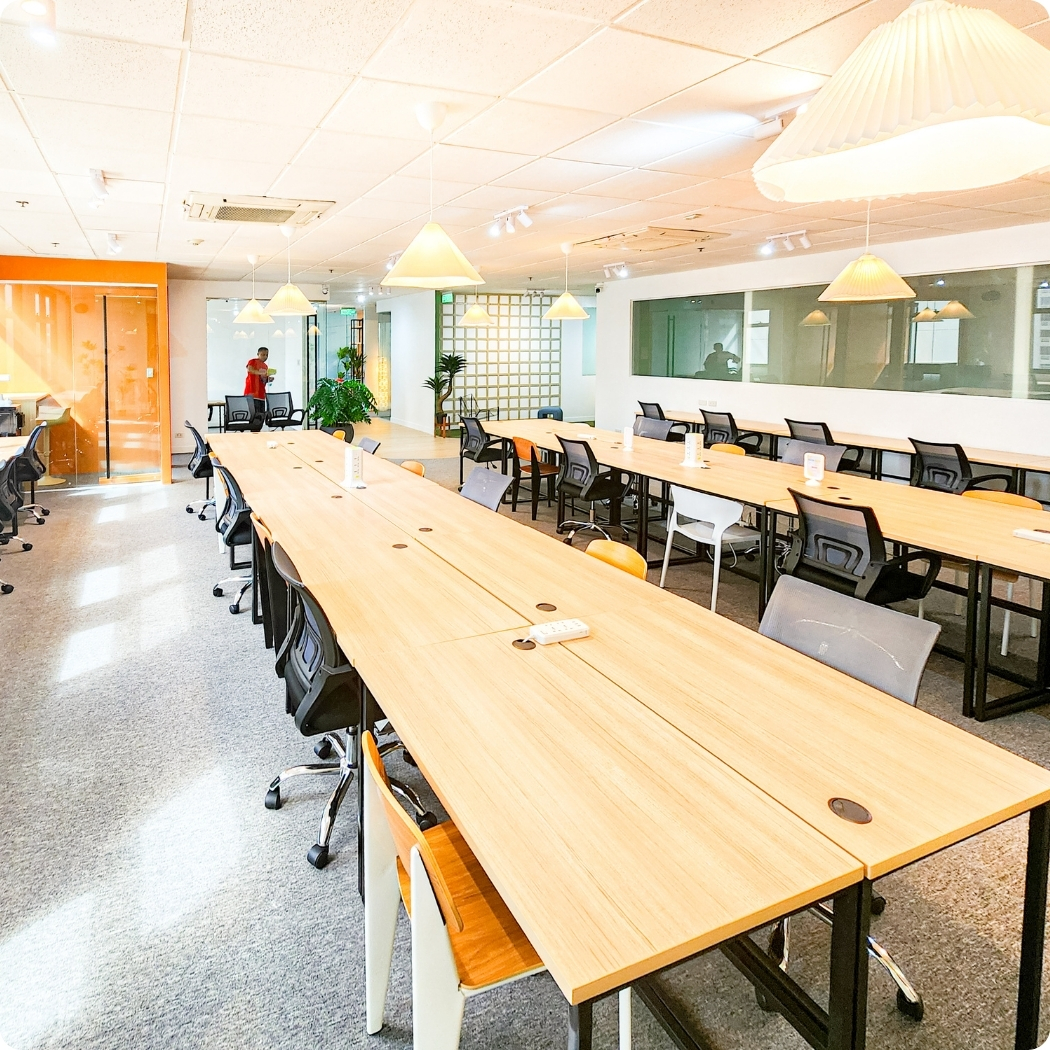
The workspace requirement also evolves at this scale. A small executive office designed for five is now overcrowded. The options are either a larger private office — The Company’s Makati space, for example, has offices ranging up to 48 square metres accommodating fifteen to twenty people — or a build-to-suit arrangement where the workspace is designed around the team’s specific needs and branded to reflect the overseas employer’s identity. The latter is particularly valuable for companies who want their Philippines team to feel genuinely integrated into the broader organisation rather than occupying a generic office that could belong to anyone.
Phase Four: Fifteen or More — Running a Real Philippines Operation
At fifteen or more people, the Philippines operation is no longer a support function or an outsourced capability — it is a meaningful part of the business that warrants the same strategic attention as any other significant operation. The employer who is still treating it as an extension of their Australian or US team, managed informally across a time zone gap, is operating well below the potential of what they have built.
HR infrastructure — proper performance management, career development frameworks, compensation review processes, benefits administration — becomes necessary at this scale in a way that it was not at five or eight people. Filipino employees at this scale have careers, not just jobs. They are making long-term commitments based on what they see ahead. An employer who cannot offer a clear path forward — promotion criteria, salary progression, skill development — will start losing their best people to organisations that can.
The EOR relationship also typically evolves at this scale. Some organisations at fifteen or more decide to establish their own Philippine entity — a ROHQ, a branch office, or a subsidiary — rather than continuing with EOR. Others find that EOR remains the right structure indefinitely, particularly if the team’s size and composition fluctuate, if the employer wants to avoid the administrative overhead of a local entity, or if the flexibility of the EOR model is more valuable than the marginal cost savings of direct employment. This is a decision that deserves proper analysis rather than default assumption, and the right answer depends on the specific circumstances of the business.
What to Get Right From the Start
The employers who scale most successfully in the Philippines are not those who got everything right immediately — they are those who built with the right principles from the start and adapted deliberately as they grew.
Choose an EOR provider who can grow with you. The relationship you build with your employment infrastructure provider at one person will shape how your operation scales to ten and beyond. A provider who offers only employment compliance — without workspace, without HR support, without the ability to accommodate a growing team’s changing needs — will require replacement at exactly the moment when a transition is most disruptive.
Invest in the working environment earlier than feels necessary. The team culture that forms in your Philippines operation’s first six months will be significantly harder to reshape than to build correctly from the start. A professional, shared workspace from the beginning of the team phase sets the foundations for the culture, the collaboration habits, and the professional standards that the team will carry forward as it grows.
Build local leadership early. A local team lead or manager who is physically present, culturally connected to the team, and trusted by both the overseas employer and the Philippines-based team is one of the highest-return investments an overseas employer can make. The cost is modest. The leverage on team performance, retention, and organisational coherence is significant.
The Company supports overseas employers at every phase of this journey — from a single co-working desk for a first hire through to build-to-suit offices for established teams, all integrated with compliant EOR employment across Makati, Cebu IT Park, and Mandaue. Find out how the EOR and workspace combination works at your scale.