100% Uptime: Why Redundant Dual-ISP Architecture Is Non-Negotiable for Your Reliable Internet Workspace Cebu Setup

Ask any CTO or engineering manager what keeps their development team highly productive, and you will inevitably hear a familiar list of answers: top-tier engineering talent, strong agile leadership, streamlined sprint processes, and a modern technology stack. Rarely does anyone think to say “underlying network architecture.” Yet for modern software development companies, blockchain startups, SaaS providers, and global technology firms, internet connectivity is arguably the most mission-critical utility in the entire organization. A frontend developer can work offline on local components for an hour, and a project manager can survive a minor delay in receiving an email. Reliable internet workspace Cebu solutions have become one of the most important requirements for modern software companies operating in Cebu IT Park.
However, when your main internet connectivity disappears entirely, all engineering velocity stops dead in its tracks. Code repositories become completely inaccessible, cloud environments disconnect, continuous integration pipelines fail, client-facing meetings freeze, and production monitoring systems go dark. Unlike other minor workplace inconveniences, internet downtime functions as a systemic bottleneck that paralyzes every single department simultaneously, making a stable reliable internet workspace Cebu setup an absolute prerequisite for daily operations.
For scaling software operations operating inside a competitive IT Park tech space, the underlying network design is no longer just a checkbox for the facilities manager. It is a fundamental pillar of business continuity. When your entire revenue model depends on pushing code to production, deploying smart contracts, or maintaining real-time support SLAs for international enterprise clients, you cannot treat your connection like a residential utility. Relying on a single internet service provider is an operational gamble that exposes your startup to immense real estate liabilities and catastrophic productivity drops. Forward-thinking technology companies are actively moving away from legacy commercial leases with unmanaged single-line configurations. Instead, they are positioning their engineers within dedicated infrastructure that guarantees network resilience through automated, multi-carrier failover architecture.
The Real Cost of a 10-Minute Internet Outage
Most organization heads completely underestimate the true financial impact of internet downtime because they only calculate the highly visible, direct duration of the outage itself. A 10-minute drop seems insignificant on a spreadsheet, but software engineering does not operate in simple, linear 10-minute increments. When a sudden network drop disconnects a development team of twenty or thirty engineers from their active cloud environments, the entire cognitive momentum of the engineering block is shattered.
An abrupt network outage immediately disrupts:
-
Real-time version control pushing via GitHub or GitLab repositories
-
Sprint tracking, ticket updates, and blockers on Jira boards
-
Active remote server terminal sessions in AWS, Google Cloud, or Azure
-
Core continuous integration and automated testing pipelines (CI/CD)
-
Live client-facing sprint reviews and prospective product demos
-
Critical production incident monitoring and automated alerting tools
While the physical line outage may only last ten minutes, the comprehensive productivity recovery window often takes closer to an hour. Engineers lose deep concentration, remote environments require secure re-authentication, interrupted code compilations must be restarted from scratch, and team alignment meetings require frustrating rescheduling. Momentum disappears entirely. For a scaling tech team working on strict, milestone-driven product launches, these cumulative delays disrupt internal release velocity, shift quality assurance testing timelines, and force awkward project postponement updates to stakeholders.
Why Development Teams Depend on Constant Connectivity
Unlike traditional back-office operations that rely heavily on localized text processing, modern software engineering depends completely on unbroken, continuous access to highly distributed cloud systems. The contemporary software development lifecycle is entirely decentralized; source code repositories live in the cloud, project management suites operate on SaaS models, technical documentation platforms require real-time syncing, and development sandboxes run on remote container clusters. Nearly every single tool an engineer interacts with throughout an eight-hour shift requires a persistent, low-latency connection.
💡 Deep Dive Resource: To see how choosing an intentionally engineered environment directly prevents team friction and boosts baseline output, explore our comprehensive guide on the 6 Proven Benefits of Ergonomic Coworking Spaces for Productivity.
When your primary connectivity becomes unstable, your development velocity mirrors that instability. If code changes cannot be staged, tested, or deployed automatically due to packet loss or erratic jitter, your sprint goals begin slipping. For growing software consultancies and product startups, protecting engineering velocity means addressing the core root of physical workplace infrastructure. By choosing a specialized fiber redundant office Cebu configuration, leadership effectively eliminates the environmental variables that stall technical work, ensuring that engineers spend their valuable hours writing clean code rather than troubleshooting network drops.
What Is Fiber Redundancy?
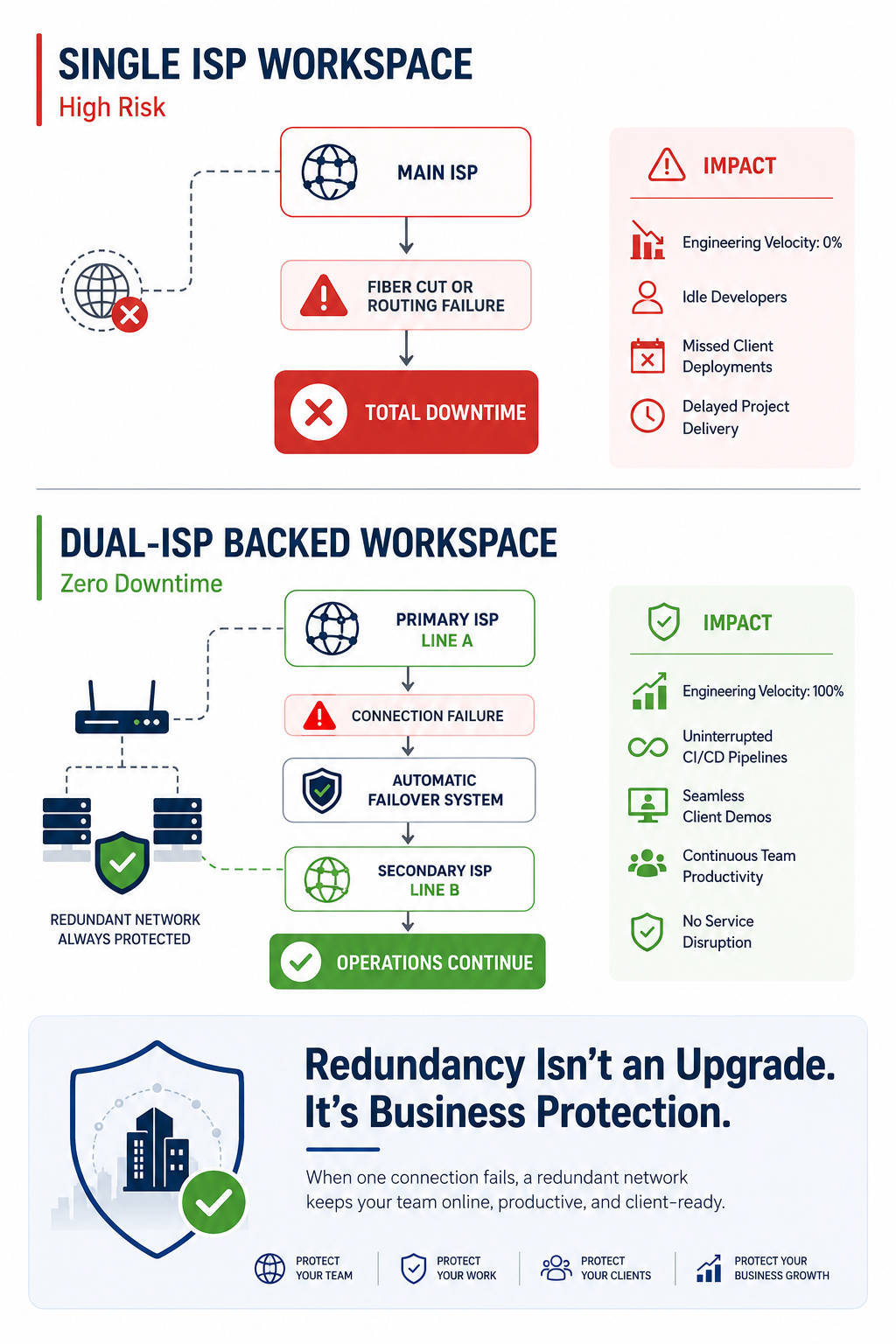
Fiber redundancy means maintaining multiple, physically isolated internet pathways from entirely separate telecom providers instead of relying on a single upstream carrier.
Most traditional commercial office spaces operate on a single-line ISP layout. If that specific provider experiences a fiber line cut due to external road construction, network-wide routing congestion, localized hardware failures, or unannounced maintenance intervals, the entire office facility plunges into complete digital isolation.
A robust fiber redundant office Cebu setup explicitly solves this vulnerability by routing independent fiber lines from separate carriers into an onsite, enterprise-grade load balancer.
If the primary carrier experiences an unexpected drop, the hardware automatically and instantly switches all local network traffic to the secondary hot-standby carrier line. In a properly tuned network environment, this failover mechanism triggers in under a second.
Local engineering teams continue pushing commits, video streams remain crystal clear during client standups, and deployment builds continue uploading without a single dropped packet.
Most team members never even realize a major carrier outage occurred right outside their windows. This seamless, continuous connection is the fundamental difference between basic internet access and true corporate internet resilience.
The Hidden Advantage of Dual-ISP Infrastructure
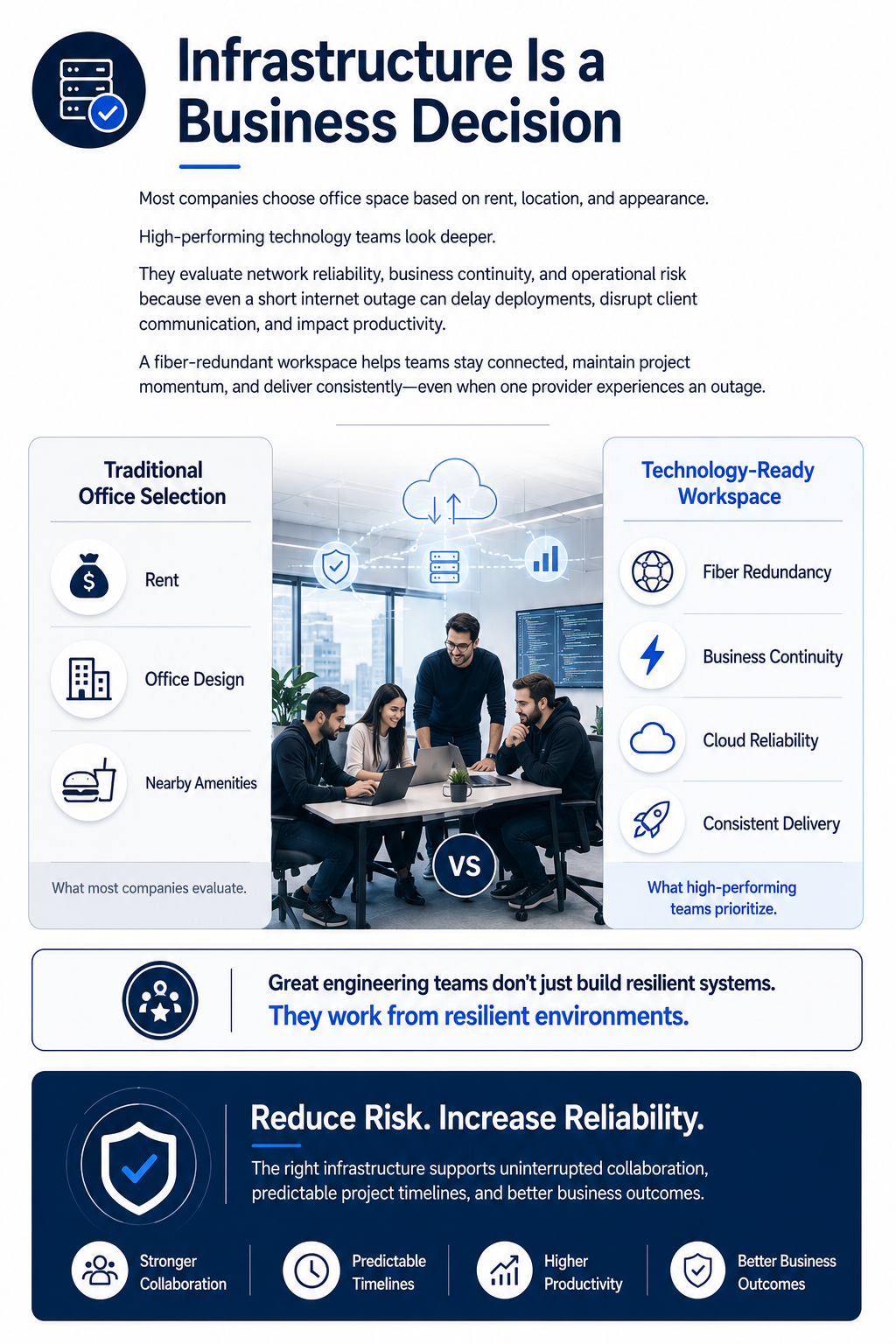
Most technology startups evaluate potential office locations almost exclusively on cosmetic parameters like monthly rent, interior aesthetic, and proximity to trendy food choices. Very few founders think to ask for a comprehensive blueprint of the building’s network topology or telecommunications entry points.
However, elite engineering organizations evaluate real estate through the lens of pure risk mitigation, knowing that physical workplace infrastructure directly influences their quarterly product delivery.
Operating within a dedicated fiber redundant office Cebu hub delivers strategic benefits that extend far beyond simply keeping the lights on. According to data provided by the JLL Workplace Insights Report, corporate entities increasingly rely on decentralized network failovers to mitigate real estate liabilities. It gives international enterprise clients immense confidence during due diligence audits, knowing your site can maintain round-the-clock operational support.
It ensures that critical cloud architecture deployments complete smoothly without data corruption, and it fosters a distraction-free environment where cross-functional product squads can collaborate with remote stakeholders without lagging video calls. For an engineering manager, these systemic advantages compound over months of development, resulting in predictable project timelines and higher collective output.
Why Single-Provider Internet Is a Growing Risk
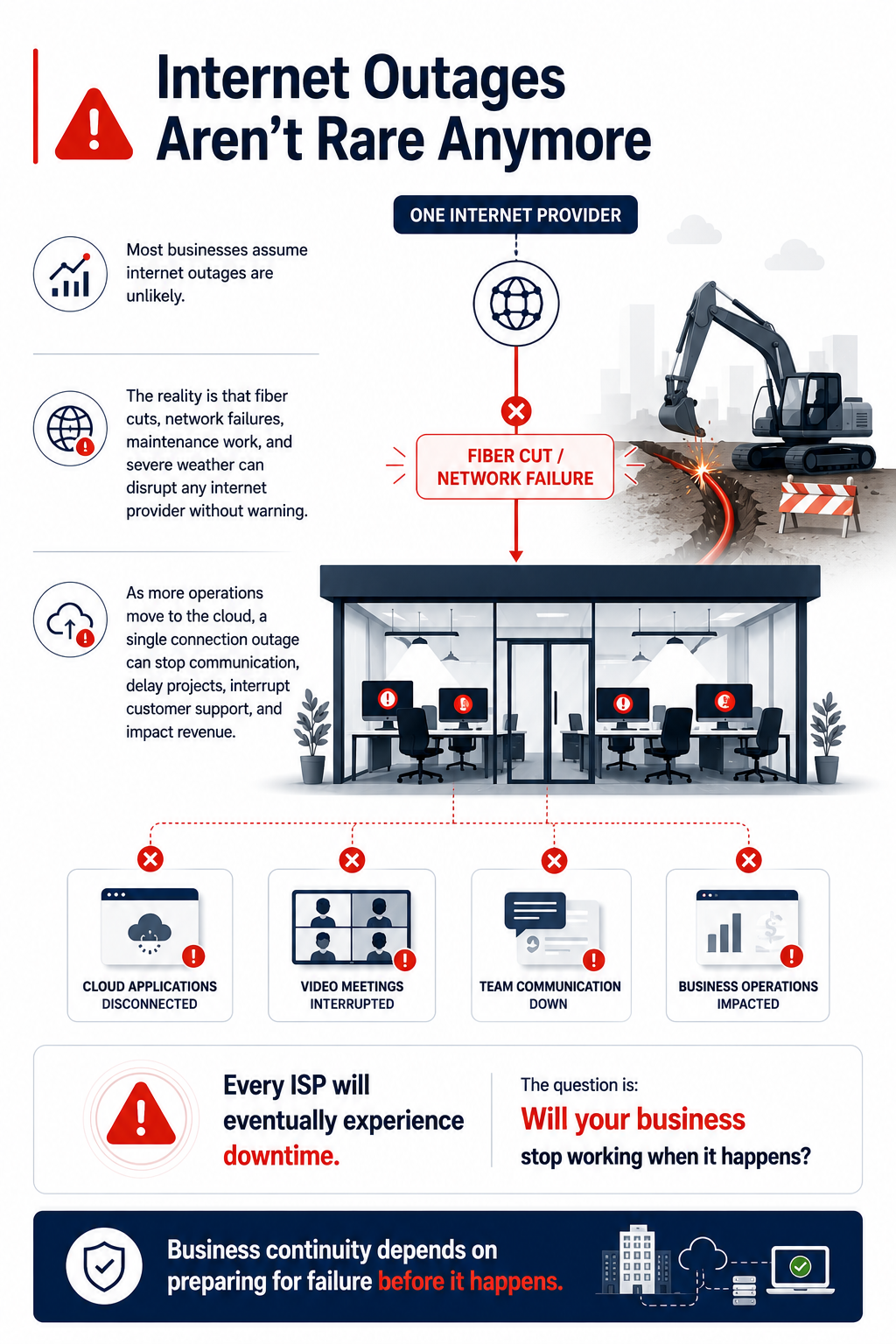
Many business owners still operate under the outdated assumption that major internet outages are rare, anomalous events. Unfortunately, that assumption becomes an incredibly dangerous operational blind spot as your day-to-day business operations become more dependent on distributed cloud infrastructure.
A single stray excavator working on a municipal road project outside an office building can instantly slice through an unshielded fiber conduit, rendering an entire commercial block offline for days while repair crews locate and splice the damaged core.
Furthermore, upstream network routing errors, DNS server failures, and sudden hardware drops at the provider level can take down whole regional sectors without warning. Unexpected carrier maintenance windows occur regularly, and severe tropical weather patterns can compromise exposed physical infrastructure across the region.
The reality is simple: every single ISP will eventually experience an unexpected failure. The critical question for your startup is whether your team will suffer an operational blackout when that failure occurs, or if your reliable internet workspace Cebu infrastructure will automatically keep your engineers productive.
Why Reliable Internet Workspace Cebu Demand Is Growing
Cebu’s regional technology ecosystem is undergoing an unprecedented wave of high-velocity expansion. The city is no longer just a hub for legacy business process outsourcing; it has transformed into a major destination for specialized software product development, global fintech platforms, blockchain engineering teams, and fast-growing SaaS startups. As these technical operations scale up, the economic stakes connected to their network connectivity increase exponentially.
💡 Deep Dive Resource: Transitioning your team from standard, unmanaged office blocks requires a clear look at local ecosystem dynamics. Read our analytical guide on The Hidden Advantage Businesses Need During Cebu’s Hottest Months in 2026 to optimize your facility scaling strategy.
Because modern tech companies handle data-intensive operations, local founders are becoming exceptionally sophisticated when inspecting potential facilities. They are moving past generic real estate pitches and demanding detailed transparency regarding technical infrastructure. They need to know the specific names of the upstream tier-1 carriers, the precise failover latency metrics of the routing core, the exact corporate uptime guarantees backed by service-level agreements (SLAs), and how the internal network is segmented to handle peak concurrency.
The Coworking Advantage for Engineering Teams
Many early-stage founders assume that enterprise-grade network infrastructure, dual-carrier redundancy, and managed network security can only be achieved by investing millions of pesos to build out a custom, corporate office space. That legacy assumption is completely holding startups back. Modern flexible workspaces have evolved significantly over the past decade, shifting away from casual, freelancer-centric hot desking hubs into highly sophisticated infrastructure providers engineered specifically for scaling enterprise teams.
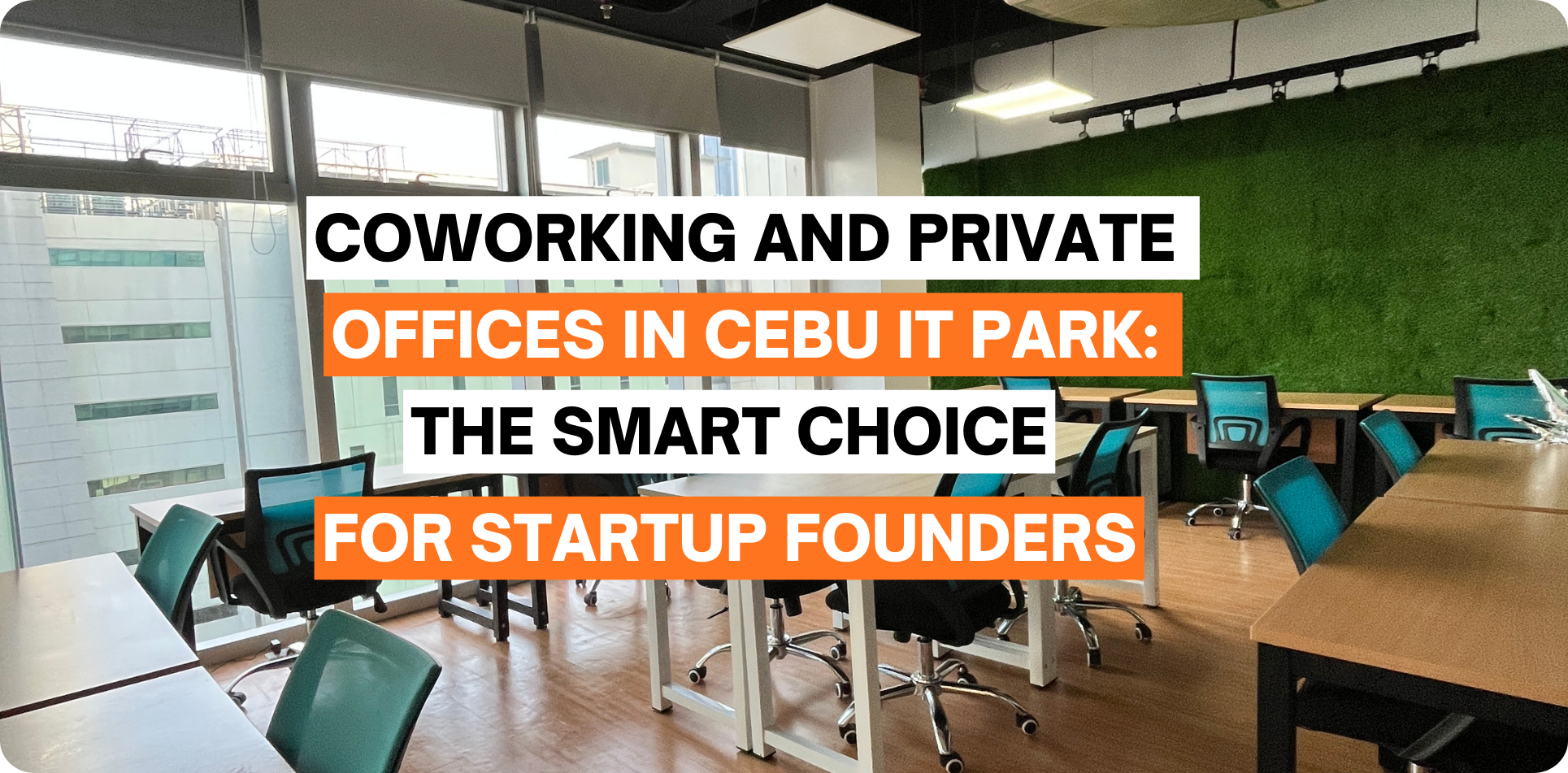
A premium coworking space in Cebu IT Park handles all of this heavy infrastructure lift on your behalf. By consolidating the network needs of multiple fast-growing companies, a managed space can justify constant, heavy investments into top-tier network hardware, redundant commercial carrier accounts, and specialized IT support personnel. For an expanding tech startup, this model provides bulletproof, enterprise-level network uptime from day one, entirely avoiding the massive capital expenditure, long-term carrier contracts, and frustrating installation delays that come with building an independent network from scratch.
Case Study: The Cost of Downtime for a 20-Person Dev Team
To understand exactly how network vulnerabilities can impact a startup’s cash runway, let us calculate the financial loss of a single, unmanaged four-hour carrier outage inside a traditional, single-ISP office setup. Consider a mid-stage software consultancy in Cebu housing a 20-person engineering pod, with an average fully loaded cost per developer of ₱600 per hour.
When you calculate the numbers, a single afternoon of unmanaged network downtime instantly drains over ₱100,000 in real economic value from your organization through lost labor velocity, context-switching friction, and delayed deployments. For a lean startup running on a strict venture-backed roadmap, experiencing just two or three of these major provider drops a year can completely derail product launch windows and damage client retention. Investing in a reliable internet workspace Cebu option is not an administrative luxury; it is a calculated capital preservation decision that protects your cash runway from unexpected real estate friction.
Why Blockchain Companies Need Redundant Infrastructure
While standard web development operations can occasionally tolerate brief network lag, decentralized application development, web3 ventures, and live node validation networks operate under an entirely different set of technical constraints. For teams writing smart contracts or handling high-throughput cryptographic consensus protocols, constant, low-latency connectivity is an absolute technical requirement.
According to technical documentation found in the Cloudflare Learning Center on Network Redundancy Models, maintaining multi-homed BGP routing protocols protects live web requests from systemic local drops. A minor packet drop or a five-minute routing freeze during a critical protocol deployment can result in catastrophic compilation errors, failed state synchronizations, or severe validator slashing penalties on public testnets and mainnets. Furthermore, web3 developers frequently interact with highly sensitive, real-time blockchain telemetry data and distributed peer-to-peer storage systems that cannot easily resume states after a harsh connection break. Positioning a blockchain venture within a dedicated reliable internet workspace Cebu setup ensures your developers maintain the persistent, uncompromised network pipelines required to interface with global ledger networks safely and continuously.
Generator Backup + Dual ISP = True Business Continuity
True operational resilience cannot be achieved by solving only half of the infrastructure equation. A cutting-edge, enterprise-grade dual-WAN network load balancer is completely useless if a regional utility transformer blowing out drops power to your entire office floor, instantly turning off your routers, workstations, and local network switches.
To build an environment that guarantees zero downtime, your organization must seek out an office hub where emergency power engineering matches network resilience. This means locating your team inside a premium business tower that provides immediate, building-wide synchronous generator backup capabilities. When your workspace seamlessly pairs a continuous power infrastructure with a fiber redundant office Cebu configuration, your team gains a bulletproof environment where engineers can continue writing code, running deployment builds, and hosting international client standups completely uninterrupted, even during major city-wide infrastructure dropouts.
Questions CTOs Should Ask Before Leasing Office Space
When evaluating potential locations for a growing engineering team, technical leaders must move past cosmetic tours and conduct a strict infrastructure audit. Before signing a long-term commercial lease, ensure you ask the building management or flexible workspace provider these critical networking questions:
-
Which Tier-1 telecommunications providers own the physical fiber lines entering the building routing room?
-
Is the local network configured with an automated dual-WAN load balancer for sub-second failover, or does it require manual technician intervention during a drop?
-
What is the specific upstream bandwidth allocation for our team, and is the speed fully synchronous (equal download and upload speeds)?
-
Are the internal local area networks (LANs) properly segmented into private VLANs to prevent neighbor congestion and unauthorized network access?
-
Does the facility provide a 100% building-wide backup power setup that keeps local networking equipment online during a power outage?
If a property manager gives vague answers to these questions, your team is likely looking at a standard residential-grade setup. For a high-growth tech operation, walking into an ambiguous network environment introduces immense operational risk that will eventually disrupt your development velocity.
Why More Cebu Tech Companies Are Choosing Agile Workspaces
The modern tech landscape has changed permanently over the past decade. Technical growth cycles are faster, deployment frameworks change constantly, and corporate real estate needs pivot more frequently than ever before. Global real estate indexes published in the CBRE Flexible Office Trends Report highlight that market-leading tech corporations now shift away from permanent ownership toward agile spaces specifically to hedge operational risks.
💡 Deep Dive Resource: Evaluating real estate strategies through major macro changes is essential for long-term survival. Dive into our analytical resource detailing Why Team Satisfaction Breaks Before Your Budget in IT Park to future-proof your upcoming spatial expansion milestones.
This dynamic landscape is precisely why forward-thinking tech companies are abandoning old commercial models and embracing agile workspace options. Transitioning to a managed IT Park tech space successfully eliminates real estate risk, absorbs upfront capital infrastructure costs, delivers enterprise-grade network resilience out of the box, and allows technology leaders to stop wasting valuable time managing physical facilities and focus entirely on what matters most: building world-class products.
Why Blockchain Teams Demand a Reliable Internet Workspace Cebu Environment
Blockchain development teams operate differently from traditional office workers. A few minutes of internet downtime can disrupt node synchronization, delay deployments, interrupt security monitoring, and affect communication with distributed teams around the world. This is why many blockchain startups actively seek a reliable internet workspace Cebu providers can support with enterprise-grade connectivity. Unlike standard office environments, blockchain teams require consistent access to cloud infrastructure, testing environments, decentralized networks, and global collaboration tools.
For teams operating inside a modern IT Park tech space, internet reliability becomes part of the product development process itself. Every deployment, code review, smart contract audit, and infrastructure update depends on uninterrupted connectivity. As blockchain companies continue expanding into Cebu, many are prioritizing coworking environments and flexible offices that provide the stability of a fiber redundant office Cebu setup rather than relying on a single ISP connection.
Why Blockchain Teams Demand a Reliable Internet Workspace Cebu Environment
Blockchain development teams operate differently from traditional office workers. A few minutes of internet downtime can disrupt node synchronization, delay deployments, interrupt security monitoring, and affect communication with distributed teams around the world. This is why many blockchain startups actively seek a reliable internet workspace Cebu providers can support with enterprise-grade connectivity. Unlike standard office environments, blockchain teams require consistent access to cloud infrastructure, testing environments, decentralized networks, and global collaboration tools.
For teams operating inside a modern IT Park tech space, internet reliability becomes part of the product development process itself. Every deployment, code review, smart contract audit, and infrastructure update depends on uninterrupted connectivity. As blockchain companies continue expanding into Cebu, many are prioritizing coworking environments and flexible offices that provide the stability of a fiber redundant office Cebu setup rather than relying on a single ISP connection.
The Competitive Advantage Most Development Teams Overlook
Many software companies assume all office internet services are essentially the same. In reality, the gap between consumer-grade connectivity and enterprise-grade redundancy is significant. A properly designed reliable internet workspace Cebu setup includes multiple layers of protection against service interruptions. This often involves dual providers, automatic failover systems, enterprise networking hardware, and proactive monitoring. Within a premium IT Park tech space, this infrastructure allows development teams to continue working even when one network experiences issues.
The result is not just higher uptime. It is greater operational confidence. Teams can deploy applications, host demonstrations, conduct client meetings, and collaborate globally without constantly worrying about connectivity interruptions. For growing engineering organizations, a fiber redundant office Cebu environment creates a competitive advantage that directly impacts productivity, delivery timelines, and customer satisfaction.
Why IT Park Tech Space Locations Lead the Shift
Cebu IT Park stands as the absolute economic center of the region’s digital economy. Thousands of high-caliber engineers, systems architects, product owners, and tech leaders pass through this master-planned district every day. In this hyper-competitive environment, businesses quickly recognize that the physical quality of their workplace infrastructure serves as a major driver of overall organizational performance.
An enterprise-grade IT Park tech space equipped with redundant telecommunications pipelines provides a massive competitive advantage over traditional commercial spaces located outside the zone. Having your infrastructure anchored inside a dedicated tech enclave ensures your team has direct access to the country’s most resilient fiber rings and municipal power grids. Developers can execute large-scale database migrations confidently, product teams can run continuous live streaming demos for international investors, and the entire business remains operational while unmanaged offices across the city scramble to deal with local connectivity drops.
How Zero-Ten Park Supports Modern Engineering Teams
At Zero-Ten Park, located on the 6th Floor of Mabuhay Tower within Cebu IT Park, physical infrastructure is built from the ground up around the core principle of absolute business continuity. The space is engineered specifically to host high-growth startups, offshore software development squads, remote-first technical teams, and compliance-driven enterprise operations that cannot afford a single minute of unexpected network downtime.
The facility features an enterprise-grade redundant fiber internet Cebu network topology that integrates independent, tier-1 commercial fiber connections into an intelligent core router. This system constantly monitors line health and automatically reroutes traffic the millisecond an upstream carrier drop occurs. When paired with the building’s 100% synchronous backup generator system, ergonomic workspace layouts, professional meeting facilities, and modular team spaces, the result is a workspace fully optimized for peak engineering output rather than simple desk occupancy.
💡 Deep Dive Resource: Network connectivity is only one piece of the puzzle when selecting a premium operational hub. Learn how to audit your next location comprehensively by reviewing our checklist on the The Ultimate Guide to 7 Essential Features in 2026.
Final Thoughts
The modern tech landscape has changed permanently over the past decade. Technical growth cycles are faster, deployment frameworks change constantly, and corporate real estate needs pivot more frequently than ever before. While traditional commercial office leases were originally built for an era of long-term predictability, modern digital businesses require total operational adaptability. As digital businesses continue expanding throughout Cebu, choosing a reliable internet workspace Cebu environment is no longer a convenience. It is a strategic operational decision.
💡 Deep Dive Resource: Evaluating real estate strategies through major macro changes is essential for long-term survival. Dive into our analytical resource detailing Why Team Satisfaction Breaks Before Your Budget in IT Park to future-proof your upcoming spatial expansion milestones.
This dynamic landscape is precisely why forward-thinking tech companies are abandoning old commercial models and embracing agile workspace options. Transitioning to a managed IT Park tech space successfully eliminates real estate risk, absorbs upfront capital infrastructure costs, delivers enterprise-grade network resilience out of the box, and allows technology leaders to stop wasting valuable time managing physical facilities and focus entirely on what matters most: building world-class products. The companies that invest in a reliable internet workspace Cebu setup today will be better positioned to scale, serve clients, and maintain development velocity tomorrow.
Internal Resources for Scaling Businesses
To help your leadership team dive deeper into workspace optimization, infrastructure planning, and team productivity, explore our comprehensive local guides:




Ready to get an office space?