Skip the $200K Entity: What Employer of Record Actually Buys You in the Philippines

You found the perfect candidate in Cebu. Sharp, experienced, exactly the skill set your team has been missing for two quarters. There’s one problem: your company has no legal way to put them on payroll in the Philippines.
This is the moment most international hiring plans stall. Founders and HR leads start Googling “how to set up an entity in the Philippines,” find out it involves a six-figure equity requirement and months of government paperwork, and quietly shelve the hire.
It doesn’t have to go that way. This is exactly the gap an employer of record exists to close — and once you understand how the mechanics actually work, it stops looking like a workaround and starts looking like the obvious move.
The Entity Trap Nobody Warns You About
Here’s the part that surprises most foreign companies: registering a wholly foreign-owned subsidiary in the Philippines isn’t just slow, it’s expensive in a very specific way. The SEC requires a minimum paid-in capital of around $200,000 for most foreign-owned entities, on top of separate registrations with the BIR, SSS, PhilHealth, and Pag-IBIG before you can legally run payroll for a single person.
That’s not a one-time annoyance — it’s capital sitting locked up before you’ve generated a single peso of local revenue. For a company testing whether the Philippines is even the right market, that’s a brutal way to find out.
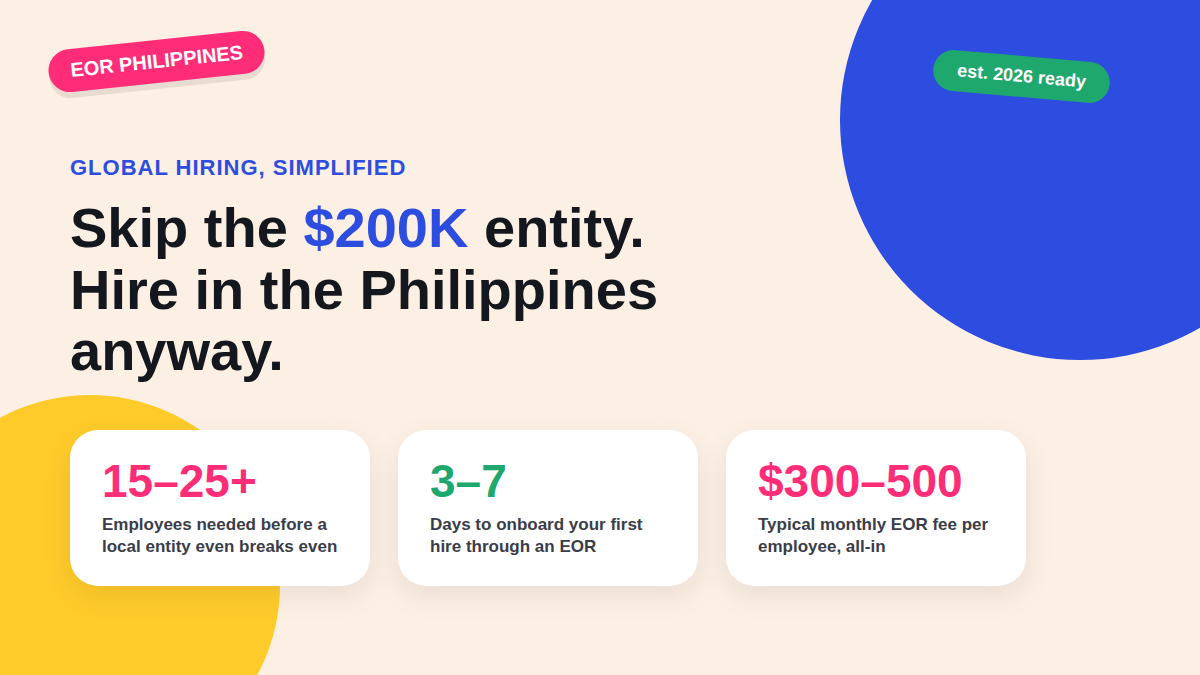
The math gets clearer once you frame it as a break-even question. Most analyses put the break-even point for setting up your own entity somewhere around 15 to 25 employees — below that, you’re paying for infrastructure you don’t need yet. Above it, ownership starts to make sense. The hard part is that most companies don’t know which side of that line they’ll land on until they’ve already been operating for a year.
An employer of record Philippines arrangement sidesteps the whole equation. The EOR already has the entity, already has the registrations, and already has the compliance machinery running. You’re not building infrastructure — you’re renting access to infrastructure that already exists.
What an EOR Is Actually Doing Behind the Scenes
It helps to be specific about what you’re paying for, because “EOR” gets thrown around as a buzzword without much explanation.
When you hire through an EOR, the provider becomes the legal employer of your team member in the Philippines, while you keep full control over their actual day-to-day work — their tasks, their schedule, their performance reviews. Underneath that, the EOR is handling:
- Drafting a Labor Code–compliant employment contract
- Registering the employee with SSS, PhilHealth, and Pag-IBIG
- Running monthly payroll, including withholding tax calculations
- Administering 13th-month pay (a legally mandated benefit equal to one-twelfth of annual basic salary, due by December 24 each year)
- Managing termination procedures under Philippine labor law, which is notably stricter than at-will employment in markets like the US
That last point matters more than people expect. Philippine labor law leans heavily toward employee protection, and getting termination wrong exposes a foreign employer to real legal and financial risk. An EOR absorbs that risk as part of the service, not as an add-on.
Pricing typically lands between $300 and $500 per employee per month for the Philippines specifically — on the lower end of global EOR pricing, since the compliance environment, while detailed, is well understood and well documented compared to markets like France or Brazil.
The Decision Nobody Wants to Make Twice
So when does it actually make sense to stop using an EOR and build your own entity? There’s no universal answer, but a few signals tend to show up together:
You’re past the break-even headcount.
Once you’re consistently above 15–25 employees in the Philippines, the per-head EOR fee starts costing more annually than maintaining your own registered entity would.
You need ownership of something an EOR can’t hold for you.
Certain licenses, government contracts, or specific IP arrangements sometimes require direct entity ownership rather than an employment pass-through.
Your hiring plan has stopped being an experiment.
EORs exist precisely for the test-and-learn phase — proving out a market, hiring a pilot team, seeing whether a region works before committing capital. Once that experiment has clearly succeeded, the calculus shifts.
Until one of those is true, an entity is usually solving a problem you don’t have yet.

Why the Philippines Specifically Keeps Winning
It’s worth pausing on why so much of this conversation centers on the Philippines rather than other outsourcing destinations. Three things compound:
The talent pool is large, English-proficient, and culturally aligned with Western business norms — a legacy of the country’s decades-long BPO industry, which has built deep institutional experience in customer support, IT services, and back-office operations specifically for international clients.
The compliance framework, while detailed, is consistent and well-documented. Mandatory benefits — 13th-month pay, SSS, PhilHealth, Pag-IBIG, five days of service incentive leave — are spelled out clearly in the Labor Code. That predictability is exactly what makes EOR pricing in the Philippines comparatively affordable; providers aren’t pricing in the kind of regulatory uncertainty they’d face in less codified markets.
Onboarding speed compounds the advantage. Most EOR providers can get a new hire compliant and paid within 3 to 7 days. Compare that to 3–8 months for entity registration, and the time-to-productivity gap alone often justifies the EOR route for anything short of a large, committed buildout.
The Mistake That Costs Companies Their Best Filipino Hires
Here’s the part that has nothing to do with payroll mechanics and everything to do with why some companies struggle to retain the talent they fought so hard to access through an employer of record Cebu or Manila-based setup: they get the legal structure right and the culture wrong.
Filipino professionals evaluating a foreign employer aren’t just comparing salary numbers. They’re reading the relationship for signals — does this company expect performative formality, or does it want a real working relationship? Workplace researchers call the thing that determines the answer psychological safety: whether people feel safe raising ideas, asking questions, or admitting a mistake without fear of being penalized for it.
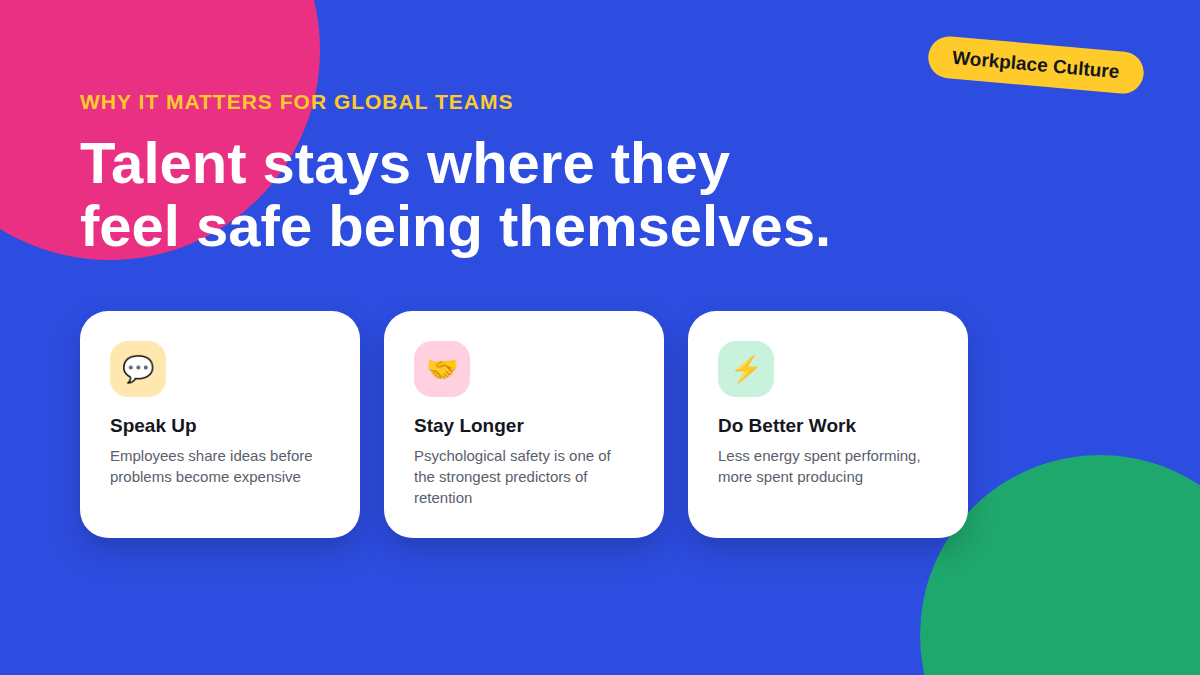
Teams with high psychological safety share ideas earlier, catch problems before they become expensive, and stay longer. Teams without it look professional from the outside while everyone inside is quietly spending their energy managing appearances instead of doing the work. For globally distributed teams — where almost every interaction happens through a screen, with no hallway conversations to soften the formality — that gap is easy to create by accident and hard to notice from the outside.
This is the unglamorous part of going global that EOR providers don’t put on their pricing pages: legal compliance gets your team set up correctly. It doesn’t make them want to stay. That part is still on you.
✨ The Real Takeaway
An employer of record isn’t a shortcut around doing things properly — it’s a different, entirely legitimate way of doing them properly, suited to a specific stage of growth. It removes the capital lockup, the months of registration, and the compliance risk that make direct entity setup such a heavy lift for an unproven hiring plan.
What it can’t remove is the work of building a workplace people actually want to be part of. Get the structure right through an EOR, and build the culture deliberately on top of it — that combination is what turns a single Philippines hire into a team people stay on for years.
If you’re sizing up whether to go the EOR route or commit to an entity, run the numbers against your actual hiring forecast rather than a rule of thumb. The break-even point moves depending on salary levels, role complexity, and how many people you’re realistically bringing on in year one — and getting that number right, before you commit capital either way, is the highest-leverage thirty minutes you can spend on this decision.