Why US Startups Are Building Back-Office Teams in the Philippines

If you have spent any time in US startup circles recently, you have probably noticed a pattern: teams that appear to be four or five people in San Francisco or New York are quietly supported by a larger operation somewhere else. Increasingly, that somewhere else is the Philippines.
This is not offshoring in the traditional sense — sending work to the cheapest available location and managing it at arm’s length. It is something more strategic. Startups with tight runways and aggressive growth targets are using the Philippines to build genuine operational capacity: accounting, customer support, marketing operations, data, HR administration, and more — functions that are essential to scaling but too expensive to hire for domestically.
The Startup Back-Office Problem
Every startup hits the same wall around the Series A or B stage — sometimes earlier. The founding team, which has been managing everything from product to payroll, can no longer scale by working harder. The business needs real operational infrastructure: finance and accounting, customer support, HR administration, data management, marketing operations.
The problem is cost. A mid-level operations professional in a US market commands a base salary of $60,000 to $90,000 per year, before benefits, taxes, and overhead. For a startup watching burn rate, hiring three or four of these roles domestically can add $300,000 or more in annualised cost before you see any return. The alternatives — fractional executives, offshore agencies, contract platforms — each have their own limitations. The Philippines offers something different: full-time, dedicated professionals who become genuine members of your team, at a cost structure that makes operational scaling financially viable.
The Cost Equation
A skilled, experienced professional in the Philippines — someone with a degree, several years of relevant experience, and strong English communication — earns between $1,000 and $2,500 per month, depending on seniority and specialisation. That is $12,000 to $30,000 per year in base salary.
For context, that is roughly one-third to one-fifth of what an equivalent role would cost in a major US market. And unlike offshore agencies or contract platforms, you are paying for a dedicated employee — someone who works full-time for your company, understands your business, and builds institutional knowledge over time.
The roles most commonly hired by US startups in the Philippines include finance and accounting, customer support and customer success, digital marketing execution, data entry and management, HR administration, executive assistance, and QA and testing. These are not low-skill roles filled by anyone available. The Philippine talent market is deep, educated, and competitive, producing tens of thousands of capable graduates every year from strong institutions including the University of the Philippines, De La Salle, and Ateneo.
Time Zone Advantage: Near-24-Hour Coverage
The Philippines sits in the UTC+8 time zone. For East Coast companies (UTC-4/UTC-5), the Philippines is 12 to 13 hours ahead. This sounds like a challenge, but it is actually an opportunity. A Philippine team starting work at 8am Manila time is coming online at 7pm or 8pm Eastern — precisely when your US team is wrapping up.
For companies that need extended coverage — customer support, monitoring, or operations functions that cannot afford gaps — a Philippine team working day shift Manila time provides near-24-hour coverage without asking anyone to work the night shift. Many US startups structure their Philippine operations specifically to take advantage of this dynamic: customer support tickets that come in overnight US time are handled by the Manila team and resolved before US business hours begin.
English Fluency and Cultural Alignment
The Philippines is one of the few countries in the world where English is an official language, used in government, business, education, and law. Filipino professionals do not just speak English — they think and work in it. Documentation, communication, reporting, and client interaction all happen naturally in English without translation friction.
There is also a cultural alignment with Western business practices that is unusually strong in the Philippines. Filipino professionals are comfortable with Western management structures, corporate communication norms, and business processes. For US startups specifically, this combination — native English fluency, Western business culture familiarity, and a genuine desire to work with American companies — makes the Philippines a particularly natural fit.
EOR vs Entity: How US Startups Get Started Fast
One of the barriers that has historically slowed US companies from expanding into the Philippines is the complexity of employment law. The Philippines has strong labour protections, mandatory benefits (including the 13th month pay, PhilHealth, SSS, and Pag-IBIG), and specific requirements around employment contracts and termination. Setting up a Philippine corporation and employing staff directly takes months and requires ongoing legal and accounting infrastructure.
The faster path for most US startups is an Employer of Record (EOR) arrangement. Under an EOR model, a licensed Philippine entity employs your team members on your behalf. You direct the work: you choose who to hire, what they do, and how their performance is managed. The EOR handles all of the legal and administrative overhead: employment contracts, payroll, tax withholding, mandatory benefits, and compliance with Philippine labour law.
For a US startup that wants to hire three people in Manila without spending six months establishing a legal entity, the EOR model compresses the setup timeline from months to weeks. You can have fully compliant Philippine employees working for you within a matter of weeks rather than quarters.

What a Philippines Back-Office Actually Looks Like
Stage 1: The first two to three hires (Seed to early Series A). A common first configuration is: one finance/accounting specialist who owns bookkeeping and financial reporting; one customer support specialist who handles tier-1 support tickets; one operations coordinator who handles the administrative work no one on the founding team has time for. Total monthly cost: approximately $3,500 to $6,000 in salaries, plus EOR fees — roughly $50,000 to $80,000 annually for three roles that would cost $180,000 to $270,000 if hired domestically.
Stage 2: Building a real team (Series A to Series B). As the company scales, the Philippine team grows to match operational complexity: a finance team, a customer support team of 3 to 5 specialists with a team lead, marketing operations, a data team, and HR administration. At this stage, the Philippine team may be 10 to 20 people — and the cost savings relative to domestic equivalents are measured in millions of dollars per year.
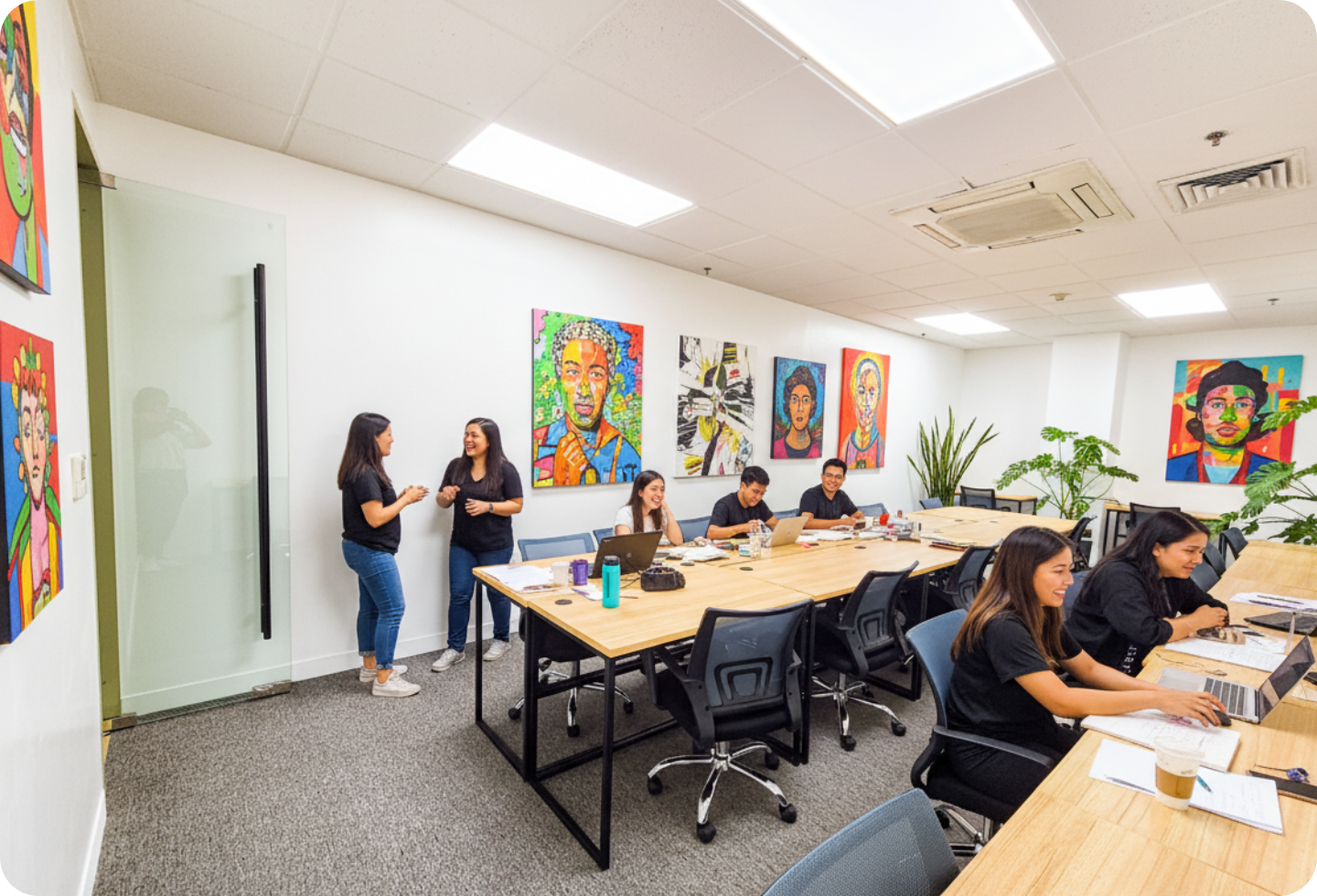
Increasingly, US startups are choosing to base their Philippine teams in managed office environments rather than fully remote setups. The reasons are practical: better performance, stronger team cohesion, more reliable infrastructure, and the ability to onboard new team members into a real physical environment. Co-working spaces and managed office suites in Makati, BGC, Cebu IT Park, and Cebu Mandaue are purpose-built for this use case.
The Setup Timeline: From Decision to First Hire
The honest answer, with an EOR model and a managed workspace: faster than you probably expect.
Weeks 1–2: Define the roles, write or refine the job descriptions, and align on compensation benchmarks for the Philippine market. Weeks 2–4: A recruiter with Philippine market experience can typically surface a strong shortlist within one to two weeks. Final interviews happen via video call. Weeks 4–6: Employment contracts are issued, mandatory benefits are registered, and the new team member begins work. Total elapsed time: four to six weeks from decision to day one.
Why the Philippines — and Why Now
The Philippines has been a destination for back-office work for decades, primarily driven by large BPO operations servicing Fortune 500 companies. What has changed in the last few years is accessibility. EOR providers have made compliant Philippine employment available to companies with no existing legal entity. Co-working and managed office providers have made professional workspace available without long leases. Digital talent platforms have made Philippine professionals visible to US startups that would never have considered international hiring five years ago.
A 15-person Series A startup can now build and operate a Philippine back-office team with the same infrastructure as a company ten times its size — and at a cost that genuinely changes what the business can afford to build.
Getting Started
If you are a US startup founder who is spending too much on back-office functions, running too lean on operational capacity, or simply trying to figure out how to scale without an unsustainable burn rate, the Philippines deserves a serious look.
The Company provides EOR employment services, managed office spaces in Manila and Cebu, and the operational support that makes building a Philippine team genuinely straightforward. We work with startups from their first Philippine hire through to multi-team operations, and we understand the specific constraints and priorities that make the startup context different from enterprise expansion. Get in touch — we would be happy to walk you through what a Philippine back-office could look like for your business specifically.