Global Workforce Engagement Models: Employer of Record Philippines Competitive Advantage

Global teams require strategic engagement model selection: Contractor (highest flexibility, highest legal risk ₱3.6M+), EOR (fastest growth at 5–14 days, lowest compliance burden at $230/month), or Direct Entity (most control, ₱1.2M setup cost). For teams under 20 people, employer of record philippines is economically dominant and compliance-mandatory. For teams over 20, direct entity costs become competitive. IP security is strongest through EOR’s “chain of title” model. Retention is 3x better with formal employment than contractors. Choose based on your exit timeline, not just cost per hour.
Executive Summary
As the global service economy matures and regulatory scrutiny intensifies, organizations are shifting from transactional “gig” relationships to structured, professionalized remote workforces with permanent integration and compliance architecture. The primary strategic decision for expanding enterprises involves choosing between three main models: Employer of Record (EOR), Independent Contractors, and Direct Hiring (Entity Setup).
The employer of record Philippines model is the dominant framework for organizations seeking a balance of speed, compliance certainty, and operational control. It allows companies to hire full-time employees in foreign jurisdictions without establishing a local legal entity, with onboarding typically achieved in 5 to 14 days and monthly costs at $230 per worker.
Independent Contractors offer the highest flexibility and lowest upfront administrative friction but carry significant legal and financial risks, particularly regarding misclassification (which can trigger ₱3.6M–₱4.8M in liability). Direct Hiring through a local subsidiary provides the most control but requires high upfront capital (₱1.2M–₱3.6M) and months of regulatory setup time.
Intellectual Property (IP) security is a critical differentiator that determines acquisition readiness; employer of record Philippines models provide the most robust legal “chain of title” for IP, whereas contractor arrangements often leave IP ownership vulnerable under Philippine labor law and judicial reinterpretation.
Taxonomy of Engagement Models
The following models define the primary methods for engaging international talent based on legal status, management control, and cost structure:
Employer of Record (EOR)
An EOR acts as the legal employer on paper, handling payroll, taxes, benefits administration, and statutory compliance obligations. The client company retains full day-to-day management of the worker and operational decisions. Zero-Ten Park Philippines operates as an EOR for clients across multiple geographies, hiring full-time employees in the Philippines (across IT Park Cebu, Mandaue, and Makati operations) who work under direct management of international companies. The EOR relationship is legally transparent and carries zero hidden risks or surprise liabilities.
Independent Contractors
Contractors operate as independent business owners with theoretical autonomy. They provide their own tools, set their own schedules (legally, though this is frequently violated), and are responsible for their own taxes and benefits. While frequently referred to as Virtual Assistants (VAs), the relationship is transactional and centered on specific deliverables rather than integrated team membership. Contractors carry the highest legal risk for employers when behavioral control indicators suggest hidden employment.
Direct Hire (Entity)
Establishing your own local subsidiary provides maximum control but requires significant capital and ongoing compliance expertise. This model involves: registering a business entity with the Bureau of Internal Revenue, obtaining BIR certificates, opening corporate bank accounts, maintaining monthly BIR filings, conducting annual audits, and ensuring ongoing compliance with labor and tax codes. It’s cost-effective once a team exceeds 20+ members in a single jurisdiction, at which point fixed costs of entity maintenance are amortized across larger payroll bases.
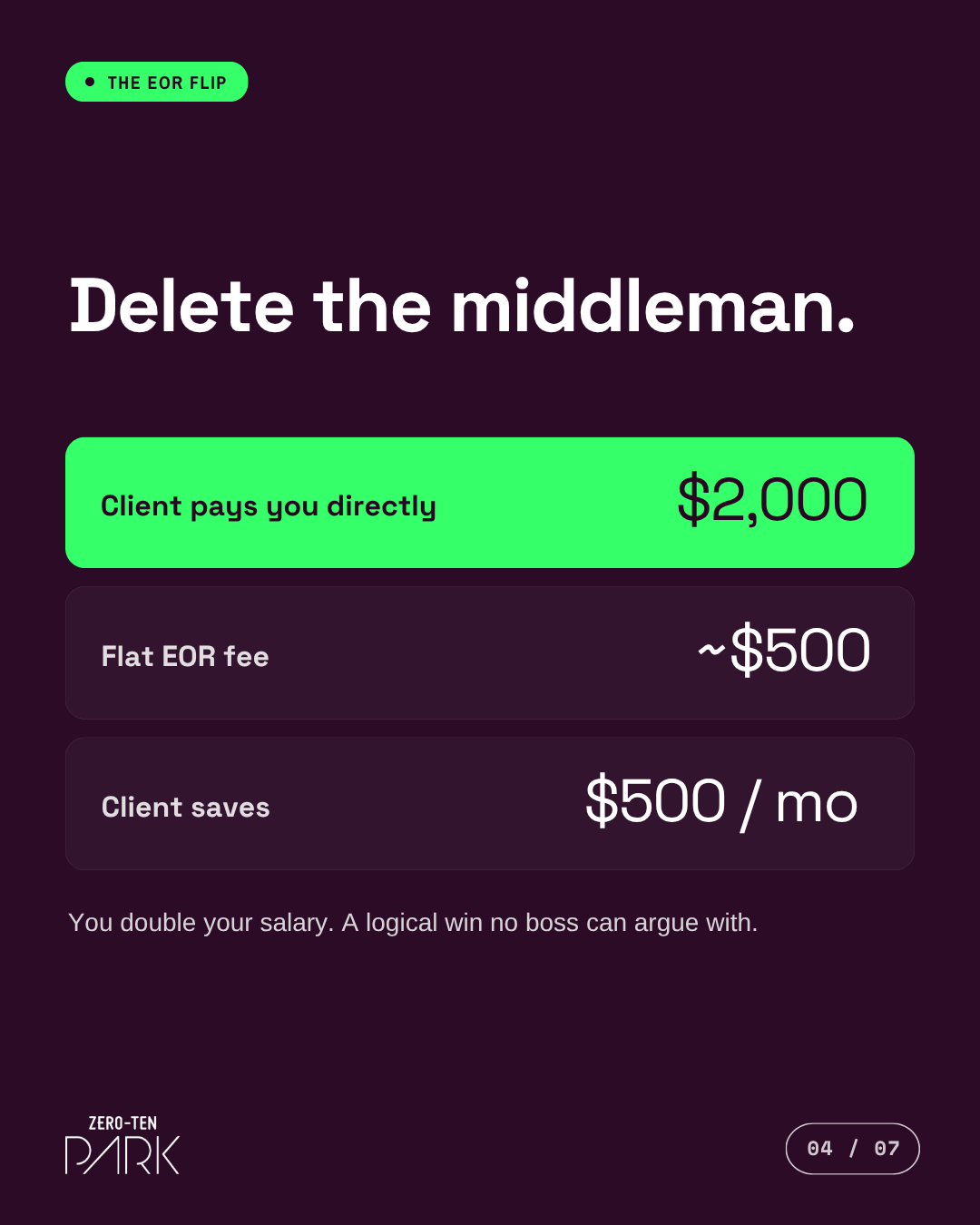
Economic Analysis: Total Cost of Ownership
The true cost of hiring involves far more than the base salary. Organizations must account for “employer load”—the additional costs of taxes, benefits, insurance, and compliance. In the US, total employment costs typically range from 1.25x to 1.4x of the base salary. In the Philippines, statutory employer load adds approximately 12–18% to base salary.
For a ₱40,000/month VA in the Philippines:
- SSS employer contribution: ₱1,800/month (4.5%)
- PhilHealth: ₱400/month
- Pag-IBIG: ₱600/month
- 13th month pay (spread monthly): ₱3,333/month
- Service Incentive Leave (value): ₱667/month
Total employer load: ₱6,800/month (17%), bringing total monthly cost to ₱46,800 base + ₱13,800 EOR = ₱60,600. Annual cost: ₱727,200.
Now compare engagement models on realistic economic footing:
- Contractor (no benefits, zero legal protection): ₱40,000/month = ₱480,000/year + exposure to ₱3.6M audit liability
- EOR (all benefits, complete protection, $230 fee = ₱13,800): ₱60,600/month = ₱727,200/year + complete legal protection
- Direct Entity (local subsidiary, all benefits, fixed maintenance): ₱60,600 + ₱75K–₱150K maintenance = ₱135,600–₱210,600/month + upfront setup cost ₱1.2M–₱3.6M
- Crossover point: Direct entity becomes cheaper than EOR at approximately 15–20 employees in a single jurisdiction, because fixed maintenance costs are amortized across larger team.

Compliance and Risk Management
The most significant risk in global hiring is misclassifying an employee as an independent contractor. Labor authorities worldwide use behavioral control and financial control tests that look past contract labels and examine the actual working relationship with forensic scrutiny. If the contract says “contractor” but the relationship exhibits employee-like characteristics, the authority will reclassify and assess massive penalties.
In the Philippines specifically, the Labor Code Article 280 presumes employment status in ambiguous situations, meaning the burden of proof rests with the employer to prove independent contractor status. Most contractor agreements don’t hold up to scrutiny when challenged.
The financial consequences of misclassification are severe and non-negotiable. Back taxes, statutory contributions (SSS, PhilHealth), overtime premium pay, bonuses, and penalties can total ₱3.6M–₱4.8M for a ₱40,000/month VA over two years. This exposure exists whether or not the employer was aware of the misclassification or attempted to comply.
Regional Regulatory Environments
The Philippines labor code is one of the world’s most employee-protective, with deep historical roots in workers’ rights advocacy and social protection principles. Understanding this context is critical for any hiring decision, particularly for global companies accustomed to more flexible labor markets.
Mandatory benefits include: SSS (retirement + disability insurance), PhilHealth (healthcare coverage), Pag-IBIG (housing fund), 13th-Month Pay (statutory bonus), Service Incentive Leave (5 days annually), and 9 national holidays + 2 special holidays (paid). These are not optional negotiating points. They are legal obligations.
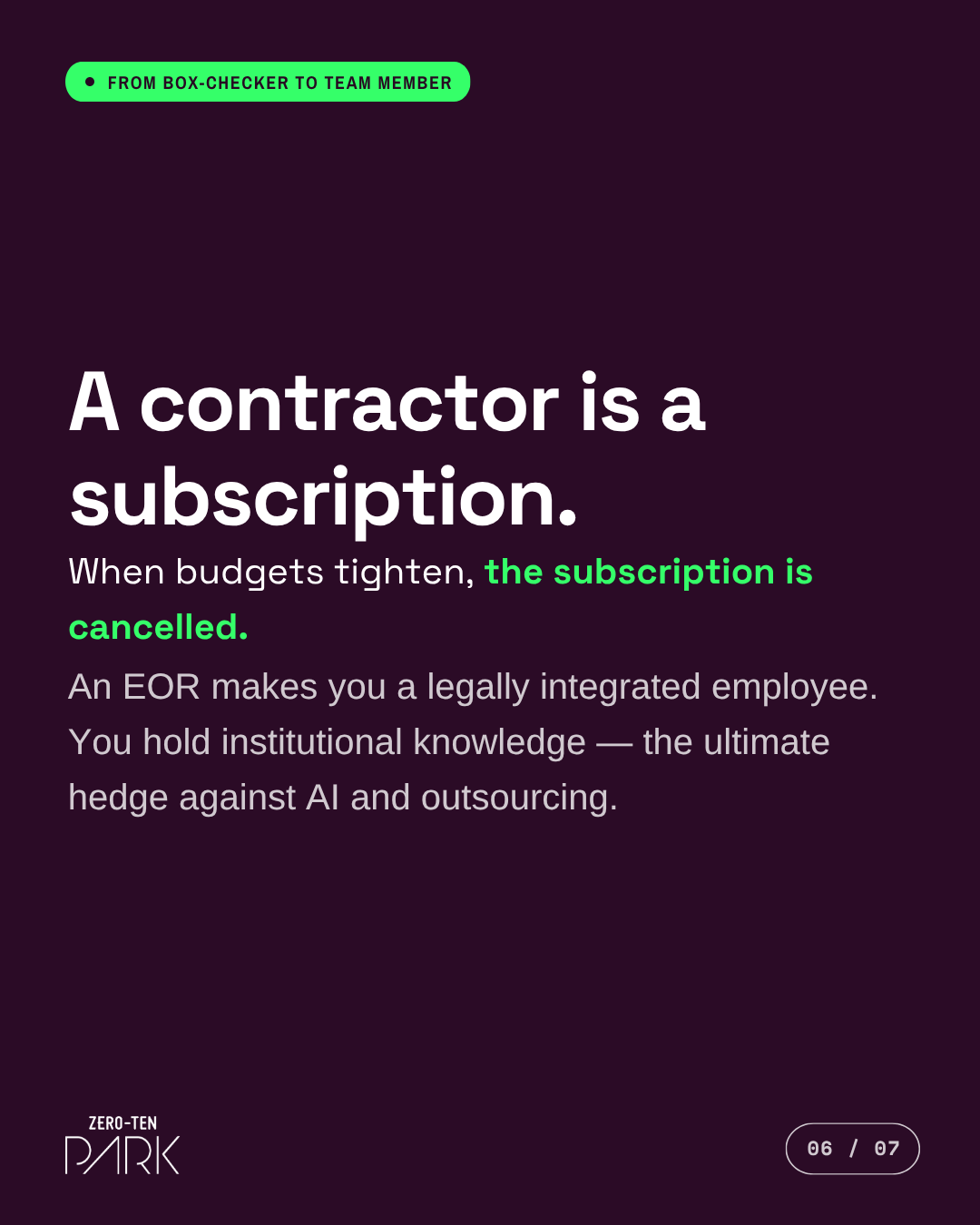
Zero-Ten Park Philippines operates across IT Park Cebu, Mandaue, and Makati, navigating these regulatory requirements daily for clients and team members. Our lived operational experience shows that formal employment is not just legally compliant—it’s operationally superior to contractor relationships in terms of retention, productivity, and institutional knowledge preservation.
Operational Dynamics and Intellectual Property
A major strategic risk in the contractor model is the vulnerability of Intellectual Property. Independent contractors often retain default ownership of their output unless a specific, legally binding IP assignment agreement is executed separately. Even with an assignment agreement, if the contractor relationship is reclassified as employment, the validity of the IP assignment can be questioned under Philippine law.
The employer of record Philippines framework solves this through a Tripartite Legal Structure that creates a clean chain of title that is legally defensible. Rights move seamlessly from the Worker to the EOR (via locally compliant employment contract with explicit “Work Made for Hire” provisions) and then from the EOR to the Client (via Master Services Agreement).
This structure is bulletproof because it uses formal employment law (which explicitly supports IP transfer to the employer) rather than contractor law (which is ambiguous and vulnerable to reinterpretation by courts). If your company is ever acquired or seeks venture funding, due diligence on IP will be clean and defensible. The alternative—contractor IP with ambiguous ownership—can derail entire acquisitions.
Strategic Decision Framework
Choose your engagement model based on your strategic objective, team size, growth timeline, and exit strategy:
- Testing a New Market (1–5 people): Employer of record Philippines (low risk, fast onboarding 7–14 days, no entity required, $230/month per person).
- Short-term Project (3–6 months): Independent Contractor (high agility, minimal long-term compliance burden, but expect 30–50% turnover post-project).
- Core Engineering/Product Team (1–3 year horizon): Employer of record Philippines (long-term stability, IP security, full operational control, 67% lower turnover than contractors).
- Large Team (20+ people, 3+ year horizon): Direct Hire (Entity) where fixed maintenance costs become less costly than scaling EOR fees.
✨ EOR "Work Made for Hire" = acquisition-ready IP. Contractors = chaos.
For organizations prioritizing compliance certainty, IP protection, and talent retention, the employer of record Philippines model at $230/month is the most resilient path for global expansion. While it carries a higher monthly fee than direct contractor engagement, it mitigates the catastrophic financial risks (₱3.6M+ exposure) associated with labor law audits and provides a professional foundation for building a resilient distributed workforce. The choice is not between cheap and expensive; it’s between paying for infrastructure now or paying for liability later.
FREQUENTLY ASKED QUESTIONS
The economic crossover typically occurs at 15–20 employees in a single jurisdiction. Below that, EOR is substantially more cost-effective due to fixed setup (₱1.2M–₱3.6M) and monthly maintenance costs (₱75K–₱150K) of direct entities. Above 20, cumulative monthly EOR fees often exceed fixed entity costs. However, even at 20+ employees, EOR remains attractive if you value compliance certainty and avoid massive upfront entity setup costs.
Yes. An EOR conversion typically takes 5–14 days. The individual remains in the same role, same team, same client relationship—but now has formal employment status, statutory benefits (13th month, SSS, PhilHealth, Pag-IBIG), and legal protection. This is one of the most common transitions we facilitate. The person’s life improves; the company’s legal exposure disappears.
Misclassification audits can result in: backpay of 1–3 years of wages, statutory contributions (SSS at 11.25%, PhilHealth at 3.6%, Pag-IBIG at 2%), 13th month bonuses, overtime premiums (30% for hours over 8/day), severance pay, plus penalties up to 100% of owed taxes, plus interest at 5–8% annually. A single ₱40,000/month contractor misclassified for 2 years can trigger ₱2M–₱2.8M in liabilities. An EOR eliminates this risk entirely by establishing proper employment from day one.
The EOR employment contract includes explicit “Work Made for Hire” provisions ensuring all IP created during employment automatically transfers to the employer. This is reinforced via Master Services Agreement with the client. The tripartite legal structure creates an ironclad chain of title that survives audits, acquisitions, and legal challenges.
We monitor regulatory changes continuously (SSS, PhilHealth, Pag-IBIG, BIR rules change 2–3 times annually) and implement updates immediately. Your $230/month fee includes compliance tracking and updates. We handle it; you don’t have to worry about navigating regulatory changes. This is what you’re paying us for.

GET A QUOTE TODAY
"*" indicates required fields
Ready to level up your business presence and save more every month? Complete the form now and our team will handle the rest.