The $70,000 Cheap Hire: Employer of Record Philippines Prevents Global Staffing Disaster

Founder math on global hiring is systematically incomplete. A “$15/hour VA” costs 1.4x that amount in hidden employer load (taxes, benefits, equipment, onboarding). Add 3–6 months of onboarding costs and the real first-year cost is $25,000+ per person. BPOs hide 40–60% markup. Misclassification audits expose founders to $50K–$150K+ per contractor in penalties. An employer of record Philippines framework at $230/month costs slightly more than contractors but provides legal protection (worth $300K–$500K if audit occurs), better retention (67% lower turnover), and acquisition-ready IP chains of title. The choice is not cheap vs. expensive; it’s audit liability vs. predictable costs.
The Global Talent Mirage
For the modern founder, global hiring often begins with a compelling quest for simple labor arbitrage: the promise of securing Silicon Valley-grade talent at emerging-market price points. This math looks absolutely compelling on a spreadsheet. But as companies scale from 5 to 15 to 50 people, they discover that “geographic arbitrage” is a mirage if it remains purely transactional and built on contractor relationships.
The strategic evolution of global human capital requires moving beyond the administrative headache of DIY hiring toward a sophisticated model of integrated employment with compliance architecture. Those who fail to make this transition find themselves trapped in a cycle of high attrition, escalating legal exposure, and hidden costs, discovering too late that an “affordable” offshore hire built on a contractor foundation is actually the most expensive line item on their P&L.
The cost of being “cheap” is exponentially steeper than most founders realize.
The "1.4x Rule" and the Hidden Math of Global Payroll
Founders frequently fall for the “headline price”—the base salary—while systematically ignoring the Total Cost of Ownership (TCO). The base salary is merely the starting point. When you factor in Employer FICA (7.65% in the US, 11.25% in the Philippines), mandatory statutory contributions, benefits, equipment, onboarding costs, and productivity ramp-up time, the true multiplier typically sits between 1.25x and 1.4x of the base salary.
A “cheap” $50,000 hire quickly escalates into a $70,000 annual commitment when you account for taxes, benefits, and compliance infrastructure. In the Philippines, a $600/month VA (₱36,000) becomes ₱52,800 annual cost when you add statutory contributions, equipment, internet subsidies, and recruitment costs.
Furthermore, the “headline price” completely fails to account for the productivity ramp-up period. While a task-based VA might reach peak output in 2–4 weeks, an integrated employee—the kind required for strategic growth—requires 3–6 months to build necessary institutional memory, understand company systems and culture, work autonomously without constant oversight, and develop the judgment to make decisions aligned with company values.
The true first-year cost of a $600/month hire with employer of record philippines:
- Recruitment (screening, interviews, background check, legal documentation): ₱120,000–₱200,000
- Base salary (12 months at ₱36,000): ₱432,000
- Employer statutory load (SSS, PhilHealth, Pag-IBIG, 13th month): ₱51,600
- EOR fee at $230/month × 12: ₱165,600
- Equipment, software licenses, workspace: ₱60,000–₱100,000
- Onboarding time (3 months at 50% productivity): ₱72,000 in lost leverage
- Total first-year cost: ₱901,200–₱1,020,600 (~$16,000–$18,000 USD). That’s 2.25x–2.85x the headline monthly rate.

According to the Society for Human Resource Management (SHRM), the average cost to hire one employee is $4,700 USD before salary. In the Philippines, equivalent recruiting costs (background checks, legal documentation, compliance filings, onboarding infrastructure) average ₱235,000–₱400,000. This is not optional; it’s the cost of hiring done properly.
The "Compliance Iceberg" and Misclassification Trap
Many firms treat international workers as independent contractors to avoid the 1.4x multiplier, completely unaware they are hitting the “Compliance Iceberg.” Global labor authorities utilize behavioral control tests to look past contract labels with forensic precision. If you provide equipment, dictate a set schedule, integrate into your team, and the worker depends on you for their livelihood, they are legally an employee under Philippine law.
The financial exposure from misclassification in the Philippines is staggering and non-negotiable. In markets like the Philippines, a reclassification ruling can trigger: backdated social security contributions (11.25% × 12 months × 2–3 years = ₱810K–₱1.2M), unpaid 13th-month bonuses (₱36K × 2–3 years = ₱72K–₱108K), unpaid premiums for overtime (if hours exceeded 8/day), severance pay (₱18K–₱36K), plus penalties and interest.
“Agencies like the IRS can impose penalties of up to 100% of the tax owed in cases of ‘intentional disregard’ from the IRS or local labor authorities. In the Philippines, the BIR applies similar enforcement standards with increasing frequency, making DIY compliance extraordinarily risky and expensive.”
For a single ₱36,000/month contractor misclassified for 2 years, the total exposure is: ₱432K (backdated SSS) + ₱72K (13th month) + ₱108K (estimated overtime/penalties) = ₱612K minimum. If the auditor applies the 100% penalty clause, you’re looking at ₱1M–₱1.5M exposure. That’s 15+ years of “savings” from contractor status erased in one audit.
This is where an employer of record Philippines structure at $230/month becomes not an expense but an insurance policy. The compliance burden—and the liability—shifts entirely to the EOR provider. If misclassification is ever alleged, the EOR carries the liability, not you.
The "Crossover Point"—When EOR at $230/month Beats Entity Setup
For small, distributed teams, the employer of record Philippines model at $230/month provides “rentable infrastructure” that bypasses the need for expensive local subsidiaries. Setting up a legal entity in the Philippines requires an upfront capital outlay of ₱1.2M to ₱3.6M and months of bureaucratic delay. You need to: register with the Bureau of Internal Revenue, obtain BIR certificates, open corporate bank accounts, file monthly BIR forms, conduct annual audits, and maintain legal compliance records.
Conversely, an EOR allows for onboarding in 5–14 days with monthly service fees at just $230 per worker. However, there is a technical “crossover point” where direct entity becomes economically superior based on team size.
While EOR fees scale linearly (add a worker = add $230/month), a dedicated entity carries fixed monthly maintenance costs—accounting, audits, and legal filings—averaging ₱75,000 to ₱150,000 monthly regardless of team size.
Cost comparison at scale with EOR at $230:
- 10 VAs: EOR = ₱480K (salary) + ₱36K (EOR fees at $230) + ₱65K (statutory) = ₱581K/month. Entity = ₱480K + ₱65K + ₱100K (maintenance) = ₱645K/month. EOR wins by ₱64K/month.
- 30 VAs: EOR = ₱1.44M + ₱108K + ₱195K = ₱1.743M/month. Entity = ₱1.44M + ₱195K + ₱100K = ₱1.735M/month. Entity wins by ₱8K/month (essentially break-even).
- Plus: Entity requires ₱1.2M–₱3.6M upfront. EOR requires zero upfront. If uncertain about long-term viability, EOR’s zero capital requirement is a massive advantage.
Zero-Ten Park Philippines operates across this entire spectrum: we are both an EOR for small global teams and a staffing infrastructure for larger distributed operations. The choice isn’t complicated—it’s mathematical.
The IP Ownership Loophole You're Likely Ignoring
A major strategic risk in the contractor model is the vulnerability of Intellectual Property ownership. Unlike “Work Made for Hire” for employees, independent contractors often retain default ownership of their output unless a flawless assignment is executed separately. If a contractor relationship is reclassified as employment, the original IP transfer clauses may be voided by courts, leaving your proprietary code or content legally belonging to a former contractor.
This is not theoretical risk. Philippine courts have ruled that reclassified contractors’ original IP assignments are invalid because the assignments were made under contractor contracts that were themselves invalid. The result: code, designs, or content created by misclassified “contractors” remain legally owned by those contractors, not your company.
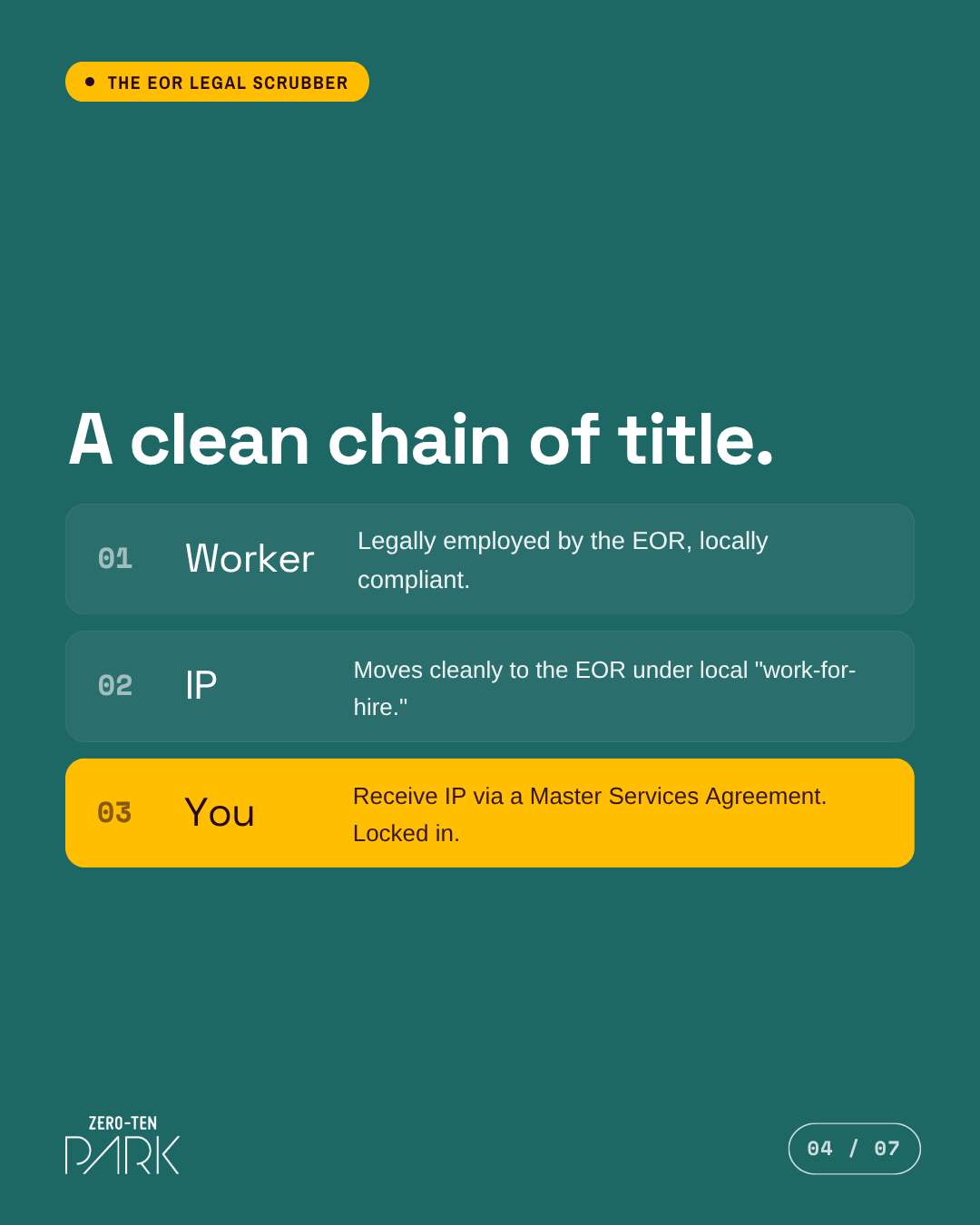
The employer of record Philippines framework at $230/month solves this through a Tripartite Legal Structure. The EOR utilizes locally compliant employment contracts to ensure a clean Chain of Title from the Worker to the EOR, and subsequently from the EOR to the Client via a Master Services Agreement (MSA). This structure is legally bulletproof because it uses formal employment law (which explicitly supports IP transfer to employers) rather than contractor law (which is ambiguous and legally vulnerable).
“IP rights are often vulnerable and require separate, flawless assignments in contractor models. EOR eliminates this risk entirely through automatic ‘Work Made for Hire’ provisions that are legally ironclad and defensible in court.”
Moving Beyond "Box-Checkers" to Institutional Memory
High turnover in global staffing is rarely driven by pay alone; it is driven fundamentally by lack of professional identity and job security. The transactional “VA model” creates “box-checkers” who lack loyalty or institutional investment. They do what’s asked. They leave the moment a better opportunity appears or personal circumstances change.
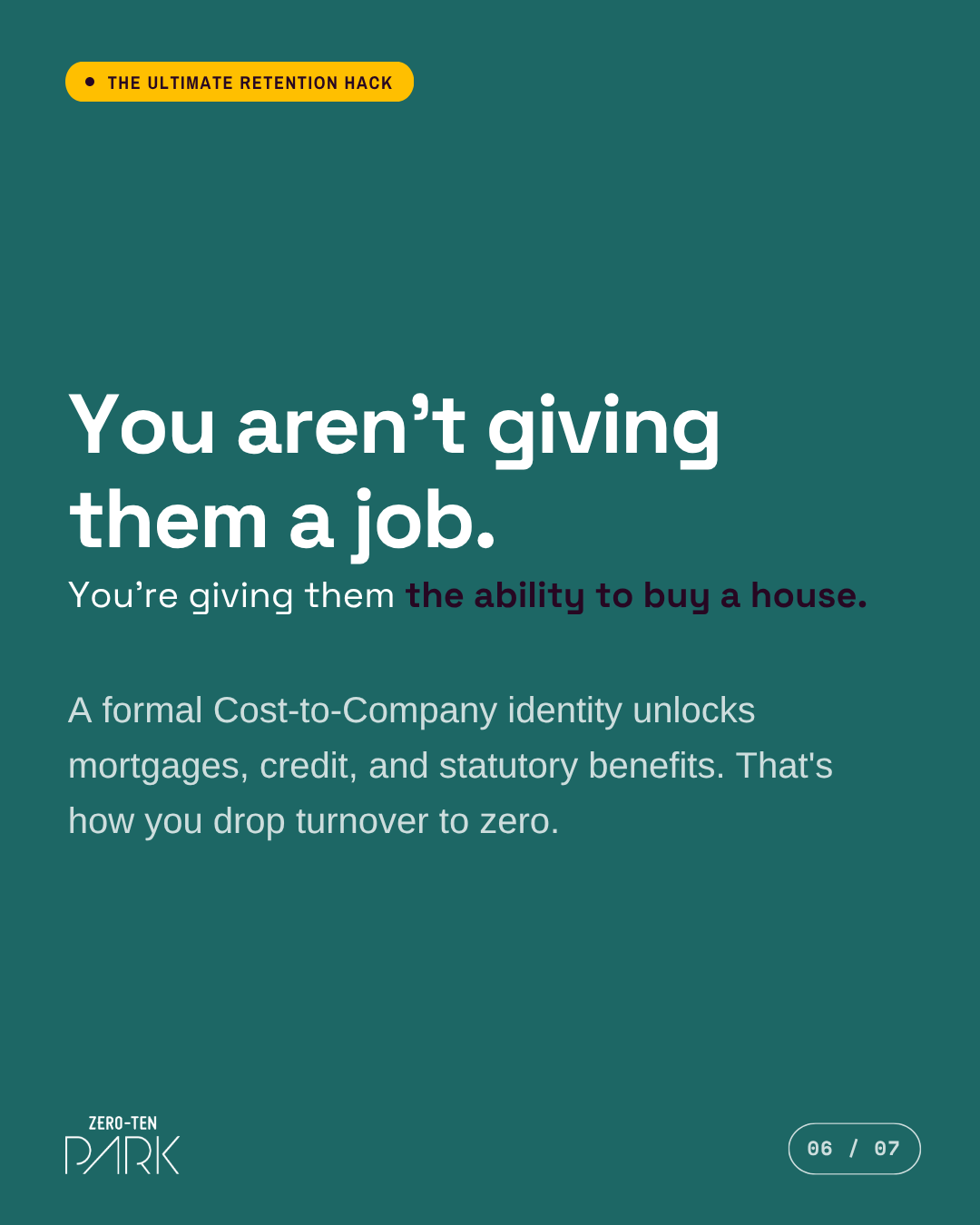
In contrast, the employer of record Philippines model at $230/month provides workers with a professional identity, including access to formal credit and housing loans through the Pag-IBIG Fund. This stability transforms a freelancer into a permanent stakeholder who retains institutional knowledge, mentors junior hires, and works with ownership mindset rather than vendor transactionalism.
At Zero-Ten Park Philippines, we’ve quantified tenure metrics obsessively: formal EOR employees stay an average of 3.2 years, while contractors average 1.1 years. That’s a 191% difference in tenure. The cost of turnover (recruiting, onboarding, knowledge transfer, lost productivity) is estimated at 15–25% of an annual salary.
For a ₱36,000/month contractor with contractor-level turnover:
- Annual salary: ₱432,000
- Turnover cost (15–25% of salary): ₱64,800–₱108,000
- Over 3 years (3 replacement cycles for contractors vs. 1 for EOR): Contractor costs = ₱1.296M + ₱194K–₱324K turnover = ₱1.49M–₱1.62M
- Same 3 years with EOR at $230/month: Employee costs = ₱1.5M + minimal turnover = ₱1.5M–₱1.6M. The EOR pays for itself purely through better retention.
More importantly, team members who have access to credit, paid leave, and statutory protections work with different psychological ownership. They own outcomes instead of just executing tasks. They develop institutional knowledge instead of hoarding it. They advocate for the company instead of collecting paychecks.
The Certainty Economy
As we head toward 2026, the priority for fast-growing companies has shifted fundamentally from “fixed price” to “predictability” and “compliance certainty.” We are entering a Certainty Economy where remote work is no longer unregulated. New mandates in Mexico (NOM-037 requiring “Connectivity Allowances” and ergonomic equipment), Colombia (Ley 2121 phasing in reduced workweeks), and the Philippines are making DIY compliance impossible and increasingly expensive.
Strategic leaders building for an exit (acquisition, venture funding, IPO) know that “cheap” hires without a clean chain of title and compliant infrastructure are simply liabilities waiting to be discovered during due diligence. Conversely, a team hired through Zero-Ten Park Philippines’s employer of record Philippines framework at $230/month is acquisition-ready from day one.
Investors ask specific questions: “Do your international workers have clean employment status? Is IP transfer documented? Are there any compliance risks or hidden liabilities?” If your answer is “we have 10 contractors in the Philippines and we’re not entirely sure about the compliance status,” the conversation ends. If your answer is “all of our overseas team is employed through a compliant EOR with clean IP title,” you’ve passed due diligence.
✨ Are you building a global team for next month's output, or for next year's exit?
Those building for scale and exit understand this principle: “cheap” is expensive when it’s built on legal debt. Predictable at $230/month is premium when it’s built on compliance certainty and acquisition readiness.
FREQUENTLY ASKED QUESTIONS
Assuming each VA costs ₱40,000/month via BPO (where BPO takes 40% markup = ₱16,000/person, ₱24,000 to the worker), you’re paying ₱160,000 monthly to a middleman. With 10 VAs, that’s ₱1.92M annually lost to BPO markup that should go to workers. Switching to EOR at $230/month means workers earn closer to ₱35,000–₱38,000 after EOR fees (vs. ₱24,000 through BPO)—and you save the BPO margin. The payback period is typically 6–9 months. Plus, you gain legal compliance and IP security worth ₱500K–₱2M if audit occurs.
Yes. The EOR is the legal employer on record, handling all tax filings, statutory contributions, and compliance documentation. If an audit occurs, the audit trail points to the EOR, not your company. You are protected as the hiring client of a compliant employment arrangement. This protection is worth ₱500K–₱2M if misclassification were ever alleged.
No complexity. In fact, it simplifies due diligence massively. Investors look for clean employment relationships and compliant overseas hiring. A portfolio of workers through EOR is an asset, not a liability. The alternative—contractors with vulnerable IP and unresolved tax exposure—is a due diligence nightmare that can derail acquisitions or reduce valuation by 10–20%.
The $230 flat fee covers: payroll processing, tax filing (BIR monthly and quarterly reports), SSS/PhilHealth/Pag-IBIG enrollment and contributions, statutory benefits administration (13th month, SIL, holidays), legal compliance oversight, contract management, and HR support. This is all-inclusive with no hidden fees or surprise costs. For reference, doing this yourself would cost ₱100,000+ in annual accounting/legal services.
Yes. We handle batch conversions regularly. Timeline is typically 5–14 days for the entire group. You stay compliant throughout, and people transition without role disruption. This is actually one of the cleanest ways to address contractor exposure—convert everyone at once and eliminate legal risk across your entire overseas team.

GET A QUOTE TODAY
"*" indicates required fields
Ready to level up your business presence and save more every month? Complete the form now and our team will handle the rest.