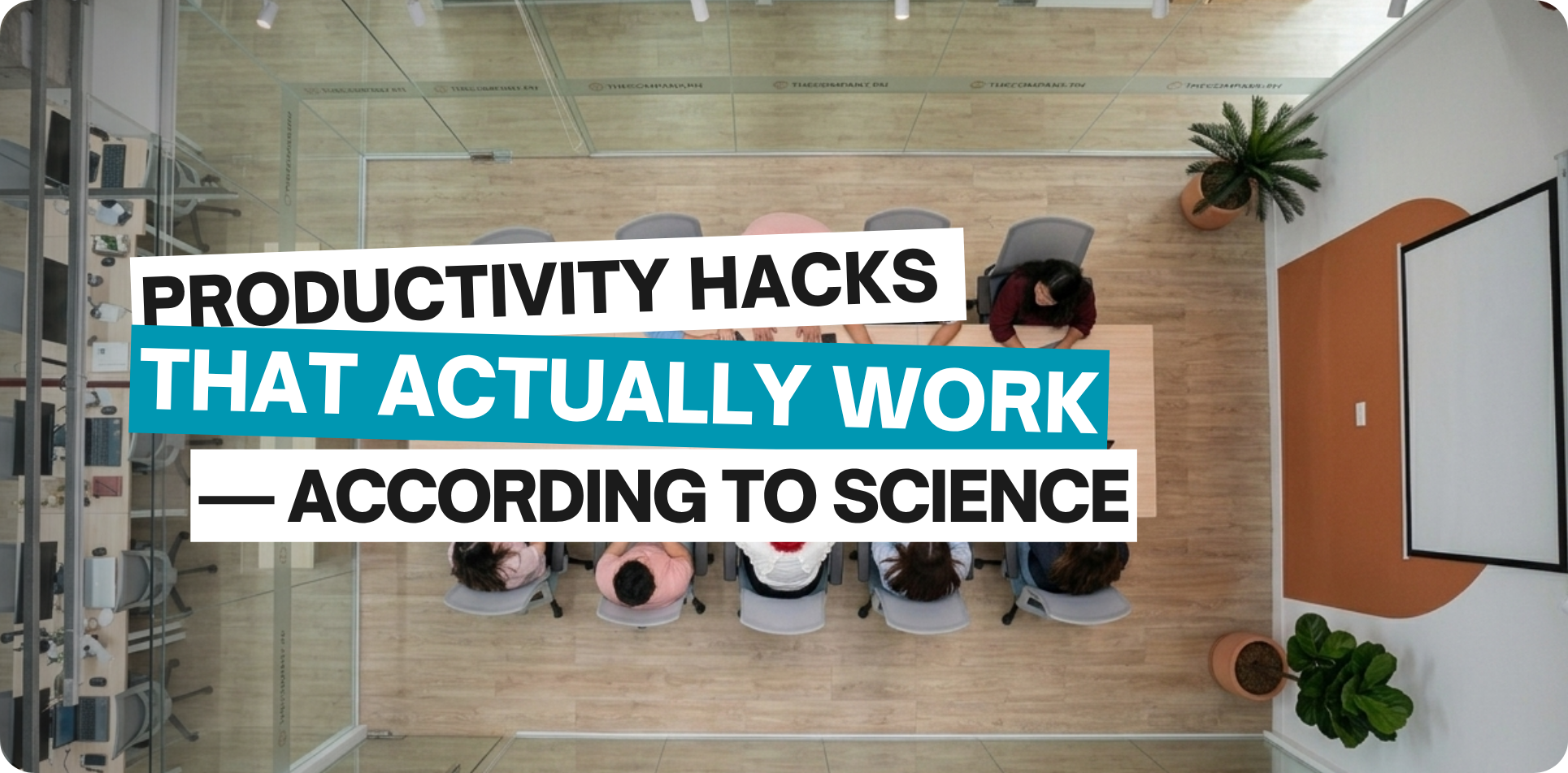
Productivity Hacks That Actually Work — According to Science

Productivity advice has become strangely exhausting.
Open LinkedIn or YouTube for five minutes and you will likely see someone recommending:
- waking up at 4 AM,
- answering emails before sunrise,
- drinking three supplements,
- taking ice baths,
- or turning your entire life into a perfectly optimized routine.
Yet despite all the productivity content available today, employees everywhere still feel overwhelmed, distracted, mentally drained, and constantly behind.
Something clearly is not working.
The truth is, most people are not struggling because they are lazy. They are struggling because modern work environments are mentally noisy.
Notifications never stop. Meetings interrupt focus constantly. Employees switch between tasks all day while trying to appear productive online. Many professionals end their workday emotionally exhausted despite feeling like they barely accomplished anything meaningful.
According to research from Microsoft Work Trend Index, employees today face increasing digital overload, constant interruptions, and communication fatigue — all of which significantly reduce focus and productivity.
This matters not only for employees, but also for employers.
Companies investing in global talent through an Employer of Record Philippines model are increasingly realizing that productivity is no longer simply about hours worked. Sustainable performance now depends heavily on focus quality, mental energy, work design, and employee well-being.
Especially in remote and hybrid environments, the most productive teams are not necessarily the busiest ones.
They are usually the teams that understand how human attention actually works.
The good news is that productivity is not purely motivational. Much of it is behavioral and psychological — which means there are practical, science-backed ways to improve it without turning work into a constant hustle competition.
Here are some productivity hacks that genuinely work according to research, workplace psychology, and behavioral science.
1. Stop Multitasking — Your Brain Is Worse at It Than You Think
Many employees still believe multitasking is a professional strength.
In reality, the brain is remarkably inefficient at handling multiple cognitive tasks simultaneously.
What most people call multitasking is actually “task switching,” where the brain rapidly shifts attention from one activity to another. And every switch comes with a mental cost.
Research from Stanford University on multitasking and cognitive performance found that heavy multitaskers perform worse on attention control, memory management, and information filtering compared to people who focus on one task at a time.
In simple terms:
The more tasks employees juggle simultaneously, the less efficiently the brain performs.
This explains why employees often feel mentally tired even after relatively simple workdays. Constantly switching between:
- Slack messages,
- emails,
- meetings,
- spreadsheets,
- and notifications
forces the brain to repeatedly reset attention.
The best productivity strategy is surprisingly simple:
Do fewer things at once.
Many high-performing professionals now intentionally create “single-focus windows” where they work on one cognitively demanding task without interruptions for a set period of time.
Not because it feels productive.
Because research shows it actually is.

2. The Brain Needs Breaks More Than Most Employees Realize
One of the biggest productivity myths is the idea that continuous work equals continuous output.
It does not.
Human focus naturally operates in cycles.
According to research on ultradian rhythms referenced by Harvard Business Review and workplace performance studies, mental focus and energy naturally decline after extended periods of concentration.
This means employees are not designed for nonstop deep focus over eight straight hours.
The brain needs recovery periods to maintain cognitive performance.
Ironically, employees who refuse to take breaks often experience:
- reduced focus,
- slower decision-making,
- more mistakes,
- and mental fatigue.
Short recovery breaks can actually improve productivity significantly.
This is why techniques like the Pomodoro Method continue gaining popularity. Structured focus periods followed by short breaks help reduce mental fatigue while maintaining attention quality.
Even small resets help:
- standing up,
- stretching,
- walking briefly,
- drinking water,
- or simply stepping away from the screen.
The most productive employees are not necessarily the people who work nonstop.
They are usually the people who manage their mental energy better.
3. Your Environment Affects Productivity More Than Motivation Does
Many people assume productivity is mainly about discipline.
But behavioral science shows environment often matters more than motivation.
According to behavior researcher BJ Fogg from Stanford Behavior Design Lab, human behavior is heavily influenced by environmental cues and friction.
This means small workplace adjustments can dramatically affect focus and consistency.
For example:
- keeping distracting apps open increases interruption frequency,
- phone visibility reduces attention span,
- cluttered workspaces increase cognitive load,
- and noisy environments weaken concentration.
Meanwhile, small environmental improvements can significantly improve productivity:
- dedicated focus spaces,
- minimized notifications,
- structured work zones,
- cleaner digital organization,
- and visual task clarity.
Many companies hiring in the Philippines through an Employer of Record Philippines setup are now prioritizing remote work systems that improve focus sustainability rather than simply tracking activity.
Because employees do not become productive through pressure alone.
They become productive when work environments support concentration.

4. Productivity Improves When Employees Stop Chasing Motivation
This may sound surprising, but highly productive people are not always highly motivated.
They simply understand momentum better.
One of the biggest mistakes employees make is waiting to “feel motivated” before starting important work.
Behavioral psychology consistently shows the opposite approach works better:
Action often creates motivation — not the other way around.
According to research surrounding the “progress principle” discussed by Harvard Business Review, even small progress on meaningful work significantly improves motivation and engagement.
This is why tiny actions matter.
Starting with:
- five minutes,
- one paragraph,
- one email,
- or one task
often creates enough momentum for the brain to continue working.
Employees who rely entirely on motivation tend to become inconsistent.
Employees who rely on systems tend to become reliable.
That difference matters enormously in professional environments.
5. Deep Work Is Becoming One of the Most Valuable Workplace Skills
Modern work rewards responsiveness.
But meaningful work usually requires concentration.
This creates a major workplace contradiction.
Employees spend large portions of the day reacting:
- answering chats,
- attending meetings,
- replying to notifications,
- and switching contexts constantly.
But according to productivity researcher and author Cal Newport’s Deep Work research, high-quality cognitive performance requires uninterrupted focus.
Deep work refers to periods of distraction-free concentration where employees can fully engage with mentally demanding tasks.
This is becoming increasingly rare — and increasingly valuable.
Especially in remote teams, companies often accidentally destroy focus through:
- excessive meetings,
- nonstop communication expectations,
- and fragmented workflows.
The most effective workplaces are now intentionally protecting focus time.
Because shallow busyness and meaningful productivity are not the same thing.
6. Sleep Impacts Productivity More Than Hustle Ever Will
Many workplace cultures still quietly glorify exhaustion.
Employees brag about sleeping four hours.
Leaders praise overwork.
Burnout becomes normalized.
Yet scientifically, sleep deprivation damages nearly every aspect of cognitive performance.
According to research from Harvard Medical School Sleep Research, insufficient sleep significantly affects:
- memory,
- concentration,
- emotional regulation,
- reaction time,
- and decision-making ability.
In other words:
Exhausted employees are not operating at full cognitive capacity.
The highest-performing professionals are often not the people sacrificing sleep constantly.
They are the people protecting recovery consistently.
As conversations around workplace sustainability continue growing, companies using Employer of Record Philippines strategies are increasingly recognizing that healthier employees are also more productive employees.
Because sustainable performance always outlasts burnout performance.
7. Meetings Are Quietly Destroying Workplace Productivity
Most employees already know this instinctively.
Too many meetings create mental exhaustion.
According to the Microsoft Work Trend Index on workplace interruptions, frequent interruptions and excessive collaboration tools significantly fragment attention and reduce focus quality.
Meetings themselves are not the problem.
Unnecessary meetings are.
Many organizations now spend so much time discussing work that employees struggle to find uninterrupted time to actually do the work.
The most productive teams are becoming more intentional about:
- meeting frequency,
- agenda clarity,
- asynchronous communication,
- and protecting focus blocks.
Sometimes productivity improves not by adding more systems — but by removing unnecessary noise.
8. Walking Improves Thinking More Than Most People Expect
This sounds almost too simple.
But walking genuinely improves cognitive function.
According to research from Stanford University on walking and creativity, walking significantly improves creative thinking and idea generation compared to sitting continuously.
This is one reason many professionals solve problems more easily while:
- walking,
- showering,
- commuting,
- or stepping away briefly from their desks.
The brain often processes information better during movement and lower cognitive pressure.
Employees struggling with mental blocks sometimes need movement more than more screen time.
Simple habits like:
- walking during calls,
- brief outdoor breaks,
- or short movement resets
can improve mental clarity significantly.
9. Employees Perform Better When Work Feels Manageable
One overlooked productivity principle is this:
The brain avoids overwhelm.
When tasks feel excessively large, unclear, or emotionally draining, employees naturally procrastinate more.
This is not always laziness.
It is often cognitive resistance.
According to research in behavioral psychology and motivation science, breaking work into smaller achievable steps reduces mental friction and improves follow-through.
This is why many productivity systems emphasize:
- smaller milestones,
- task chunking,
- visible progress,
- and prioritization.
Employees work better when workloads feel psychologically approachable.
The best managers understand this.
And increasingly, Employer of Record Philippines providers helping global companies manage Filipino teams are recognizing that productivity improves significantly when workflows become clearer, more structured, and less emotionally chaotic.
10. Sustainable Productivity Is the Future of Work
For years, workplaces rewarded visible exhaustion.
Now many companies are realizing exhaustion is expensive.
Burned-out employees:
- disengage faster,
- make more mistakes,
- lose creativity,
- and eventually leave.
According to World Health Organization burnout findings, chronic unmanaged stress significantly affects both well-being and workplace performance.
This is why the conversation around productivity is changing.
Modern productivity is no longer about squeezing maximum output from employees every hour of the day.
It is about creating systems where employees can:
- focus deeply,
- recover properly,
- communicate clearly,
- and perform consistently without destroying their mental health.
That shift matters enormously for the future of hiring in the Philippines and global workforce management.
Because the companies that will retain top talent long-term are not necessarily the companies demanding nonstop output.
They are the companies designing work in ways humans can realistically sustain.
✨ CONCLUSION
The future of productivity is becoming less about hustle and more about human performance design.
Employees today are not struggling because they lack ambition.
Most are struggling because modern work environments constantly compete for their attention, energy, and mental clarity.
The best employers understand that productivity is deeply connected to:
- focus quality,
- mental recovery,
- workplace systems,
- communication culture,
- and sustainable expectations.
Especially for businesses building global teams through an Employer of Record Philippines model, understanding how employees actually work — not just how companies expect them to work — is becoming a major competitive advantage.
Because the most productive workplaces are rarely the loudest, busiest, or most exhausting ones.
They are usually the environments where employees can think clearly, work meaningfully, and perform consistently without burning themselves out in the process.

GET A QUOTE TODAY
"*" indicates required fields
Ready to level up your business presence and save more every month? Complete the form now and our team will handle the rest.