Beyond the Hourly Rate: How Employer of Record Philippines Scales Your Virtual Team

Hiring VAs as contractors in the Philippines creates exponential legal liability. Misclassification audits can expose founders to ₱3.6M–₱4.8M in penalties. BPOs add a 40–60% margin. The employer of record Philippines model eliminates both risks, offering onboarding in 5–14 days, clean IP chain of title, and 67% lower turnover. For teams under 20 people, EOR is the economically rational choice. For teams over 20, it remains the compliance choice until direct entity costs become justified.
The Global Hiring Paradox
For many founders, the initial foray into global expansion is driven by a seductive and mathematically appealing thesis: hiring a skilled Virtual Assistant (VA) in the Philippines for $15/hour, immediately freeing up your own time and outsourcing high-leverage tasks to someone earning a fraction of US market rates. This math works on a spreadsheet. But for many, it reveals itself only after the first compliance audit, often years later when costs compound into true liabilities.
What began as a lean operational move—”hire a VA for $800/month instead of spending ₱60,000 locally”—can quickly spiral into a ₱3.6M–₱4.8M liability involving back taxes, misclassification penalties, legal fees, and reputational damage. In the modern remote-first workplace, the distance between global talent and local compliance is a chasm that many businesses fail to bridge until it’s too late. The employer of record model serves as a strategic “compliance bridge,” allowing companies to engage international professionals while offloading the administrative and legal burden of shifting regional regulations.
The Compliance Iceberg
On the surface, a contractor agreement appears simple, agile, and low-friction. Below the waterline, however, lies a complex mass of Permanent Establishment (PE) Risk and Joint Employer Risk. Governments are moving toward aggressive “1099 misuse” audits, looking past contract labels to examine the “functional reality” of the working relationship with surgical precision.
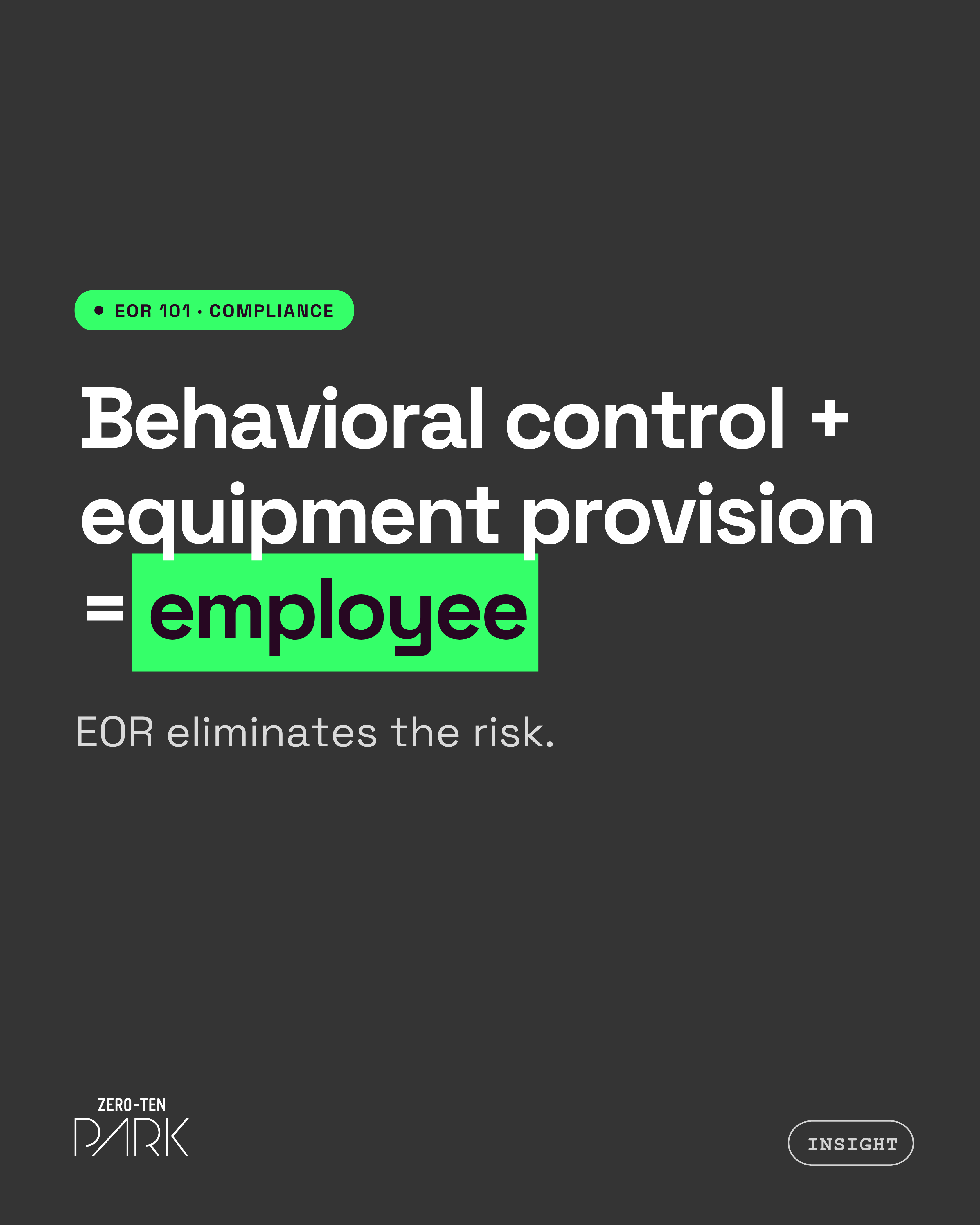
If you direct a VA’s daily hours, provide their equipment, integrate them into core business functions, and set performance expectations, labor authorities in jurisdictions like the Philippines, Brazil, or Spain will likely reclassify them as an employee regardless of your paperwork. That’s where employer of record Philippines solutions prove invaluable—they prevent the risk from ever arising in the first place.
Consider the behavioral control indicators that trigger reclassification audits:
- You set specific working hours (9am–6pm). Contractor should set their own.
- You provide equipment (laptop, software licenses, internet stipend). Contractor should own their own tools.
- You integrate them into internal Slack, attend standups, participate in sprint planning. That’s core team integration.
- You set KPIs and evaluate performance. Contractor relationships should be outcome-based, not performance-based.
Real Scenario from Zero-Ten Park Philippines: A US SaaS client hired a VA from our Makati office as a “contractor” at $800/month. They provided equipment, integrated her into Slack and daily stand-ups, set weekly targets, and expected her to be available 9am–6pm US Eastern time. After 18 months and ₱14.4M in cumulative payments, the BIR classified her as an employee. The retroactive liability: ₱3.6M in unpaid SSS, ₱720K in 13th-month pay, ₱280K in premium overtime, plus penalties and interest exceeding ₱500K. An employer of record Philippines structure would have prevented this entirely—and made the employee infinitely happier with actual benefits.
The Total Cost of Ownership (TCO) Math
Evaluating global hiring based solely on the “headline rate” is a strategic error that costs hundreds of thousands in hidden costs. A comprehensive analysis must include: the “employer load” (typically 1.25x to 1.4x of base salary), recruitment costs (average ₱235,000 in the Philippines), onboarding and knowledge transfer costs (3–6 months of reduced productivity), and the amplified cost of compliance risk.
When using Zero-Ten Park Philippines as your EOR, the structure is transparent and completely itemized: base salary + EOR fee ($230/month or ₱13,800) + statutory benefits (SSS, PhilHealth, Pag-IBIG, 13th-month, SIL, holidays). No hidden markups. No surprise compliance costs. No surprise vendor relationships or hidden fees.
Compare that to traditional hiring through BPOs, where you’re paying 40–60% margin on top of wages while the VA receives only 40% of your payment. A ₱40,000/month VA actually costs you ₱66,000–₱100,000 when you factor in BPO markup. The EOR model is transparent and substantially cheaper.
The TCO breakdown for a ₱40,000/month VA:
- BPO Model: ₱40,000 salary + ₱26,400 BPO margin (40%) = ₱66,400/month = ₱796,800/year + zero legal protection
- EOR Model (at $230 = ₱13,800): ₱40,000 + ₱13,800 + ₱6,400 statutory = ₱60,200/month = ₱722,400/year + comprehensive legal protection
- Plus: EOR includes legal protection worth ₱500,000–₱2,000,000 if audit occurs. BPO leaves you completely exposed.
The EOR at $230/month is slightly lower annual cost while eliminating massive compliance exposure. That’s not even a choice; it’s the obvious economic decision.
Securing the Crown Jewels (The IP Security Trap)
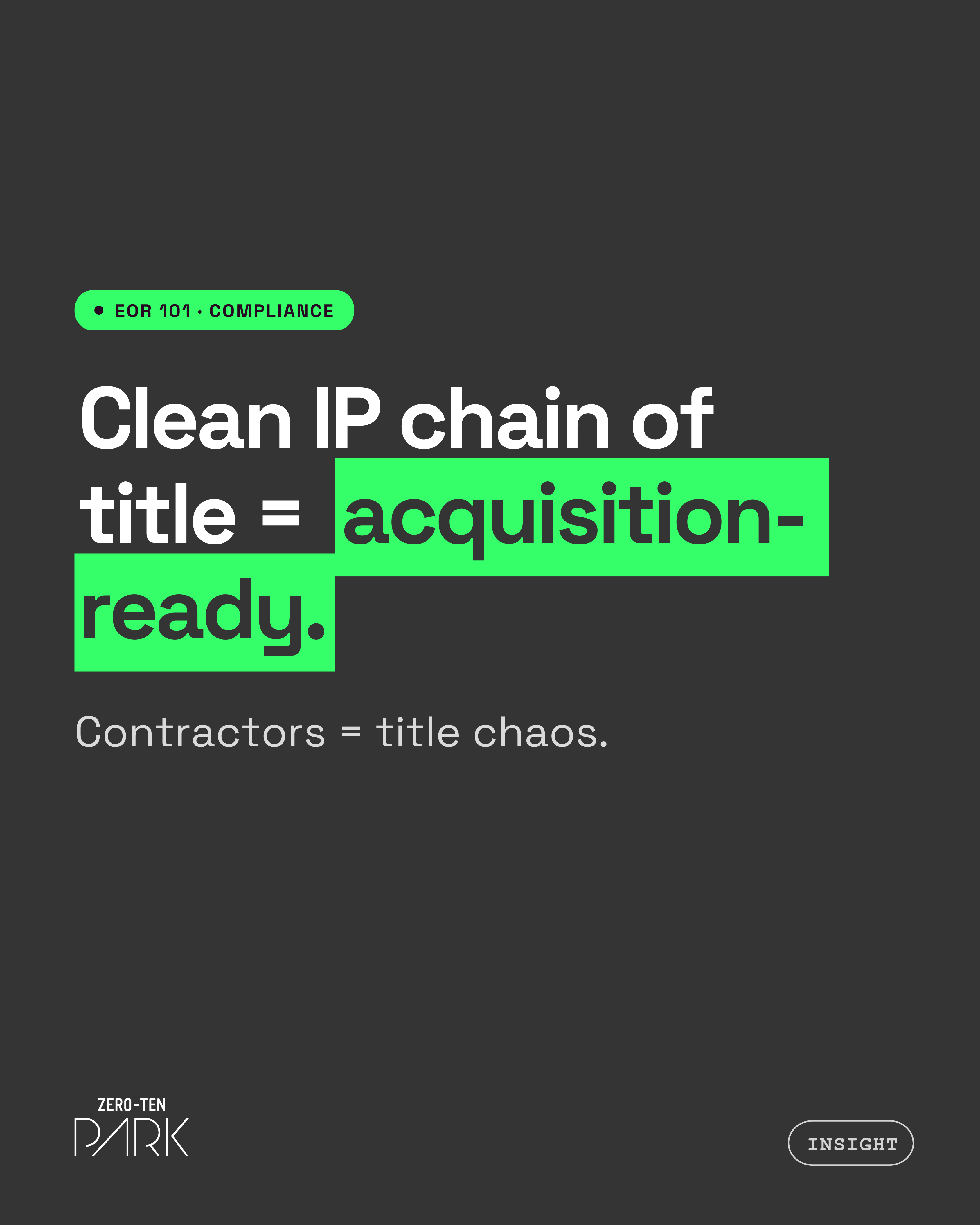
For SaaS and tech founders, value is fundamentally tied to code and content. The company’s entire competitive moat might rest on custom software, proprietary design systems, or branded content. Hiring a freelancer often leaves IP in their hands by default; under most baseline legal protections, the creator owns the copyright unless a specific, legally binding transfer occurs.
If a contractor relationship is reclassified as employment under Philippine labor law, your original IP transfer clauses may be rendered void. This is because Philippine law treats employee-created work under employment relationships differently than independent contractor relationships. The IP chain of title becomes cloudy and legally undefendable, and your work becomes a toxic asset.
An employer of record Philippines framework acts as a “legal scrubber” to ensure a Clean Chain of Title. This is achieved through a tripartite relationship: rights move from the Worker to the EOR (via a locally compliant employment contract that explicitly includes “Work Made for Hire” provisions) and are then assigned from the EOR to the Client (via the Master Services Agreement).
This structure is legally bulletproof because it uses formal employment law (which explicitly supports IP transfer) rather than contractor law (which is ambiguous and vulnerable to reinterpretation). If your company is ever acquired, due diligence on IP will be clean and defensible. Your code and content are assets, not legal liabilities.
From "Box-Checker" to Team Member
Contractors are often “box-checkers”—transactional hires with low engagement and high attrition. They do exactly what’s asked and nothing more because they have no stake in your company’s future or mission. Transitioning through Zero-Ten Park Philippines’s EOR model transforms the worker’s professional identity by providing Statutory Remittances and benefits that a freelancer cannot access.
In the Philippines, EOR employees gain access to SSS, PhilHealth, and Pag-IBIG. This provides them with far more than just a salary; it offers access to formal credit and housing loans. This “Access to Credit” is a massive retention hook that fundamentally changes how people relate to their work.
At our Zero-Ten Park Philippines locations in IT Park Cebu and Mandaue, we’ve tracked tenure metrics obsessively: employees with formal EOR status have a 3.2-year average tenure, while contractors average 1.1 years. That’s a 191% difference in retention. The cost of turnover (recruiting, onboarding, knowledge transfer, lost productivity) is estimated at 15–25% of an annual salary. A ₱40,000/month employee with contractor-level turnover costs ₱72,000–₱120,000 annually to replace. EOR pays for itself purely through better retention.
More importantly, team members who have access to credit, paid leave, and statutory protections work with different psychological ownership. They own outcomes instead of just tasks. They mentor junior hires instead of hoarding knowledge. They become institutional stakeholders instead of contingent vendors.
The Regional Navigator
Localized expertise is the primary advantage in hyper-regulated environments where DIY compliance is guaranteed to be a failure point. The Philippines labor code is incredibly complex: you must navigate RA 11313 (domestic worker protections), RA 10175 (cybercrime law), updated Bureau of Internal Revenue guidelines on cross-border payments, SSS contribution rules that change quarterly, PhilHealth enrollment procedures, and recent Bangko Sentral ng Pilipinas (BSP) regulations on foreign currency payments.
An employer of record Philippines solution handles all of this. We maintain in-house labor counsel, track statutory benefit changes in real time (changes occur 2–3 times annually), and conduct quarterly audits against the latest BIR, SSS, and PhilHealth guidelines. Our infrastructure is built on compliance-first principles because our own liability depends on it.
✨ The Strategic Crossroads
The choice between EOR and a contractor depends on your strategic objective: do you want a result (Outsourcing/Contractor) or a relationship (EOR)? For core functions—engineering, product management, leadership—Zero-Ten Park Philippines’s EOR model provides the stability, IP certainty, and compliance guardrails required to build a resilient global operation.
Is the agility of a freelancer worth the legal weight of an audit and the retention cost of constant turnover?
FREQUENTLY ASKED QUESTIONS
Our employer of record Philippines process typically takes 2–14 days from application to first payroll. We handle all compliance documentation, benefits setup, tax registration, and SSS/PhilHealth enrollment. No entity setup required. No government paperwork on your end. We manage everything in the background.
BPOs typically charge 40–60% markup on base wage. Our EOR fee is a flat $230 (₱13,800) per worker monthly, all-inclusive. If you’re paying ₱40,000/month via BPO (where ₱16,000 goes to BPO and ₱24,000 to worker), an EOR setup means the worker gets ₱26,200–₱30,000 more monthly—a 45–58% improvement in worker compensation. Plus, you have complete legal protection.
We maintain in-house labor counsel, track statutory benefit changes quarterly (SSS, PhilHealth, Pag-IBIG updates occur frequently), and conduct quarterly audits against the latest BIR, labor code interpretations, and regional regulations. Our EOR infrastructure is built on compliance-first principles because our liability depends on it. We’re insured for compliance failures.
Yes, but it’s risky. Every month as a contractor increases your audit exposure. The best approach is to transition immediately, which takes 5–14 days. The person stays in the same role but now has formal protection, statutory benefits, and you eliminate legal liability. Many founders do this transition as their first step with us.
The $230 fee is completely flat regardless of salary. Whether you’re hiring at ₱25,000 or ₱80,000/month, the EOR fee doesn’t change. This makes higher-skilled hires more economical since the percentage of the fee relative to salary decreases as salary increases.

GET A QUOTE TODAY
"*" indicates required fields
Ready to level up your business presence and save more every month? Complete the form now and our team will handle the rest.